
The most useful benefit of custom furniture is not exclusivity. It is alignment: the furniture is designed around the home, the people who live there, and the work it needs to do. Instead of adapting daily routines to a standard cabinet depth or an almost-right sofa, homeowners can shape dimensions, storage, materials, and details around real constraints.
That difference is especially noticeable in compact apartments, older houses with uneven walls, awkward alcoves, and rooms that serve more than one purpose.
Custom is not automatically the best answer. It asks for more decisions and lead time. The useful question is: “Which problems in this home are important enough to solve with custom work?”

First, What Counts as Custom Furniture?
The word custom covers a wide spectrum. At one end, a retailer may let you choose from preset widths, fabrics, finishes, or leg styles. At the other, a piece may be designed from field measurements, with its structure, dimensions, materials, and installation details developed for one room and one household.
Before comparing prices, identify what can actually change. Avrela Home's overview of custom furniture, room-specific options, and coordinated collections offers a practical starting point for defining the scope. Ask whether dimensions are genuinely made to order, whether the internal layout can change, and which details remain standardized. That distinction prevents buyers from paying a custom premium for a mostly fixed product.
1. It Makes Better Use of Space Without Sacrificing Flow
Ready-made furniture has to work in thousands of different homes, so its dimensions are based on broadly useful averages. Those averages rarely correspond perfectly to a particular bay window, stair landing, recessed wall, or narrow entry. A few inches of unused space may sound minor, but repeated gaps can mean a lost drawer, an awkward dust trap, or a walkway that always feels pinched.
Custom furniture can respond to the room's actual width, depth, and height. A shallow wall can become useful closed storage instead of being overwhelmed by a standard cabinet. An under-stair void can hold shoes and a bench. A built-in desk can fit between two walls while leaving enough knee space and clearance for the door.
The goal is not to fill every surface with cabinetry. Good planning protects circulation, daylight, door swings, drawer extension, outlets, and HVAC returns. It also accounts for baseboards, uneven floors, walls that are not square, and restricted delivery paths. A careful room-measuring process captures both the installation opening and the route the piece must travel.
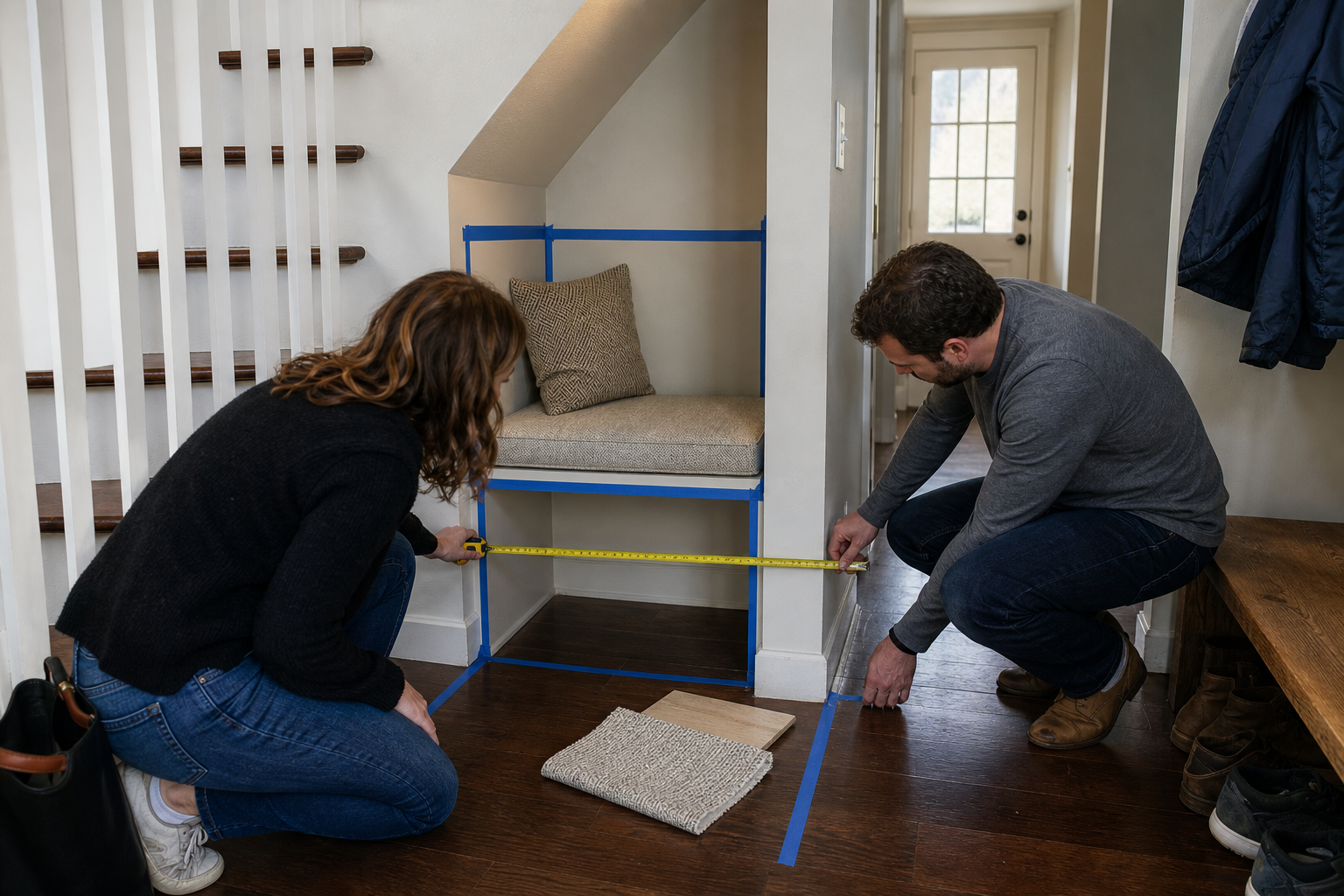
This is where made-to-measure design creates value that a product photo cannot show. It balances capacity with breathing room, so the room stores more while remaining comfortable to move through.
2. Function Can Follow the Household's Real Routines
Two families can occupy identical floor plans and need completely different furniture. One may want a media cabinet that conceals game consoles, speakers, and cables while allowing heat to escape. Another may need low toy drawers children can use independently. A hybrid worker may need a printer garage, file storage, task lighting, and a calm video-call background in one compact unit.
Begin with an inventory rather than a style board. Note object dimensions and daily use, then decide what should be displayed or concealed. Drawers, shelves, charging access, lighting, and ventilation can then be assigned deliberately.
The strongest details are often ordinary: a vacuum stands upright, a router remains accessible and ventilated, and a pet-food bin lifts out for cleaning. These small reductions in friction matter more than simply adding the maximum number of compartments.
3. Dimensions Can Better Fit the People Using Them
Standard dimensions do not serve every body or activity equally well. Height, reach, mobility, dominant hand, and hours spent working or relaxing all affect comfort. A desk that is acceptable for occasional paperwork may be tiring during an eight-hour workday. A deep sofa can feel generous to one person and leave another without foot support. A nightstand may look balanced yet sit too high relative to the mattress.
Custom work can adjust desktop height, seat depth, handle placement, and the reach range of frequently used storage. It can support multigenerational living by keeping everyday items accessible while placing occasional storage higher or lower.
Personalization should still be tested, not guessed. Mock up a critical height with a folding table, cardboard, or painter's tape. Sit, reach, open an imaginary door, and walk the route. When future needs may change, specify adjustable shelves, replaceable hardware, removable inserts, or internal components that can be reconfigured. The best custom solution fits now without becoming unnecessarily rigid later.
4. Buyers Gain More Control Over Materials and Indoor-Air Considerations
With custom furniture, buyers can ask what is beneath the visible finish. The specification may identify the substrate, veneer, edge treatment, adhesives, coating, upholstery, and hardware instead of reducing the decision to a color name. That makes it possible to assign materials according to moisture, wear, cleaning, appearance, and budget.
A bathroom vanity needs a different moisture strategy than a bedroom bookcase, and a dining tabletop needs a finish that tolerates frequent wiping. Solid wood may suit repairable surfaces, while quality plywood or an engineered core may stabilize a wide panel. Material value depends on where it is used, not on a simplistic hierarchy.
The U.S. Environmental Protection Agency notes that some pressed-wood products used in cabinetry and furniture can be indoor sources of formaldehyde. Buyers can ask whether applicable composite wood complies with EPA TSCA Title VI requirements, how exposed edges are sealed, what finish system is used, and what ventilation is recommended after installation. Reviewing a clear guide to wood, plywood, MDF, veneers, metals, and finishes helps turn a vague request for “good materials” into questions a supplier can answer.
Material control does not make every custom piece inherently healthier, nor does “solid wood” resolve every performance question. It gives the buyer better visibility and a chance to request documentation appropriate to the project.
5. Construction Can Prioritize Durability and Repairability
A high price does not guarantee a long service life. Durability comes from the relationship between construction, load, hardware, finish, environment, and maintenance. A beautiful drawer will still disappoint if its slides are underspecified. A tabletop may be made from an expensive species and still perform poorly if its finish does not suit daily use.
Custom design lets the specification concentrate money where wear actually occurs: hinges, drawer slides, seat cushions, work surfaces, edges, and structural connections. Less stressed or hidden areas can use efficient materials without compromising the experience. This targeted approach often creates more value than applying the most expensive finish everywhere.
Repairability deserves equal attention. Can a damaged hinge be replaced with a readily available size? Can the back be removed to reach wiring? Can a cushion be reupholstered? Can a wood surface be refinished? Can one damaged door be reproduced from the approved color and material records? A useful comparison of custom and ready-made furniture should consider maintenance and replacement, not only purchase price.
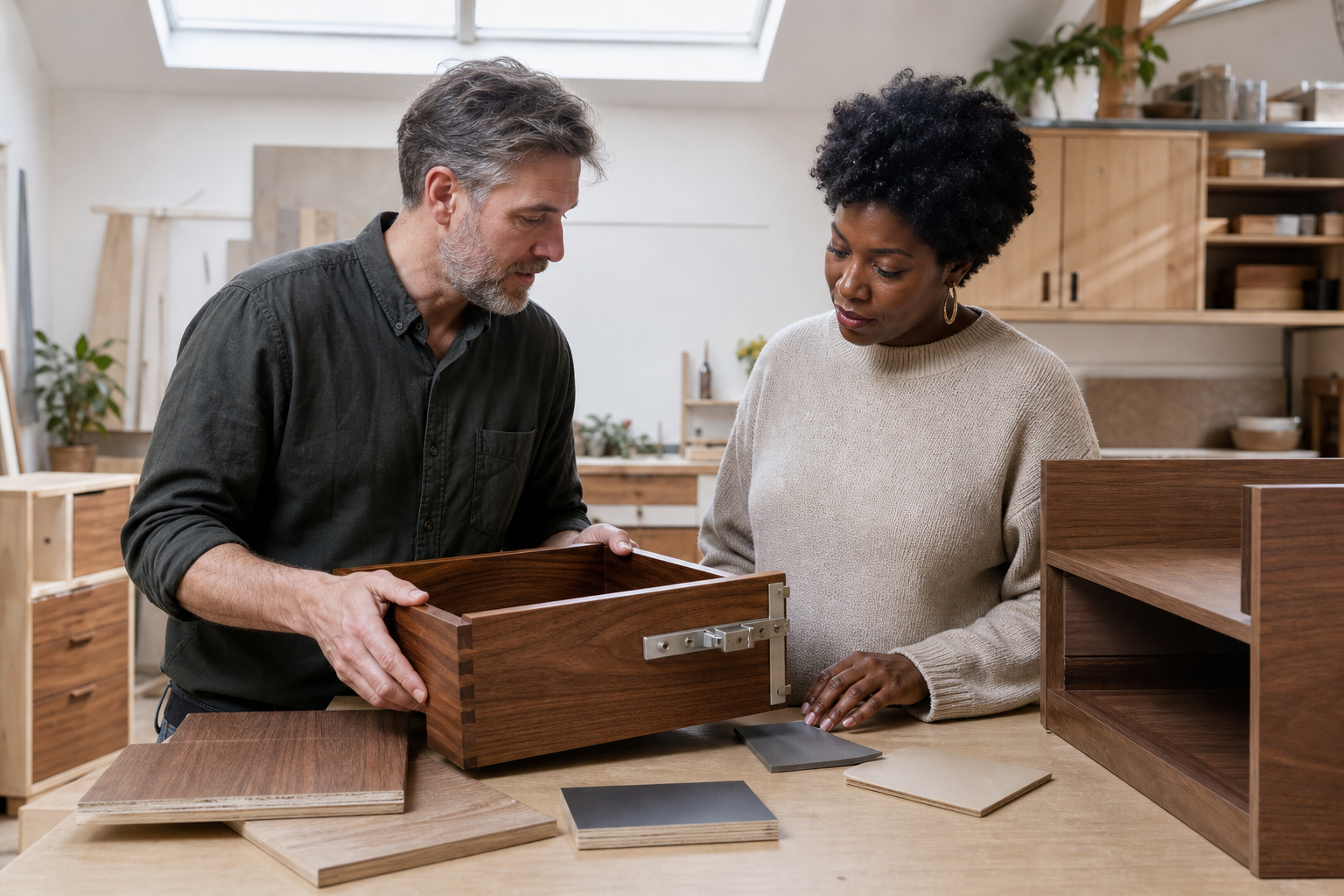
When components are specified, documented, and serviceable, the piece has a better chance of adapting instead of being discarded after one failure.
6. The Home Can Feel Cohesive Without Looking Matched
A cohesive interior does not require copying one cabinet door into every room. Custom furniture can repeat a small design vocabulary—perhaps a wood tone, edge profile, metal finish, reveal, or radius—while changing color, proportion, and function from space to space.
Ready-made pieces often miss by a small but visible amount: two woods are nearly the same but clash, handles feel too delicate for the room, or a cabinet stops at an arbitrary point below a molding. Custom work can resolve those transitions. The result should feel integrated, not overly coordinated—a home assembled with intention over time rather than a showroom suite purchased in one afternoon.
7. It Can Solve Unusual Property and Household Needs
Sloped ceilings, curved walls, bay windows, shallow niches, narrow mudrooms, and multipurpose guest rooms reveal the practical strength of custom design. So do needs that standard categories overlook: instrument storage, pet stations, sports equipment, collections, mobility considerations, or one room shared by work, exercise, and overnight guests.
The key is to translate a broad desire into a testable requirement. “Pet-friendly” could mean a ventilated compartment with a removable liner. “Accessible” might define clear approach space, reachable hardware, and easy-grip pulls. “Kid-friendly” should specify anchoring, edge details, and cleanability.
This level of specificity makes customization valuable. Without it, an unusual-looking piece may be no more useful than a standard one.
8. The Final Specification Is More Visible and Controllable
A well-run project produces dimensioned drawings, material selections, hardware schedules, finish samples, and approval milestones. This record clarifies the scope and reduces assumption-driven disputes.
Visibility also brings responsibility. The client should review drawings carefully, and the supplier should explain tolerances, natural material variation, site conditions, change costs, and warranty coverage. Before signing, use a structured list of questions about drawings, samples, installation, delivery, and after-sales support. Renderings communicate appearance, but they should never replace dimensions and written specifications.
9. Long-Term Value Comes From Fewer Compromises—not a Guaranteed Return
Custom furniture commonly costs more upfront. It should not be marketed as a guaranteed way to raise a home's resale price. Its more defensible long-term value comes from using otherwise wasted space, avoiding repeated replacement of poorly functioning pieces, and extending service life through appropriate construction and repair.
To evaluate value, divide installed cost by the years you expect to use the piece, then consider frequency. A daily-use entry cabinet deserves a different budget than a guest-room table. Also ask whether it stays with the property: a restrained built-in may help future buyers, while a highly personal freestanding piece may have little resale appeal.
This is why the best custom plan is rarely “customize everything.” Spend precision where the home imposes constraints or the household repeats a frustrating task. Keep movable, low-use, or temporary pieces flexible.
Where Is Custom Furniture Usually Worth It Most?
Custom work tends to earn its place in high-use areas and difficult dimensions:
- entry and mudroom storage where circulation is tight;
- alcove bookcases and media walls with wiring or ventilation needs;
- home offices that combine equipment, storage, and an ergonomic workstation;
- wardrobes and bedroom storage where every inch affects capacity;
- window seats, banquettes, and under-stair installations;
- dining or living-room pieces that must preserve a precise traffic pattern.
Freestanding side tables, temporary guest-room pieces, and furniture for a short rental may be better purchased ready-made. A mixed strategy often produces the most convincing home: invest in the fitted anchor pieces, then add ready-made chairs, lamps, stools, and occasional tables that can move as life changes.
Avrela Home approaches whole-room and whole-home furniture planning as coordination rather than a demand that every object be custom. A shared material palette can still leave room for vintage finds and readily replaceable pieces.
When Is Ready-Made Furniture the Smarter Choice?
Choose ready-made when time is short, the residence is temporary, needs are changing, or the budget would compromise construction. It is also sensible when a standard product already fits and functions well.
Walk away from a custom proposal if the supplier will not provide drawings, material descriptions, finish samples, change rules, installation scope, and written warranty terms. A persuasive rendering cannot compensate for an unclear specification. Likewise, be cautious when every question receives a promise instead of a document.
How to Protect the Benefits Before You Order
Start with the problem, not an inspiration image. Inventory what the furniture must hold. Identify primary users, daily frustrations, required clearances, fixed building elements, and the maximum installed budget. Measure the room and delivery route, then have critical dimensions field-verified before production.
Request samples of the actual finish, core material, upholstery, and hardware. Review exterior elevations and internal layouts. Confirm door handing, cable access, lighting service, and how cabinetry meets uneven walls or floors. Record approvals and changes in writing.
Finally, define delivery and installation: site protection, access, assembly, wall anchoring, debris removal, punch-list timing, and responsibility for damage. These details are part of the product. A provider such as Avrela Home should connect design intent, material decisions, manufacturing information, and installation requirements in a reviewable process.
Conclusion
The real benefits of custom furniture are fewer long-term compromises: a more accurate fit, storage shaped around real possessions, dimensions suited to the user, greater material visibility, targeted durability, and a calmer relationship between furniture and architecture.
Those benefits are not automatic. They depend on clear requirements, verified measurements, documented specifications, capable production, and careful installation. The smartest buyer does not pay for the word custom. They use customization selectively, wherever a better fit or better function will improve life often enough to justify the added time and cost.
Frequently Asked Questions
Is custom furniture always better quality than ready-made furniture?
No. Quality depends on the materials, construction, hardware, finish, quality control, and installation. Custom work gives buyers the opportunity to specify and review those elements, but the label alone guarantees nothing.
Is custom furniture more expensive?
It usually has a higher initial cost because the price may include design, drawings, samples, nonstandard production, and installation coordination. Compare complete scopes rather than a custom installed price with the shelf price of an unassembled product.
How long does custom furniture take?
Lead time varies with design complexity, approvals, material availability, production, shipping, and installation. Ask for a milestone schedule and include a realistic buffer for revisions and site conditions rather than relying on one delivery date.
Does custom furniture increase home value?
Well-designed built-ins may improve utility and buyer appeal, but there is no guaranteed financial return. Durable, restrained, broadly useful installations are more likely to appeal to future owners than highly personal layouts or finishes.
Can I customize just one room?
Yes. Starting with the room that has the clearest fit or storage problem is often the best approach. It allows you to test the design, approval, production, delivery, and installation process before expanding the scope.
What should I ask a custom furniture maker before ordering?
Ask what is truly customizable, how measurements are verified, which materials and hardware are included, what drawings and samples you will approve, how changes are priced, who installs the furniture, and what the written warranty and service process cover.
—