

Choosing between custom and ready-made furniture is not as simple as deciding which one is “better.” The two options solve different problems.
Custom furniture is developed or adjusted around a particular room, set of dimensions, or functional requirement. Ready-made furniture has already been designed in standard sizes and may be available from stock, through quick-ship programs, or as a standard catalog product.
For a homeowner dealing with an awkward alcove, limited storage, or a highly specific layout, custom furniture may be worth the additional time and expense. A renter, frequent mover, or buyer furnishing a conventional room may get more value from ready-made pieces.
The most practical decision is rarely to make everything custom or buy everything off the shelf. It is to identify where an incorrect size or poor layout would create the greatest long-term inconvenience—and where flexibility matters more than a perfect fit.
Custom Furniture vs. Ready-Made Furniture: The Quick Answer
Custom furniture is usually the better choice when the furniture must fit a particular space, support a specific routine, or coordinate with permanent architectural features.
Ready-made furniture makes more sense when standard dimensions work, the item is needed quickly, the budget is limited, or the furniture may need to move to another home.
A useful rule is:
That still leaves room for a mixed approach. Built-in storage can be custom while dining chairs, side tables, and other movable pieces remain ready-made.
What Is Custom Furniture?
Custom furniture is made or substantially modified for a particular space, customer, or function.
A project may begin with an existing design, or it may be planned around the room from the start. Depending on the supplier, customization may include:
Width, height, and depth
Cabinet interiors
Drawer, shelf, and hanging layouts
Sofa length and sectional direction
Materials and finishes
Hardware and lighting
Cable or equipment openings
Selected structural changes
A custom wardrobe, for example, can be built around the wall width and ceiling height, with the interior divided according to the owner’s clothing, shoes, luggage, and accessories.
Avrelahome’s custom furniture solutions cover individual pieces as well as coordinated room furniture, but the underlying principle is the same: the design should respond to the project rather than forcing the room to accommodate a fixed product.
Custom does not always mean completely original, and it does not automatically mean higher quality. A piece can be custom because its dimensions and functions have been changed, even when the overall style began with an existing model.
What Is Ready-Made Furniture?
Ready-made furniture is designed before the customer places an order. In many cases, the product has already been manufactured and stored in inventory.
Customers choose from the sizes, colors, materials, and configurations offered by the retailer. The underlying frame or construction normally remains unchanged.
Common examples include:
- In-stock sofas
- Standard dining tables
- Freestanding wardrobes
- Desks
- Bed frames
- Side tables
- Modular storage units
Ready-made does not mean inexpensive or poorly made. The category includes everything from entry-level flat-pack furniture to premium pieces built with high-quality frames, upholstery, wood, and hardware.
Made-to-order furniture sits between the two categories. It begins with an existing product but is manufactured after the customer selects from preset fabrics, finishes, sizes, or modules. The product is personalized, although its core design is usually unchanged.
Custom Furniture vs. Ready-Made Furniture at a Glance
| Comparison | Custom Furniture | Ready-Made Furniture |
|---|---|---|
| Dimensions | Adjusted to the project | Standard sizes |
| Design control | Moderate to high | Limited |
| Materials | Often offers broader choices | Selected by the manufacturer |
| Upfront cost | Usually higher | Wider price range |
| Lead time | Requires design and production | Usually faster |
| Installation | May require professional installation | Often assembled or placed |
| Returns | Commonly more restricted | Usually more flexible |
| Portability | Built-ins can be difficult to move | Generally easier to relocate |
| Space efficiency | Strong in unusual spaces | Best in conventional rooms |
| Best use | Long-term, specific requirements | Standard, temporary, or changing needs |

Which One Fits Your Space Better?
Fit is the clearest practical difference between the two options.
Ready-made furniture is designed around common room sizes and widely used dimensions. When a room has straight walls, enough clearance, and conventional proportions, a standard product may work perfectly well.
Real homes, however, are not always standard.
A city apartment may have a compact elevator, a narrow entry, or limited wall space. Older homes in cities such as Boston, Philadelphia, or New York may have tight stair turns and doorways that cannot accommodate a deep sectional. In a suburban open-plan house, the opposite problem can occur: a standard sofa or media console may look undersized and fail to define the room.
Custom furniture is particularly useful for:
- Alcoves and recessed walls
- Sloped ceilings
- Under-stair areas
- Narrow entryways
- Mudroom storage
- Floor-to-ceiling bookcases
- Home offices
- Media walls with equipment
- Unusually shaped living rooms
Accurate measurement is essential. A practical room measurement guide should cover not only the intended location but also doors, hallways, elevators, stairs, and turning points along the delivery route.
A piece that fits the wall is not useful if it cannot reach the room.
Ready-made furniture remains the logical choice when standard sizes preserve comfortable walkways, do not block outlets or doors, and provide enough storage. Customization is valuable when it fixes a real spatial problem—not simply because a piece could be made differently.
Which Option Costs More?
Custom furniture generally requires a higher upfront investment.
The quote may include site measurement, design development, technical drawings, materials, special production, transportation, and installation. Unusual dimensions, complicated structures, premium hardware, and specialized finishes can add to the total.
Ready-made furniture covers a much broader price range. Standard production allows manufacturers to distribute design and tooling costs across many units, while inventory sales and retail promotions may lower the purchase price further.
Upfront price, however, is only one part of value.
An inexpensive cabinet that leaves a large unusable gap may eventually require another storage unit. A sofa that does not fit through the entry may create return, redelivery, and replacement expenses. Poorly selected ready-made furniture can also be replaced sooner if it never works comfortably in the room.
Custom furniture can be overbuilt as well. Extra mechanisms, unusually specific compartments, or rare finishes may raise the cost without improving everyday use.
A detailed custom furniture cost guide can help separate design, materials, labor, delivery, and installation before two quotes are compared.
The better question is not simply, “Which one is cheaper?”
Ask instead:
Does the additional cost solve a specific problem that will continue to matter over the life of the furniture?
When the answer is no, ready-made furniture may offer better value. When a poor fit would affect the room every day, paying more for custom work may be justified.
Lead Time, Convenience, and Purchase Flexibility
Ready-made furniture has a clear advantage when timing is the priority.
An in-stock piece may be available within days or weeks. Even when assembly is required, the buying process is normally straightforward: choose the product, confirm delivery, and place it in the room.
Custom furniture involves more stages. The project may require:
Initial requirements
Site or client measurements
Design development
Material and finish selection
Drawing approval
Production
Quality inspection
Shipping
Installation
A coordinated whole-house customization process becomes more complex because several rooms, products, finishes, and installation conditions must be managed together.
Design revisions, material availability, shipping, and site readiness can all affect the schedule. A production estimate alone does not necessarily include the time needed for drawings, approvals, transportation, or installation.
Before ordering custom furniture, confirm:
- When measurements will be finalized
- How long design revisions usually take
- Which approval starts the production schedule
- Whether shipping is included in the stated lead time
- When the site must be ready for installation
- What happens if construction delays the installation date
When a move-in date cannot change, reliable delivery may be more important than additional personalization.
Design Control and Personalization
Ready-made furniture offers limited but often sufficient design choice.
A retailer may provide several colors, fabrics, finishes, sizes, or sectional arrangements. For many rooms, those options are enough to create a coordinated interior without requiring a custom project.
Custom furniture allows deeper control. Dimensions can respond to the room, storage can reflect the household’s belongings, and finishes can coordinate with flooring, doors, wall panels, or cabinetry.
More control is not automatically more useful.
Every alteration should have a reason. A deeper desktop might be needed for multiple monitors. A shorter sofa may preserve a walkway. Additional drawers may organize small items that would otherwise be difficult to store.
Changes that only make the piece appear more exclusive can increase cost, extend the timeline, and reduce future flexibility without improving the room.
Good customization is not about making every detail unusual. It is about removing the compromises that interfere with everyday use.
Is Custom Furniture Better Quality?
Not necessarily.
Both custom and ready-made furniture can be well made or poorly made. Quality depends on materials, construction, hardware, finishing, and quality control—not on the label alone.
For custom furniture, ask for information about:
- Board, wood, or metal specifications
- Frame and joint construction
- Hardware
- Edge treatment and finishes
- Upholstery foam and support
- Material samples
- Technical drawings
- Inspection procedures
- Warranty coverage
For ready-made furniture, review:
- Frame construction
- Product weight and stability
- Drawer and door operation
- Fabric or leather specifications
- Assembly methods
- Long-term customer feedback
- Return and warranty policies
Custom work has one important potential advantage: buyers may have more visibility into the specifications and more control over material selection.
That advantage disappears when the supplier provides only renderings and broad descriptions. A mature ready-made product with clear construction details may be more dependable than a custom piece with vague specifications.
Quality should be verified, not assumed.
Delivery, Returns, and Moving
Delivery conditions matter more than many buyers expect.
In the United States, large sofas, beds, and dining tables may be offered with white-glove delivery. The service can include carrying the furniture into the room, assembling it, positioning it, and removing the packaging.
Coverage varies. Stairs, long carries, elevator reservations, difficult access, and old furniture removal may involve additional charges or require advance notice.
Ready-made furniture usually has a more established return process, although large-item returns may still involve shipping costs or restocking fees.
Custom orders often have stricter cancellation and return terms because production begins after the dimensions, materials, or upholstery have been approved. A customer-approved drawing or fabric selection may make the order final, subject to the supplier’s policy.
Moving plans also affect the decision.
Freestanding ready-made furniture is generally easier to disassemble, rearrange, or take to another home. A built-in cabinet made for one wall may not fit anywhere else, even if it can be removed without damage.
Renters, military families, and homeowners expecting another move should consider portability before investing heavily in site-specific furniture.
When Is Custom Furniture Worth It?
Custom furniture makes the most sense when it solves a clear, long-term problem.
Standard Sizes Consistently Fail
After several unsuccessful searches, continuing to compromise may cost more time than developing a piece around the room.
The Furniture Has a Specific Job
A media wall may need equipment ventilation and cable access. A wardrobe may need space for long garments, shoes, luggage, and accessories. A home office may require several monitors, files, and concealed wiring.
In these situations, the internal configuration matters as much as the exterior appearance.
The Home Has Difficult Architecture
Compact urban residences, sloped ceilings, structural columns, and narrow circulation areas can make standard furniture inefficient. Properly planned custom apartment interiors may improve storage and movement without filling the room with several unrelated pieces.
You Expect to Stay Long Term
The longer the furniture remains in the same home, the more opportunity there is to benefit from a precise fit and a layout based on established routines.
A Measurement Error Would Be Expensive
Kitchen cabinets, full-wall wardrobes, and built-in entertainment centers have little room for error. A poor fit can affect adjacent walls, doors, flooring, electrical access, and installation.
Several Rooms Need to Work Together
A coordinated project can carry related finishes and proportions through the entryway, living room, kitchen, and bedrooms without making every room identical.
When Is Ready-Made Furniture the Better Choice?
Ready-made furniture is not a lesser option. In many situations, it is the more responsible purchase.
It generally works well for:
- Renters
- Frequent movers
- Buyers who need furniture quickly
- First-time homeowners managing a limited budget
- Rooms whose use may change
- People who enjoy updating their interiors regularly
Guest rooms, children’s rooms, and temporary home offices may not need permanent, highly specific furniture. Their functions can change as the household changes.
A ready-made piece is also the right answer when it already offers the correct size, quality, comfort, and design. Customization should not be used simply to make an ordinary purchase feel more exclusive.
Flexibility has value. Furniture that can move between rooms or homes may serve the household longer than a perfectly fitted piece with only one possible location.
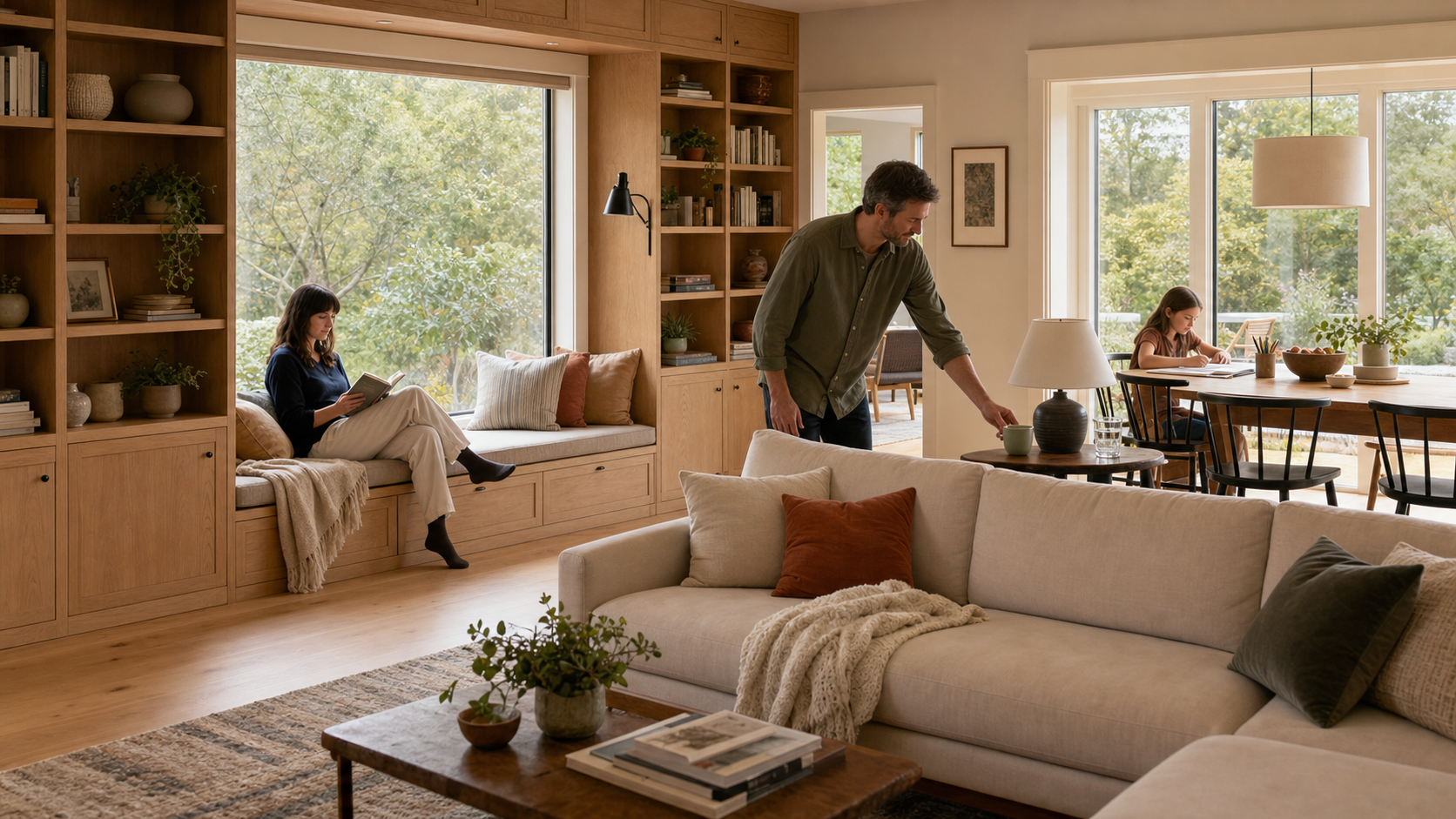
The Smartest Choice May Be a Mix of Both
Most homes do not need an all-custom or all-ready-made approach.
A more effective strategy is to divide the furniture according to two questions:
How expensive would a poor fit be?
How likely is the item to move or change later?
Custom furniture often provides the most value for:
- Kitchen cabinetry
- Built-in wardrobes
- Entryway and mudroom storage
- Home-office wall systems
- Under-stair storage
- Full media walls
Ready-made furniture often works well for:
- Accent chairs
- Side tables
- Dining chairs
- Nightstands
- Movable desks
- Decorative pieces
Put the custom budget into furniture that must interact with the architecture. Use ready-made furniture where movement, replacement, and future flexibility are more important.
This approach avoids over-customizing the home while still addressing the areas where standard dimensions create genuine problems.
How to Decide Between Custom and Ready-Made Furniture
Before placing an order, work through these questions:
1. Does a Standard Size Fit?
Check the furniture footprint, walkway clearance, door movement, outlets, vents, and access route.
2. What Specific Problem Must the Furniture Solve?
“Making the room look better” is too broad. Identify the missing storage, incorrect size, equipment requirement, or layout issue.
3. Will the Problem Still Matter in Several Years?
A long-term requirement supports customization. A temporary need favors flexibility.
4. How Long Will You Stay in the Home?
Highly site-specific furniture becomes easier to justify when the household expects to remain in the property.
5. How Quickly Is the Furniture Needed?
A nonnegotiable move-in date may rule out complex custom work.
6. Will the Piece Need to Move?
Freestanding furniture can still be custom, but unusual dimensions and built-ins reduce portability.
7. What Does the Quote Include?
Confirm design, materials, hardware, delivery, installation, adjustments, and warranty.
8. Does Each Custom Change Improve the Result?
Remove features that do not improve fit, function, durability, or the overall design.
Make the Furniture Fit the Project
Avrelahome works on individual custom furniture pieces as well as coordinated whole-home projects. A project can begin with a floor plan, room dimensions, storage requirements, and reference images rather than a fully developed design package.
The goal should not be to customize everything. A useful scope review identifies where made-to-measure work is necessary, where standard configurations remain practical, and which information must be confirmed before production.
When you are comparing custom and ready-made options, send your project details to Avrelahome for a room- and requirement-based review.
Frequently Asked Questions
Is Custom Furniture Always More Expensive Than Ready-Made Furniture?
The upfront price is usually higher, but the difference depends on size, materials, construction, delivery, and installation. A poorly fitting ready-made piece may also create replacement or additional storage costs.
Is Ready-Made Furniture Lower Quality?
No. Ready-made furniture ranges from entry-level products to premium pieces with strong materials and established construction. Quality should be evaluated through specifications, structure, and warranty rather than category.
How Long Does Custom Furniture Take?
The schedule depends on design complexity, revisions, material availability, production, shipping, and installation. Ask when the quoted timeline begins and which stages it includes.
Can Custom Furniture Be Moved to Another Home?
Freestanding custom pieces can often move, although unusual dimensions may limit where they fit. Built-ins are designed around a particular wall or room and may not work in a new property.
Is Custom Furniture Worth It for a Small Apartment?
It can be, especially when standard furniture wastes important wall or storage space. Focus customization on the areas with the greatest impact instead of assuming the entire apartment must be custom.
Can Custom and Ready-Made Furniture Be Used Together?
Yes. This is often the most practical strategy. Custom pieces can handle fixed storage and difficult dimensions, while ready-made items provide flexibility.
Which Option Is Better for Home Resale?
Neither option guarantees a higher resale value. Built-ins should have broad utility and a relatively neutral design. Highly personalized layouts may be less useful to a future owner.
Conclusion
Custom and ready-made furniture are not two levels of quality or lifestyle.
Custom furniture is most useful when dimensions, storage, or long-term space planning require a project-specific solution. Ready-made furniture provides speed, price flexibility, and portability when standard products already meet the need.
The strongest furniture plan may use both.
Spend the custom budget where a poor fit would be expensive or disruptive. Choose ready-made pieces where the household needs freedom to move, replace, or rearrange them. The goal is not to collect the largest number of personalized features. It is to make the home work better in everyday life.