
A dining bench is often described as the space-saving choice, while individual chairs are treated as the comfortable choice. Both claims are incomplete. A bench can disappear visually when it tucks under a table, but people still need room to reach it, sit down, and leave. Chairs occupy separate positions, yet each person can move independently.
The better option depends on what “better” means in your home: a clear weekday walkway, flexible seating for children, support during a long dinner, easier access for an older adult, or furniture that can move to another room later. Many households find that one bench plus chairs works better than committing to either option everywhere.
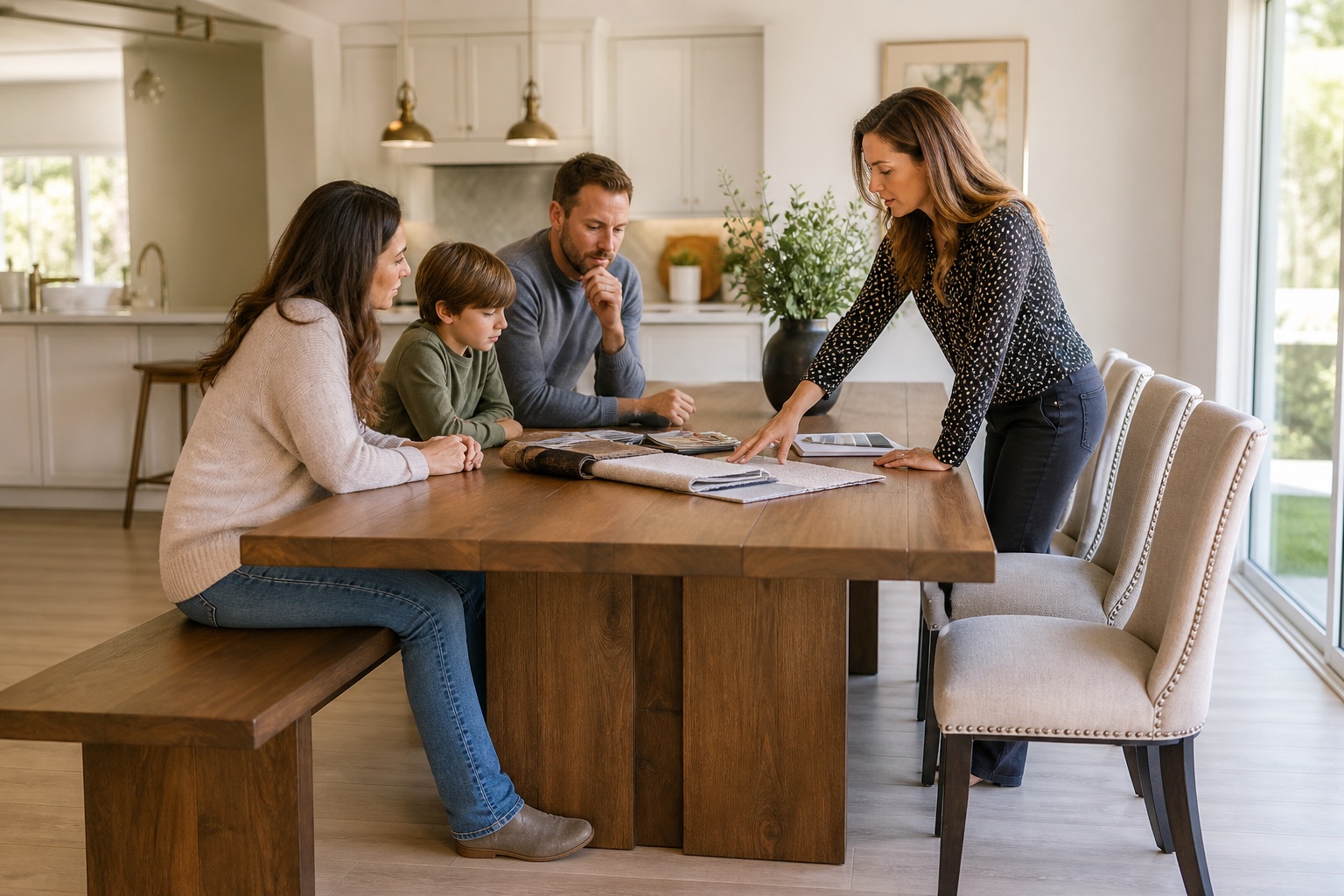
The Short Comparison
Use this table as a first screen. A specific bench or chair can perform differently because of its base, weight, seat geometry, upholstery, and relationship to the dining table.
| Decision factor | Dining bench | Dining chairs | Practical advantage |
|---|---|---|---|
| Independent access | People may need to move together | Each diner controls one seat | Chairs |
| Visual openness | Low backless forms can disappear under the table | Multiple backs remain visible | Bench |
| Posture and fit | One seat geometry serves several people | Different chair types can serve different users | Chairs |
| Occasional capacity | Children or close guests can shift along the seat | Capacity is clearly defined | Depends on use |
| Future flexibility | Can move to an entry or foot of a bed | Can be replaced or rearranged one at a time | Depends on room |
The central tradeoff is simple: a bench makes the furniture composition quieter, while chairs make the seating behavior more independent. Measure and test both states before deciding which advantage matters more.
Measure Below the Tabletop
The tabletop length does not tell you whether a bench will fit. Measure the clear distance between table legs or through the table base. A 72-inch top may have substantially less usable length below it. Leave handling room so the bench can slide in without scraping a leg, and confirm that the bench's own legs or stretchers do not collide with the base.
Record table height, the bottom of any apron, bench seat height, compressed cushion height, and the sitter's thigh clearance. For chairs, note overall width rather than seat width alone. Splayed rear legs and curved arms can consume space that a simple front elevation hides.
The published dining table size guide explains room and chair-clearance measurements in more depth. Add a second test for a bench: can one person pull the full piece away from the table, and can someone in the middle leave without requiring an awkward group movement?
A bench against a wall may appear extremely compact. In practice, diners must slide in from one end, and cleaning behind it becomes harder. That arrangement can work for children or occasional use, but it is less suitable for someone who stands frequently during a meal.
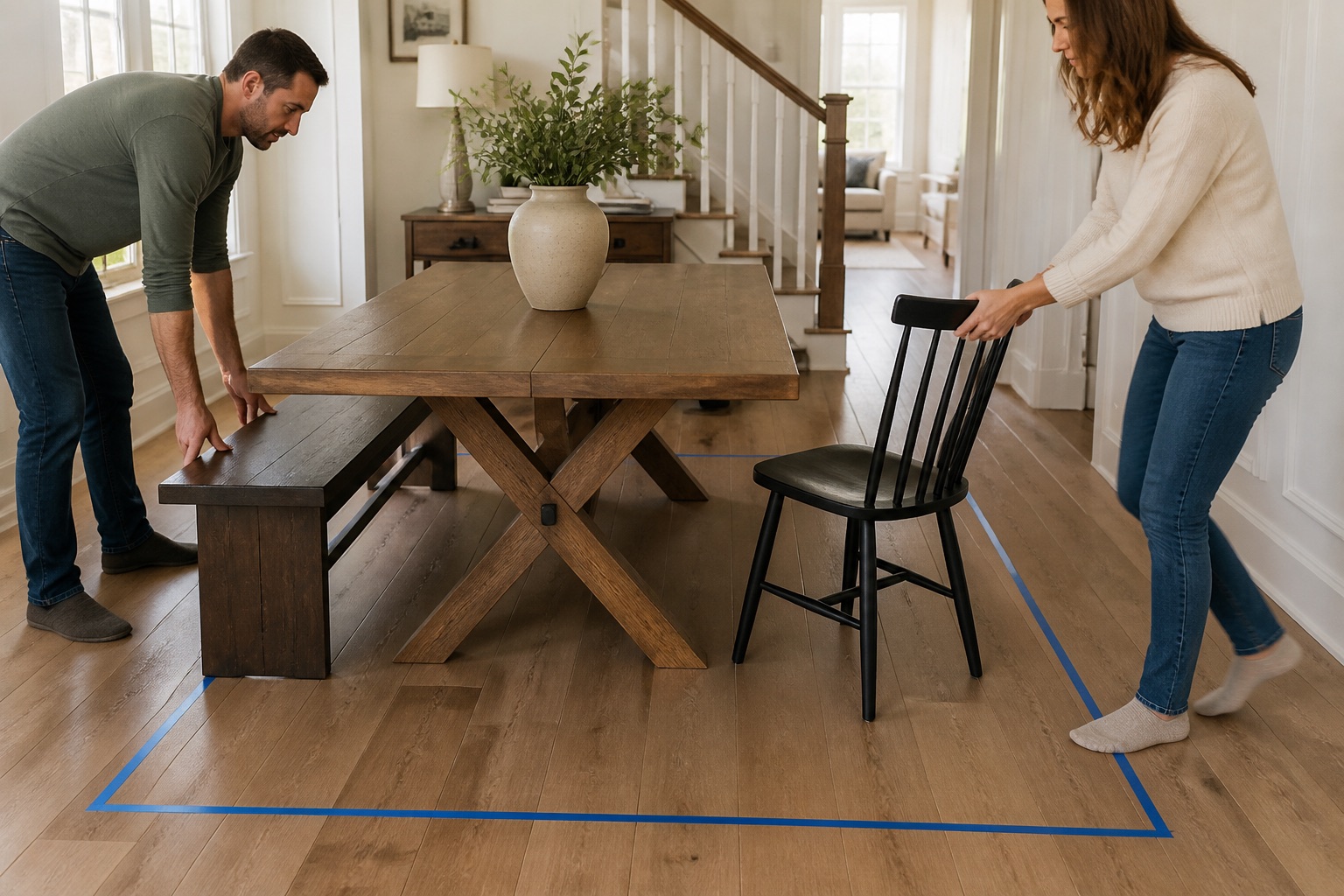
Count Comfortable Seats, Not Squeezed-In Bodies
A product listing may say that a bench seats three, but comfortable capacity depends on adult shoulder width, the table edge available to each person, place-setting width, and interference from table legs. Three children may share a length that feels cramped for three adults. Flexible capacity is useful, but it should not become the everyday assumption.
Mark a clear segment of table edge for every regular diner. Check knee room at the base and make sure the person in the center can reach a comfortable position without sitting across a leg or support rail. If the middle place works only when everyone sits down at once, treat it as an occasional seat.
Chair capacity also needs verification. Wide upholstered chairs, arms, and outward-splayed legs can reduce the number of usable places. Do not buy six chairs because a table is marketed for six. Put the actual overall chair widths between the actual table legs.
For a mixed arrangement, avoid automatically making the bench as long as the tabletop. A slightly shorter bench can tuck under the edge, clear the base, and remain easier to handle. The best length comes from the structure below, not a decorative rule.
Compare Comfort for the Way You Actually Eat
A backless bench can feel comfortable during breakfast, homework, or a short casual meal. During a long dinner, many adults prefer back support and a clearly defined personal position. A backed bench improves support, but it is heavier, occupies more visual space, and usually cannot disappear under the tabletop.
Seat depth is important. A deep upholstered bench may prevent a shorter person from reaching the back while keeping both feet stable. A shallow bench provides little thigh support. Cushion softness also changes working seat height, so assess the compressed cushion rather than the unloaded dimension.
Chairs make it easier to choose different support for different people. Armchairs at the table ends can assist someone who values a stable handhold, while lighter armless chairs along the sides preserve room. If household members vary significantly in height, build, or mobility, individual chairs usually accommodate those differences more effectively.
Try the seat for the length of a normal meal, not for thirty seconds in a showroom. Sit close enough to the table to use flatware, then stand up without pulling on the tabletop. A beautiful bench that discourages people from lingering is not the more comfortable option simply because it has thick upholstery.
Think Separately About Children, Older Adults, and Mobility
Children often like benches because they can shift along the seat, and parents may appreciate having fewer separate chairs to manage. That freedom also means children can scoot, stand, or push one another. Check the bench's stability, corner shape, surface grip, and spacing around the table. A backless bench is not a substitute for an age-appropriate child seat or restraint.
Older adults and people with limited balance commonly benefit from a defined seat, a back, a direct exit route, and sometimes arms. The middle of a wall-side bench requires sideways movement and should not be treated as the default place for someone who finds standing difficult. A chair at the table end often offers the clearest approach.
Temporary needs matter too. An injury, pregnancy, visiting relative, or changing household can make yesterday's efficient arrangement awkward. Movable mixed seating adapts more easily than a fixed bench designed around one stage of family life.
In an open room, the recently completed open-plan dining furniture guide can help you test the bench against island stools, appliance doors, and the living-room route. Low visual height is useful only when the occupied furniture still allows safe movement.
Compare Cleaning, Upholstery, and Maintenance
A solid-wood or durable coated bench is straightforward to wipe, although a hard seat may be less comfortable for a long meal. Loose cushions can be removed or replaced, but they may slide. Fixed upholstery looks integrated; ask about fabric cleaning, stain treatment, seam placement, foam replacement, and whether the seat can be reupholstered.
Multiple chairs create more legs to clean around, but each chair is usually light enough to move separately. A long bench reduces the number of bases while concentrating the weight in one piece. Test whether one adult can move it safely on the actual flooring or rug. Consider whether a robot vacuum can pass through the base without becoming trapped.
For children and pets, rounded edges, repairable finishes, tight seams, and realistic stain tolerance matter more than vague “family-friendly” language. Ask for the wood or panel substrate, face material, coating, upholstery fiber, and approved care method. View samples in the dining area's real daylight and evening light.
The serving and storage furniture nearby affects cleaning too. The sideboard, buffet, and credenza comparison can help you decide whether a cabinet earns its footprint, but leave enough room to open it while the bench or chairs are occupied.

Consider Five Common Seating Arrangements
All individual chairs
This arrangement provides the clearest personal access and the easiest way to accommodate different users. It suits longer meals, adults who entertain, and households that may replace seats gradually. The tradeoff is more visible chair backs and a larger collection of separate pieces.
One bench with chairs opposite
This is often the most balanced arrangement. Put the bench where its lower profile preserves a sightline, and use chairs where direct access matters. Table-end chairs remain useful for guests or family members who prefer arms or independent movement.
Benches on both long sides
Two benches produce a clean, informal look and can tuck in neatly. They also create the weakest independent access and provide little variation in support. Test the full household at the table before choosing this arrangement for daily dining.
A movable bench against a wall
The wall can eliminate rear circulation, but people may need to enter from an end. Check baseboards, wall finish, cushion movement, and cleaning access. Do not assume a loose bench performs like a purpose-built banquette.
A fixed corner banquette
A built-in banquette can use a corner and add storage, but it is an installation project. Wall conditions, baseboards, outlets, floor registers, lid clearance, seat ergonomics, and final field dimensions become part of the design. Its permanence deserves a more rigorous review than a freestanding bench.
Decide Between Ready-Made and Custom Seating
Ready-made benches and chairs make sense when their dimensions fit, comfort can be tested, and the finish works with the table. They offer faster comparison and predictable replacement. The limitations are fixed lengths, base positions, seat heights, fabrics, and table relationships.
Custom seating is valuable when it solves a defined condition: a bench must clear an unusual trestle base, the seat height must align with an existing table, upholstery must coordinate with another room, or a delivery path requires knock-down construction. The broader custom versus ready-made furniture guide provides a useful cost, timing, and flexibility framework.
Start with the current Dining Tables & Chairs collection to compare the components as a package. If standard dimensions do not resolve the table-base or seating problem, the Custom Furniture page explains the wider planning scope. Customization should earn its cost through measurable function, not the label alone.
When contacting Avrelahome, send the table drawing or underside photographs, clear leg spacing, desired daily and occasional capacity, user needs, material references, and delivery route. Approval should remain tied to verified dimensions, physical samples, and a written production scope.
Review Delivery, Stability, and the Written Specification
Measure the delivery path from the unloading point through doors, elevator or stairs, hallway turns, and the dining opening. A bench is narrower than a tabletop but can still be too long to rotate on a tight stair landing. Confirm whether the table and bench ship assembled or in parts, who performs assembly, and how finished floors are protected.
Ask for weight guidance, connection details, glides, and warranty coverage. Sit near each end and shift weight normally to check stability. A storage bench needs careful review of lid hinges, finger-clearance risks, lid support, ventilation where relevant, and safe access when the table is in place.
For a fixed banquette, identify responsibility for field measurement, wall attachment, baseboard treatment, electrical or HVAC conflicts, installation, and final touch-up. Wall fasteners must suit the actual construction and avoid concealed utilities.
Write the final brief with tabletop and base dimensions, bench length/depth/height, compressed seat height, chair overall dimensions, clear width per diner, material and upholstery specifications, care method, shipping configuration, and installation scope. Quotes are meaningfully comparable only when they describe the same furniture and responsibilities.
Frequently Asked Questions
Does a dining bench really save space?
It can reduce the closed footprint and visual clutter when it tucks under a table. During use, however, diners still need room to sit, stand, and pass behind it. Test the occupied arrangement, not just the stored position.
How long should a bench be for a 72-inch table?
Do not size it from the top alone. Measure the clear space between legs or through the base, then leave room to slide and handle the bench. Desired seat count and table-edge space also matter.
Is a dining bench suitable for children?
It can be, provided the bench is stable, has appropriate edges and surfaces, and is used with adult supervision. It does not replace a child seat designed for the child's age and size.
Should a dining bench have a back?
A back can improve comfort for longer meals, but it adds depth, weight, and visual height and may prevent the bench from tucking away. Choose according to meal length, user needs, and room clearance.
Will a bench on one side and chairs on the other look mismatched?
Not necessarily. Repeat one or two elements—wood undertone, upholstery color, edge shape, or base finish—while allowing the forms to differ. The mixed arrangement often looks intentional and improves access.
Can a dining bench sit against a wall?
Yes, but middle diners usually have to slide in from an end, and cleaning behind the bench is harder. Have the intended users complete a full entry and exit test before committing.
Choose the Seating That Works on an Ordinary Day
A bench offers a quiet profile, flexible informal capacity, and the possibility of tucking under a table. Chairs offer independent access, clearer support, and easier adaptation for different bodies. Test the real table, real route, and real people. That evidence will answer the question more reliably than whichever seating style looks more current.