
Sideboard, buffet, and credenza are useful search terms, but they are not reliable specifications. In traditional use, a sideboard is dining-room storage placed against a wall, a buffet emphasizes a surface for serving food, and a credenza tends to be lower and longer. In current U.S. retail, however, the names overlap heavily. Two cabinets with nearly identical dimensions and interiors may be listed under different categories.
That means the best choice rarely comes from settling a vocabulary debate. It comes from defining what the cabinet must store, how the top will be used, where doors and drawers can open, and whether the piece can reach the room. Start with the label, then buy by function, measured fit, and construction.
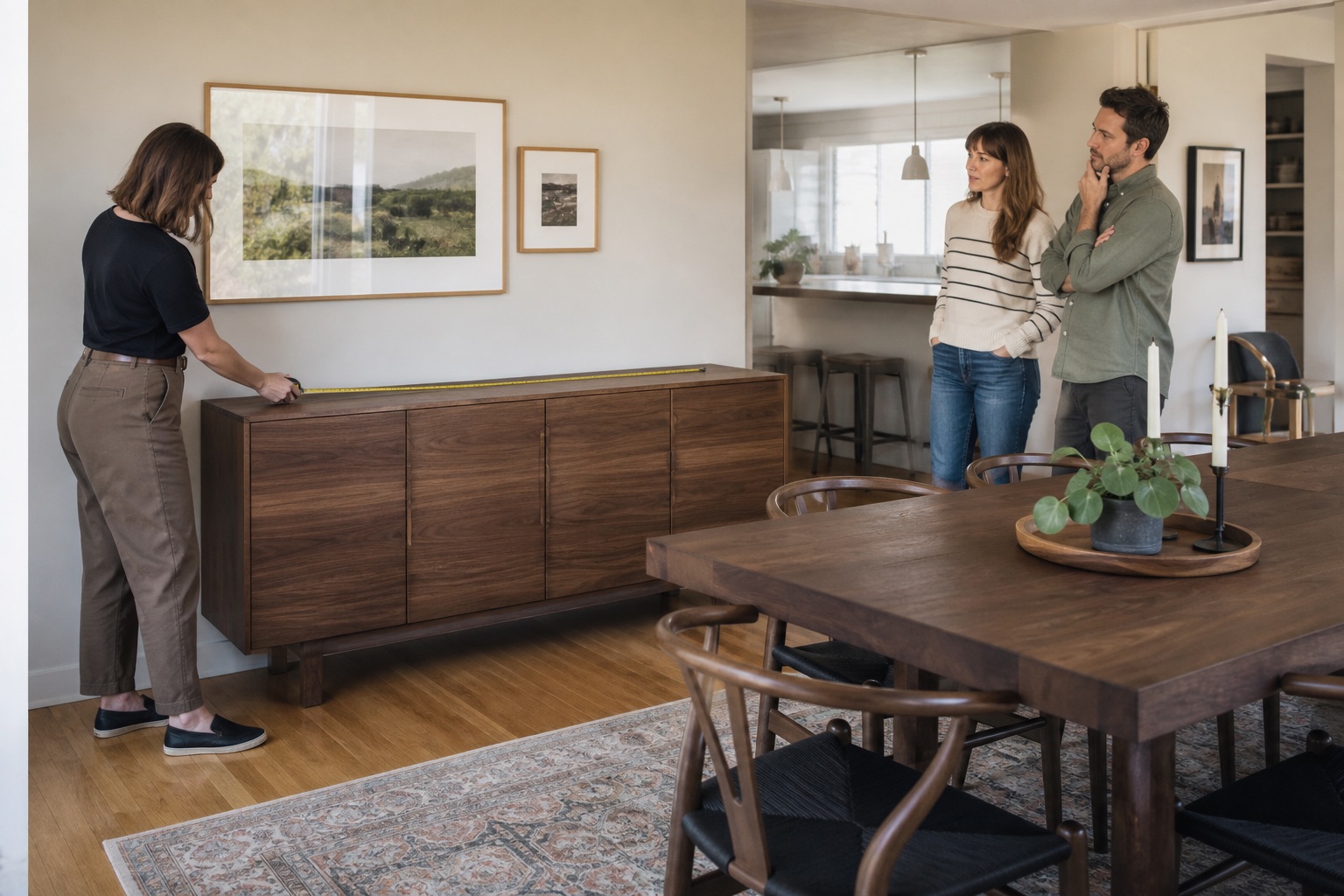
The Short Comparison
The ranges below are common screening points, not industry rules. A maker can use any of the three names for a cabinet outside these dimensions.
| Term | Traditional emphasis | Common height range | Typical location | Best reason to choose it |
|---|---|---|---|---|
| Sideboard | Dining storage plus a usable top | About 30–38 in | Dining room or open dining area | Mixed storage for dishes, linens, and serving pieces |
| Buffet | Serving surface with storage below | About 32–38 in | Dining room | Comfortable setup for food, drinks, or entertaining |
| Credenza | Low, long enclosed storage | About 26–34 in | Dining room, living room, or office | Broad storage with a quieter horizontal profile |
These categories describe tendencies. They do not tell you the usable interior depth, shelf spacing, drawer quality, weight capacity, or door clearance. Those details determine whether the piece works after it enters the house.
What Makes a Sideboard a Sideboard?
A sideboard is usually a freestanding cabinet designed to support a dining room. It often combines shallow drawers for flatware and linens with doors that conceal adjustable shelves. The top provides a temporary landing place for serving dishes, flowers, lamps, or objects removed from the dining table during a meal.
The most useful sideboard is not necessarily the largest one that fits the wall. It should hold the intended inventory without narrowing the room's working aisle. A family that uses everyday stoneware may need strong adjustable shelves and full-extension drawers. Someone who owns tall pitchers or small appliances may need fewer shelves and more vertical clearance.
Compare sideboard depth with the active dining layout, not with an empty room. The recently published dining table size guide explains how chair pullout changes the occupied footprint. A cabinet can appear comfortably distant from the tabletop yet conflict with a seated diner, an open drawer, or a person carrying a platter.
When the Word Buffet Is More Helpful
A buffet traditionally puts serving first. Its top is expected to receive dishes, drinks, desserts, or a coffee setup while storage below supports that activity. This is why many buffets sit toward the taller end of the category: a surface near a comfortable standing work height can be easier to use during entertaining.
In practice, a buffet and a sideboard may be the same physical product. Retailers sometimes call a cabinet a buffet when marketing it for dining and call a similar cabinet a sideboard when presenting it as general storage. The name matters less than the height, top material, and room around the user.
Think through an actual evening. Can one person set down a casserole while another walks from the kitchen? Can a lower drawer open without striking a dining chair? Is the finish reasonably tolerant of condensation and normal cleaning? If the cabinet is used for serving only twice a year but constricts the route every day, a shallower piece may be the better buffet.
The current Dining Room Furniture collection can help you compare coordinated cabinet, table, and seating categories. Still, verify the exact dimensions of every selected item together; a category page cannot resolve a specific room's door swings or circulation.
Why Credenzas Show Up in More Rooms
A credenza generally has a lower, longer visual profile and substantial enclosed storage. Traditional credenzas often rely more on doors and shelves than on multiple small drawers. That horizontal proportion makes them useful below artwork, along a living-room wall, behind a floating desk, or at the edge of a conference area.
In a dining room, a credenza can store dishes as effectively as a sideboard if its interior fits the inventory. The tradeoff is surface height. A lower top may look calm beneath a large artwork or window, but it can be less comfortable for repeated serving tasks. In a living room, the same low cabinet might support a television or hide games and electronics.
Using a credenza for media requires more than placing equipment behind a door. Check clear interior depth after accounting for hinges and the back panel. Plan ventilation, cable bend radius, outlet access, remote-control behavior, and the heat produced by every component. Do not assume an ordinary enclosed wood cabinet is suitable for powered equipment without those checks.
Choose by the Job, Not the Product Name
Before comparing styles, make a written inventory. Measure the largest platter, tallest bottle, widest appliance, deepest file box, or electronic component that must fit. Add handling room so fingers can lift objects and cords can bend without being crushed. The cabinet's advertised exterior depth is not its usable interior depth.
Match the interior to the way each category is used:
- Shallow drawers keep flatware, napkins, placemats, and small tools visible instead of stacked in a deep cavity.
- Adjustable shelves accommodate changing plate stacks, pitchers, serving bowls, and seasonal pieces.
- Wide doors create flexible access, but their swing can conflict with nearby chairs or walls.
- Sliding doors preserve aisle space, though the overlapping panels limit access to one section at a time.
- Glass doors display selected objects while exposing clutter and requiring more frequent visual maintenance.
- Open bays make frequently used items easy to reach but collect dust and increase visual activity.
Photograph the inventory and place key dimensions on a simple list. This prevents an attractive cabinet with poorly spaced shelves from winning the decision. Avrelahome's Sideboards & Buffets planning page is a useful starting point when a standard interior does not match the objects or the available wall.
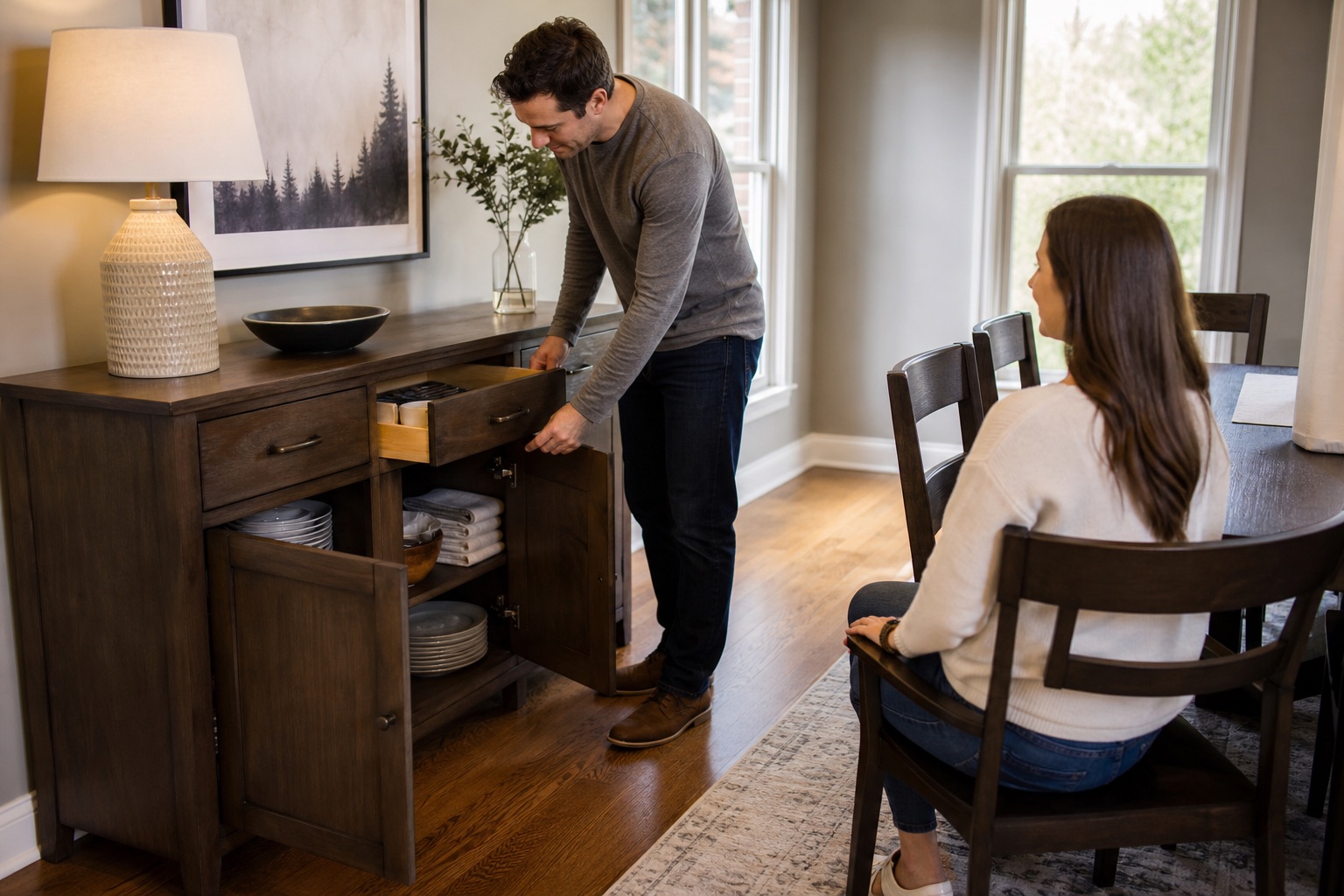
Size the Cabinet in the Real Room
Measure the usable wall, then subtract everything that limits it: door casing, baseboard returns, floor registers, radiators, outlets that must remain accessible, switches, window trim, and the reach of adjacent doors. Older homes may have walls and floors that are not square, so measure at several points instead of trusting one dimension.
Many freestanding sideboards and credenzas are roughly 16 to 22 inches deep. That is only the closed cabinet body. Add projection for pulls, allow space for cords when relevant, and mark the full path of an open door or drawer. A 20-inch-deep buffet with a 16-inch drawer can temporarily occupy close to three feet from the wall.
Height should follow the task. A surface used frequently for setting out food can be near a comfortable standing work height for the household. A credenza below a television, window, or artwork may need to stay lower. Check outlet positions and thermostat controls before using a tall cabinet. There is no universal rule that the cabinet must align with the dining table or fill a particular percentage of the wall.
Width affects both storage and visual weight. Leave intentional breathing room near door casings and curtains rather than forcing a cabinet into every available inch. On a long blank wall, a wider low piece can feel grounded. In a compact dining nook, a narrower taller sideboard may provide more storage per inch of wall, but it also requires a more serious stability and anchoring review.
Use painter's tape to mark the cabinet footprint and a second line for its open doors or deepest drawer. Place the dining chairs in their occupied positions, then walk the kitchen-to-table route while someone else opens the cabinet. The method is simple, but it exposes conflicts that a catalog photo hides.
Decide Between Ready-Made, Custom, and Built-In
Ready-made cabinets usually offer the fastest comparison and the most predictable sticker price. They can be moved, resold, or repurposed when the layout changes. The compromises are fixed dimensions, standard interiors, limited finish choices, and the possibility of wasted gaps beside the cabinet.
A custom freestanding sideboard or credenza can control width, depth, drawer arrangement, shelf spacing, door style, finish, cable openings, and base design while remaining movable. It makes the most sense when those changes solve a defined problem: an unusually shallow aisle, oversized serving pieces, a finish that must coordinate with an existing table, or equipment that needs planned ventilation.
Built-in cabinetry can use a full wall, negotiate an alcove, and visually connect with paneling or adjacent millwork. It also involves field measurement, wall conditions, baseboard decisions, installation, and a greater commitment to the room. The practical differences in this built-in versus freestanding comparison matter more than whether the finished cabinet is called a sideboard or a credenza.
Custom work is not automatically the sensible upgrade. If a standard cabinet fits the wall, stores the actual inventory, and arrives in the required timeframe, customization may add little value. The custom versus ready-made guide offers a broader decision framework for budget, fit, lead time, and flexibility.
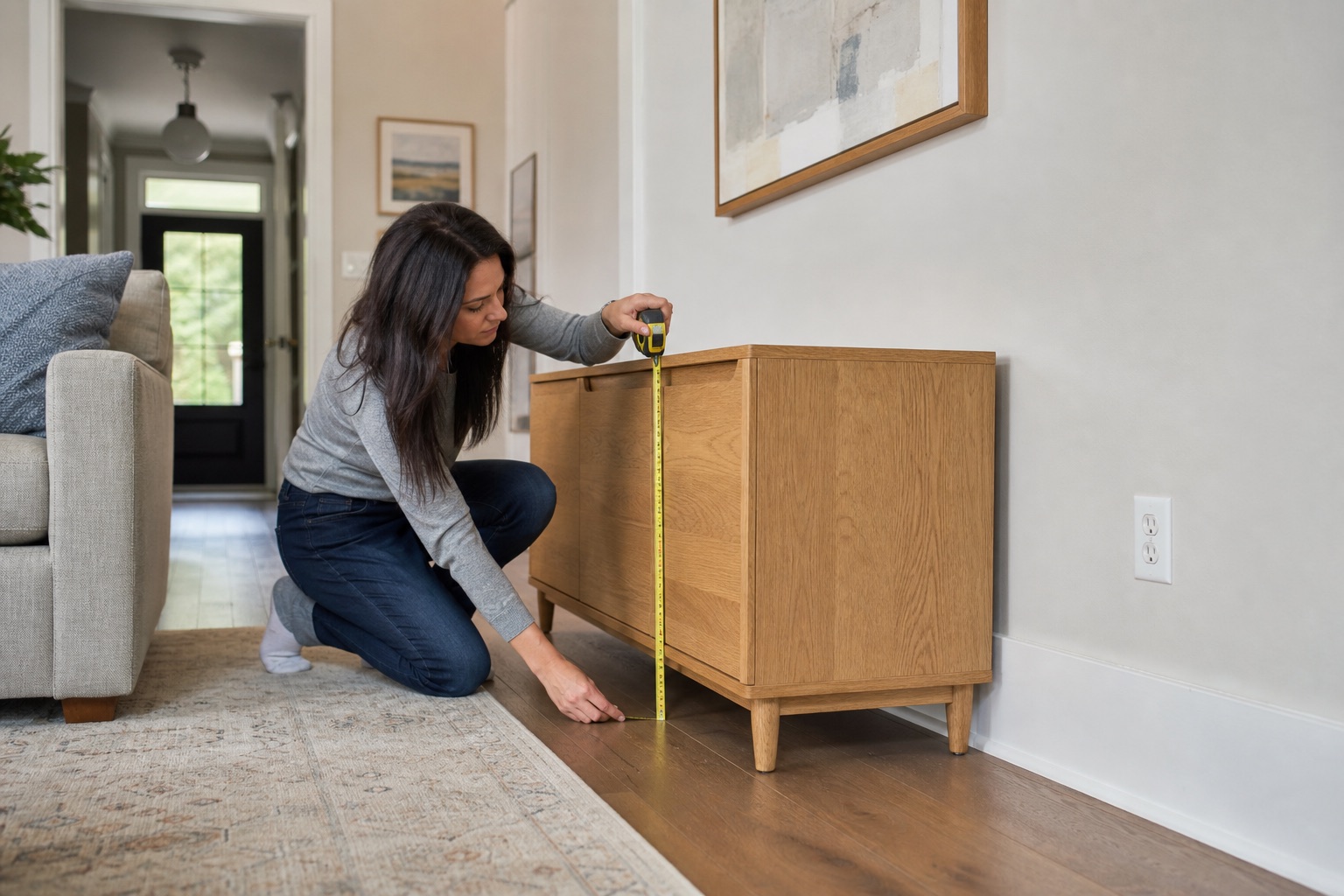
Inspect Materials, Finish, and Hardware
Material descriptions should be specific. Solid wood has natural variation and responds to humidity. Veneer can provide consistent grain over a stable substrate. Quality engineered panels can be appropriate for flat painted doors and stable cabinet boxes. Stone or sintered-stone tops can resist normal surface wear but add weight, seam decisions, and delivery risk.
The custom furniture materials guide explains the tradeoffs among solid wood, boards, veneers, and finishes. For this cabinet category, focus on the combination: substrate, face material, edge treatment, coating system, interior finish, and intended care. A vague phrase such as “premium wood” is not enough for comparison.
Open every door and drawer on a sample when possible. A wide drawer for heavy flatware needs appropriate runners and a box built for the load. Adjustable shelf pins should seat firmly. Door hinges should permit useful access without striking an adjacent wall. Check the finished back if the cabinet will be visible from an open-plan room, and ask how the piece is leveled on an uneven floor.
Request an actual finish sample rather than choosing from a screen alone. View it next to the dining table, flooring, and wall color in morning and evening light. Coordination does not require an exact furniture set. Repeating an undertone, edge shape, metal finish, or proportion can create a relationship without making every piece identical.
Check Delivery, Installation, and Safety
Measure the route from the unloading point to the final wall: entry door, porch turn, apartment corridor, elevator, stair landing, hallway, and room opening. Record the narrowest width and height as well as diagonal turns. A long credenza that fits a 10-foot wall may not rotate through a compact stair landing.
Confirm whether the cabinet ships in one piece, in modules, or flat-packed for assembly. Ask who is responsible for carrying, assembly, leveling, wall attachment, packaging removal, and damage documentation. Protect finished floors before the piece enters the room, and inspect corners, doors, stone tops, and hardware while the delivery team is still present.
Freestanding does not mean free from restraint. Tall or narrow cabinets, pieces with heavy doors or drawers, and furniture accessible to children may need anti-tip anchoring according to the manufacturer's instructions and the actual wall construction. Wall fasteners must suit the substrate and avoid concealed utilities. If the piece contains electrical equipment, keep ventilation and cord routing consistent with the equipment instructions.
Put the Decision Into a Written Specification
Before paying a deposit or approving production, write down the external width, depth, and height; minimum internal openings; drawer and door arrangement; shelf adjustability; expected loads; cable or ventilation openings; top material; finish sample; hardware; base or legs; visible-back requirements; leveling method; wall restraint; delivery route; installation scope; and the party responsible for final field dimensions.
Attach room photographs, a dimensioned sketch, and measurements of the largest stored objects. If dining chairs or a nearby door affect access, include both their closed and active positions. A written specification makes quotes easier to compare and prevents a familiar label from hiding a different product.
Avrelahome can review those details within a broader custom furniture project, but the final approval should always be tied to verified site dimensions, documented materials, the agreed interior layout, and the real delivery route.
Frequently Asked Questions
Are a buffet and a sideboard the same thing?
They often are in today's retail market. Traditionally, buffet emphasizes serving while sideboard emphasizes dining storage, but many products have the same cabinet form. Compare dimensions, interior layout, and intended use instead of relying on the listing name.
Does every dining room need a sideboard?
No. A small dining area may work better with clear circulation, especially if nearby kitchen cabinets already hold serving pieces. Add a sideboard only when its storage or serving surface solves a real problem without crowding chairs and routes.
What is a good height for a dining-room sideboard?
About 30 to 38 inches is a common range. The better height depends on the user's comfortable reach, whether the top is used for serving, the artwork or window above it, and its relationship to nearby furniture.
Can a credenza be used as a TV stand?
Yes, if the top can safely support the television and the cabinet provides enough equipment depth, ventilation, cable routing, outlet access, and stable placement. Confirm the cabinet and equipment manufacturers' requirements rather than assuming any credenza will work.
Should a sideboard match the dining table?
It does not have to match exactly. A shared wood undertone, metal finish, line, or proportion can coordinate the pieces. Exact matching can feel heavy, while completely unrelated finishes can feel accidental unless another room element connects them.
Does a freestanding sideboard need to be anchored?
It may. Height, depth, weight distribution, drawer extension, door weight, wall condition, and access by children all affect tip risk. Follow the manufacturer's anchoring instructions and use hardware appropriate for the actual wall.
Choose the Cabinet That Does the Work
Use sideboard, buffet, and credenza as search doors, not as final specifications. The right cabinet is the one that holds the real inventory, leaves the room operable, arrives through the available route, and uses materials and hardware suited to daily life. Once those conditions are documented, the name on the product page becomes a minor detail.