
Choosing a custom furniture manufacturer requires more than comparing attractive photos and total prices. The right partner should understand your type of project, turn the brief into buildable documents, identify missing decisions, explain materials and construction, and manage problems before they reach the installation site. Style matters, but documentation and execution usually predict the outcome better than a polished portfolio does.
Start by defining the work, then compare candidates against the same requirements. A small shop that makes excellent solid-wood dining tables may not be equipped for a multiroom cabinet package. A factory organized for hotel casegoods may not welcome a single residential built-in. There is no universally best manufacturer; there is a manufacturer whose capabilities, order size, communication, and delivery model fit your project.

Define the Project Before You Contact Manufacturers
Prepare a short brief with the rooms and products, known dimensions, quantities, intended use, visual references, material preferences, budget range, delivery destination, and desired installation window. If you are still deciding what must be personalized, use the custom furniture overview to distinguish fit-critical requirements from optional choices.
Sort the information into three groups: requirements, preferences, and open questions. An alcove width or appliance model may be fixed. A wood tone may be selected from samples. A pull style may still be open. This distinction lets a manufacturer propose alternatives without quietly changing something essential.
For a US residence, note the front-door opening, stairs, elevator, parking, HOA delivery rules, and current construction status. For a commercial project, identify room types, prototype approval, phased delivery, on-site storage, and opening milestones. A meaningful quote cannot be separated from access and installation conditions.
Choose the Supplier Model That Fits the Work
Local Custom Shop
A local shop may suit a project that requires site visits, repeated field measurements, a small quantity, or hands-on craft detail. Communication and problem response can be direct. Capacity, purchasing leverage, and installation coverage outside its immediate area may be limited, so confirm these rather than assuming them.
Domestic Production Manufacturer
A larger domestic producer may be a strong fit for repeatable construction, multiple rooms, or coordinated schedules. Ask whether your quantity fits its normal production model, who prepares shop drawings, whether finishing is in-house, and whether installation is provided or subcontracted.
Overseas Manufacturer
International sourcing can make sense for a broader product package, repeat quantities, or consolidated purchasing. The buyer must also manage time zones, sample shipping, international payments, freight, customs, warehousing, final-mile delivery, and local installation. Compare the full delivered scope, not only the factory price.
OEM or ODM Partner
This model is usually relevant to brands, designers, developers, and commercial buyers creating repeatable products. OEM production generally follows a buyer’s specifications; ODM may include more development support, though companies use the terms differently. Avrelahome’s OEM and ODM furniture service explains its offering, but ownership of drawings, samples, tooling, and revisions should still be defined in the project agreement.
Build a Shortlist From Relevant Evidence
Look for experience that resembles the work you actually need: materials, construction complexity, quantities, dimensional range, finishing, and delivery model. A manufacturer does not need to show your exact room, but it should demonstrate an adjacent capability. Project photographs are more useful when supported by drawings, material descriptions, work-in-progress evidence, or an explanation of scope. Renderings alone do not prove manufacturing performance.
The Avrelahome home page offers a quick view of its product and project categories, but any manufacturer’s website is only a screening tool. Verify the methods, samples, and written specifications that apply to your order.
A focused shortlist of three to five candidates usually produces better results than sending a vague request to a dozen companies. Give each candidate the same brief. Their questions, assumptions, and exclusions will show whether they have actually reviewed it.
Test Drawing and Technical Communication Skills
A capable manufacturer asks about details that affect production and installation before presenting a confident price. For fitted cabinets, that may include out-of-square walls, scribe fillers, baseboards, outlet access, door conflicts, appliance ventilation, and connections between modules. Questions are not a weakness when they expose decisions the buyer has not yet made.
Ask for a redacted drawing example suited to your project. Useful shop drawings identify overall dimensions, material thicknesses, reveals, hardware, opening direction, installation interfaces, and necessary sections. A beautiful three-dimensional view cannot replace a drawing from which the product can be made and checked.
The distinction among custom, bespoke, and made-to-order furniture is useful here. It helps determine whether “custom” means dimensions and construction can change or merely that you can choose from a fixed menu of finishes.
If a candidate cannot explain a critical dimension before approval, the workshop will not solve that ambiguity safely by guessing. Record every assumption that affects fit, function, or appearance.
Make Materials, Hardware, and Samples Specific
Terms such as “solid wood,” “premium board,” or “imported hardware” are not complete specifications. The quote and approval documents should identify, as relevant, wood species, panel type and thickness, veneer, edge treatment, finish system, hardware function, and acceptable substitutions. Stone, glass, metal, fabric, and foam need equally recognizable descriptions.
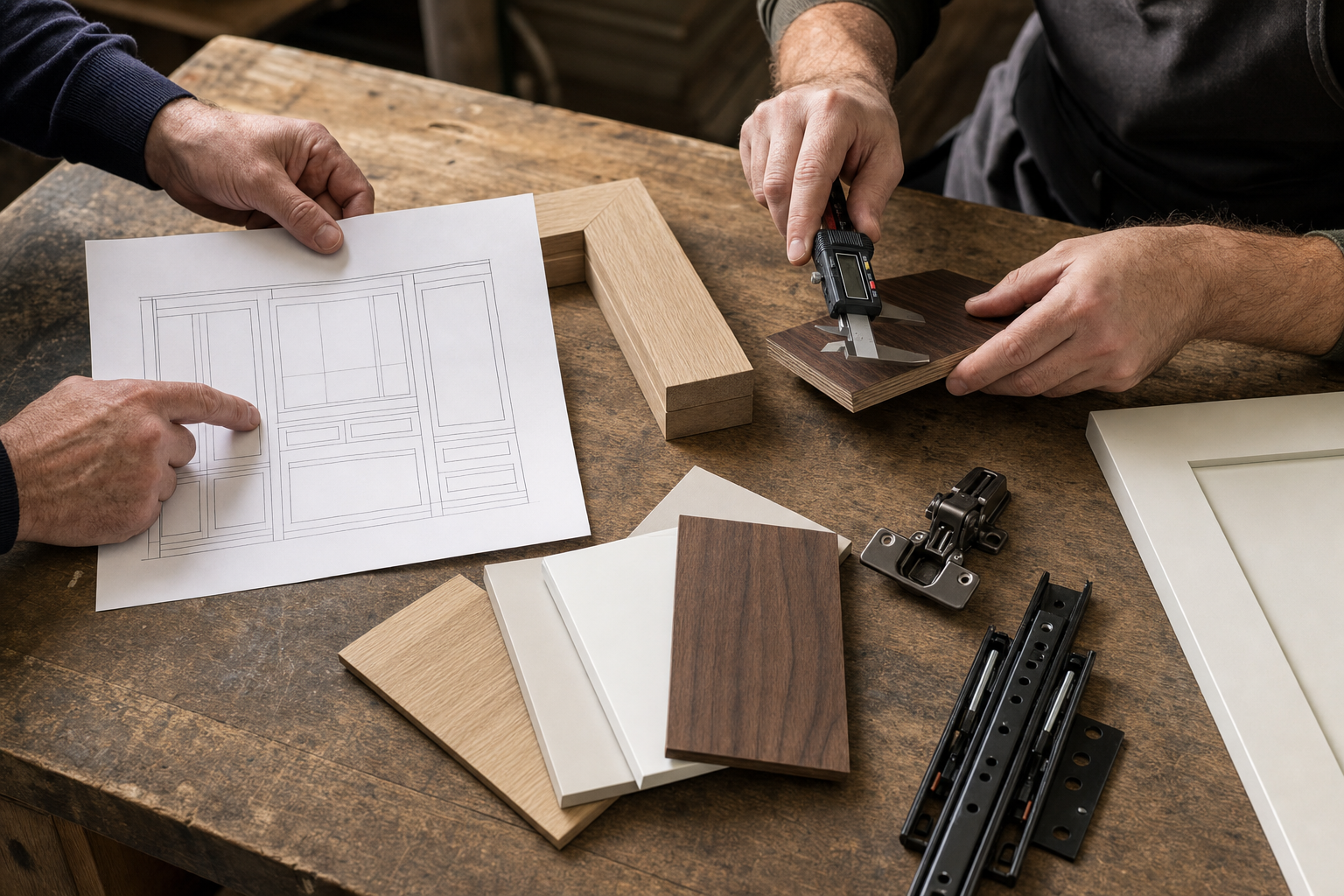
A sample should represent actual sourcing and production conditions. A small color chip can confirm tone but may not reveal large-scale grain, panel matching, sheen, or edge quality. For a high-value or repeated order, a sample door, drawer, upholstered panel, or functional mockup can reveal construction and operating quality that a flat swatch cannot.
Do not treat a certificate as the only proof of quality, and do not accept a broad claim that cannot be tied to the product. Project-specific material records, approved samples, and inspection criteria are more useful than generic promotional language. If a compliance document is necessary for your market or application, define the exact document and verify it independently.
Compare Quotes on the Same Scope
Normalize every quote before comparing totals. Identify what is included for design development, samples, furniture, hardware, packing, tax, freight, insurance, customs, final-mile delivery, installation, touch-ups, and corrections. The custom furniture cost guide explains how specification choices affect price; manufacturer selection also requires comparing where each party’s responsibility begins and ends.
A low total may reflect a different material, thinner construction, simpler hardware, fewer samples, basic packing, or an excluded installation. It may also contain an honest production efficiency. Ask each candidate to quote the same product schedule and specifications, then list every exception. A clear higher quote may carry less total risk than an attractive number built on omissions.
Payment milestones should correspond to verifiable progress, such as approved drawings, an agreed production checkpoint, passed inspection, or shipping documents. The exact structure depends on transaction location, order size, and negotiation. Avoid using a generic payment template without understanding what you can verify at each stage.
Use Communication and Change Control as Evidence
Watch how the candidate responds during quotation. Does the reply address the question? Are unknowns acknowledged? Are versions labeled? Does the contact follow up when promised? A fast but ambiguous answer is less valuable than a precise response that explains conditions and next steps.
Appoint one day-to-day contact and one authorized approver. Dimensions, colors, quantities, and revisions should be confirmed in dated or versioned documents. The whole-house customization process illustrates how many handoffs can occur between planning and installation; version control prevents an old decision from reappearing downstream.
Ask how change orders work. Who evaluates the impact? When will added cost and delay be provided? Does production pause until the change is approved? A manufacturer that stops to document a change may be more dependable than one that promises every revision is easy and free.
Verify Production and Quality-Control Capability
Depending on project risk, request a live or recent workshop video, an explanation of relevant equipment and processes, in-progress images, and a sample inspection form. A site visit or independent inspection may be justified for a high-value, repeated, or overseas order. Avrelahome’s factory and manufacturing overview provides public context about its operation, but no web page replaces an order-specific quality plan.
Define inspection points before production. They may cover critical dimensions, material and color, door gaps, drawer operation, hardware, visible finish defects, quantities, accessories, and packing. Remote photographs should correspond to a checklist and identify the item being reviewed instead of showing only flattering angles.
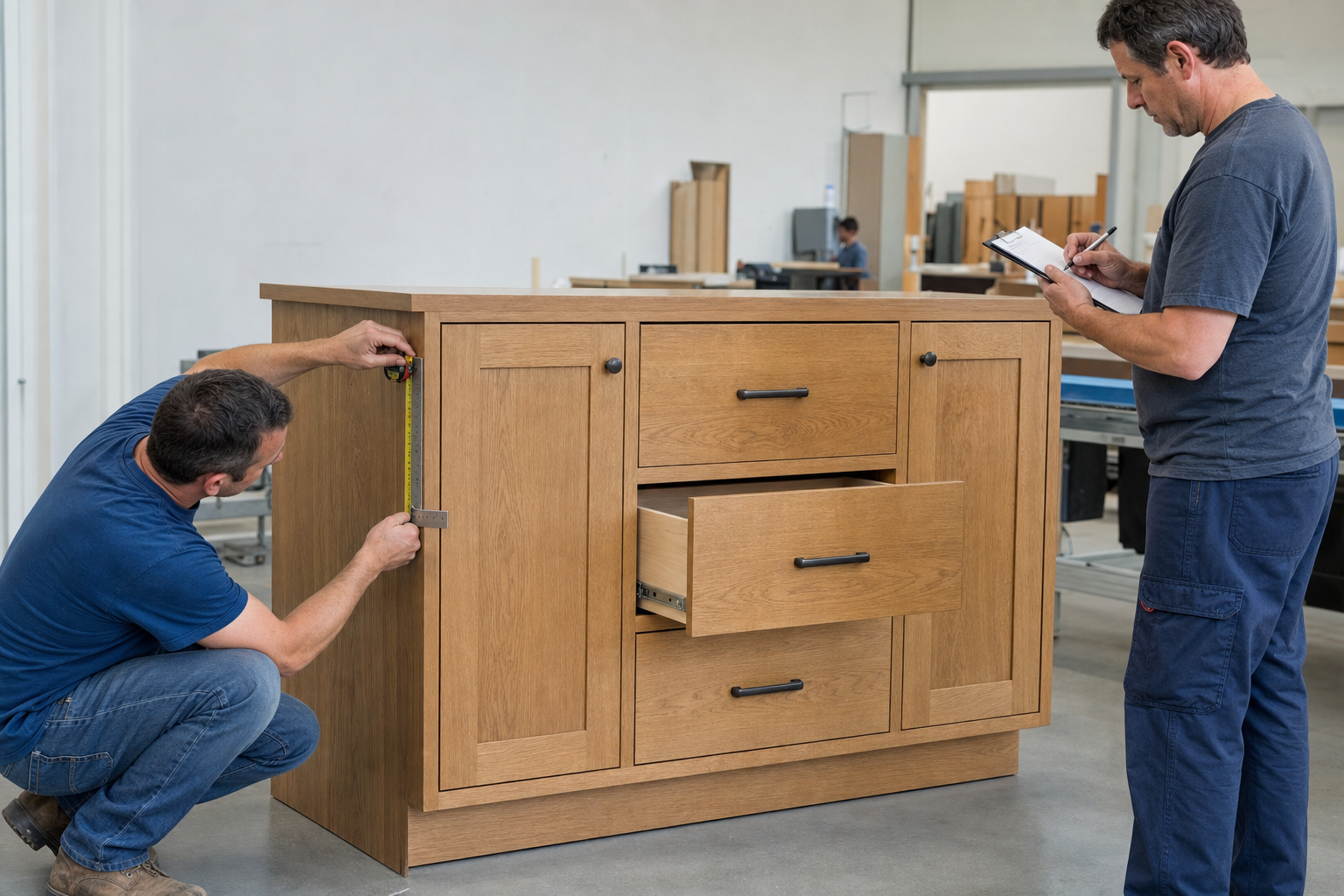
For repeated products, inspect and approve a prototype or first article before releasing the full quantity. Sampling frequency, allowable variation, and corrective action should reflect the risks of that product. Wood, panel cabinetry, upholstery, stone, and metal do not share one universal tolerance, so be cautious with a generic number applied to every material.
Plan Freight, Receiving, Installation, and Support
A manufacturer’s responsibility might end at its loading dock, origin port, destination port, warehouse, residence, or completed installation. The quote should state the freight terms and the point at which risk transfers. An international order also needs ownership of export packing, the packing list, customs documents, storage, delivery appointments, and final-mile access.
Installation should influence product design. Ask how modules are divided, connected, leveled, and scribed; what instructions, fasteners, and special tools the local crew will receive; and who handles discrepancies. When a third party installs the product, accurate labels and as-built documents become especially important.
Support terms should address missing parts, transit damage, finish discrepancies, hardware failure, and incorrect dimensions. Save final drawings, finish references, hardware identifiers, and spare components after closeout. These records are more useful for future service than a generic warranty statement without a claim process.
Red Flags That Deserve a Closer Look
- A firm price and lead time issued before dimensions and scope are reviewed
- Refusal to identify materials, hardware, or construction
- A portfolio dominated by renderings with little verifiable production evidence
- Conflicting drawing or quote versions sent repeatedly
- Promises that every change can be made without cost or delay
- A large payment request before essential specifications are defined
- No clear answer about packing, transit damage, missing parts, or replacement
- Vague certificates or customer counts used instead of project evidence
One concern does not automatically disqualify a supplier. Several concerns together should not be ignored because the quote is lowest.
Use a Weighted Scorecard for the Final Decision
Set weights based on project risk. A one-room residential built-in may prioritize local field service. An overseas hotel package may prioritize documentation, repeated consistency, packing, and phased delivery. A starting framework could assign 25% to technical and project fit, 20% to materials and samples, 20% to communication and documents, 15% to quality control, 10% to logistics and installation, and 10% to price and payment terms.
The scorecard is not intended to create scientific precision. It prevents the final choice from collapsing into instinct or total price. Attach evidence to each score—for example, “provided a similar drawing with sections” or “did not explain the replacement-parts process.”
When a Sample or Pilot Order Is Worthwhile
A paid prototype, model room, or small pilot order is often sensible when the order value is high, quantities repeat, the finish is sensitive, or the relationship is untested. The pilot should test the actual risks: key materials, hardware, documentation, packing, and communication. A decorative sample built differently from the production item gives limited evidence.
After approval, translate the pilot results into production standards. Identify which material-batch or process changes require a new approval. A successful sample is the beginning of controlled production, not a reason to stop inspecting.
Frequently Asked Questions
How many custom furniture manufacturers should I compare?
Three to five well-matched candidates are usually enough for a focused review. Too many candidates can reduce the quality of the brief and make unlike scopes harder to compare.
Do I need to visit the factory?
Not for every project. A high-value, repeated, or international order makes a visit or independent inspection more useful. When a visit is impractical, request a live video, relevant production records, physical samples, and an order-specific inspection plan.
Is the lowest-priced manufacturer always riskier?
No. A lower price may come from legitimate efficiency. The risk rises when the scope, materials, or responsibilities differ or remain vague. Normalize the quotes before judging the number.
How can I verify materials and hardware?
Request identifiable specifications, representative physical samples, and a written approval record. Compare production evidence and the packing list against those approvals before shipment.
Does an overseas manufacturer make sense for one residential piece?
Sometimes, but freight, customs, minimum quantities, receiving, and local installation can erase the apparent advantage. Compare the full delivered cost and responsibility, not only the factory price.
Choose the Partner That Makes Risk Visible
Selecting a custom furniture manufacturer is ultimately a choice about who can control specifications, changes, and delivery risk. Define the project first, compare the same scope, and include drawings, samples, quality control, logistics, and support in the decision. The strongest evidence is not a promise that “anything is possible.” It is the manufacturer’s ability to turn your requirements into clear, inspectable, deliverable work.