
Living room furniture does not have to come from one collection to feel coordinated. In fact, many comfortable American homes develop over time: a sofa comes from one move, a cabinet is inherited, and chairs change as family life changes. The room looks intentional when those pieces share a few clear relationships—not when every finish is identical.
Start with scale, undertone, line, and visual weight. Repeat a small number of those qualities, then allow individual pieces to differ. One clear contrast is usually easier to manage than several finishes that almost match but miss.

Diagnose What Actually Feels Uncoordinated
Do not assume the furniture itself is the entire problem. A room may feel disconnected because the rug is too small, lighting is limited to one ceiling fixture, the walls are empty, or all the dark pieces sit on the same side. Replacing the sofa will not fix an unbalanced composition.
Photograph the room from the main entrance, the primary seat, and any connected dining or kitchen area. A photograph makes visual weight easier to see. Two dark wood chairs and a floor-based media cabinet may pull one wall downward. Three oak-colored pieces that are close but not quite the same can look more accidental than a confident light-and-dark mix.
Inventory What Must Stay Before You Shop
List every piece that is staying. Record its outside dimensions, condition, function, dominant color, wood undertone, line quality, and visual weight. Note why it is staying too. An inherited walnut chest may deserve a prominent position, but sentimental value does not require placing it in a traffic path or making every new item imitate it.
Mark doors, windows, fireplace projections, returns, outlets, television sightlines, and unavoidable routes. The step-by-step living room furniture layout guide can help you translate those constraints into a measured plan. In many U.S. suburban homes, the route from the entry or garage to the kitchen brushes the edge of the living area. In an apartment, the same room may also be the only path to a balcony.
Walk those paths as you use them: carrying groceries, guiding a child, moving a laundry basket, or letting two people pass. A coordinated furniture plan still fails if you clip the coffee table every morning.
Choose One Lead Piece and Define Its Direction
The lead piece may be the sofa, rug, large artwork, or an older case piece with presence. It does not have to be the most expensive object. Its job is to tell you what the supporting furniture should echo and where contrast would be useful.
Turn vague style words into observable attributes. Instead of “warm modern,” write down medium-to-dark warm woods, low-saturation upholstery, slim black metal, softened corners, and limited gloss. Instead of “transitional,” identify which traditional details you want to keep—perhaps turned legs or a framed cabinet door—and which cleaner contemporary lines should quiet them.
Use this description as a filter, not a rigid theme. Keep one or two expressive traits and let the rest of the furniture support them.
Build a Compact Coordination Palette
A useful palette can include one base neutral, one main wood-temperature direction, one primary metal direction, one or two accent colors, and a mix of textures. This is not a formula. It is an approval tool that prevents an unplanned fourth wood tone or third metal finish from entering the room.
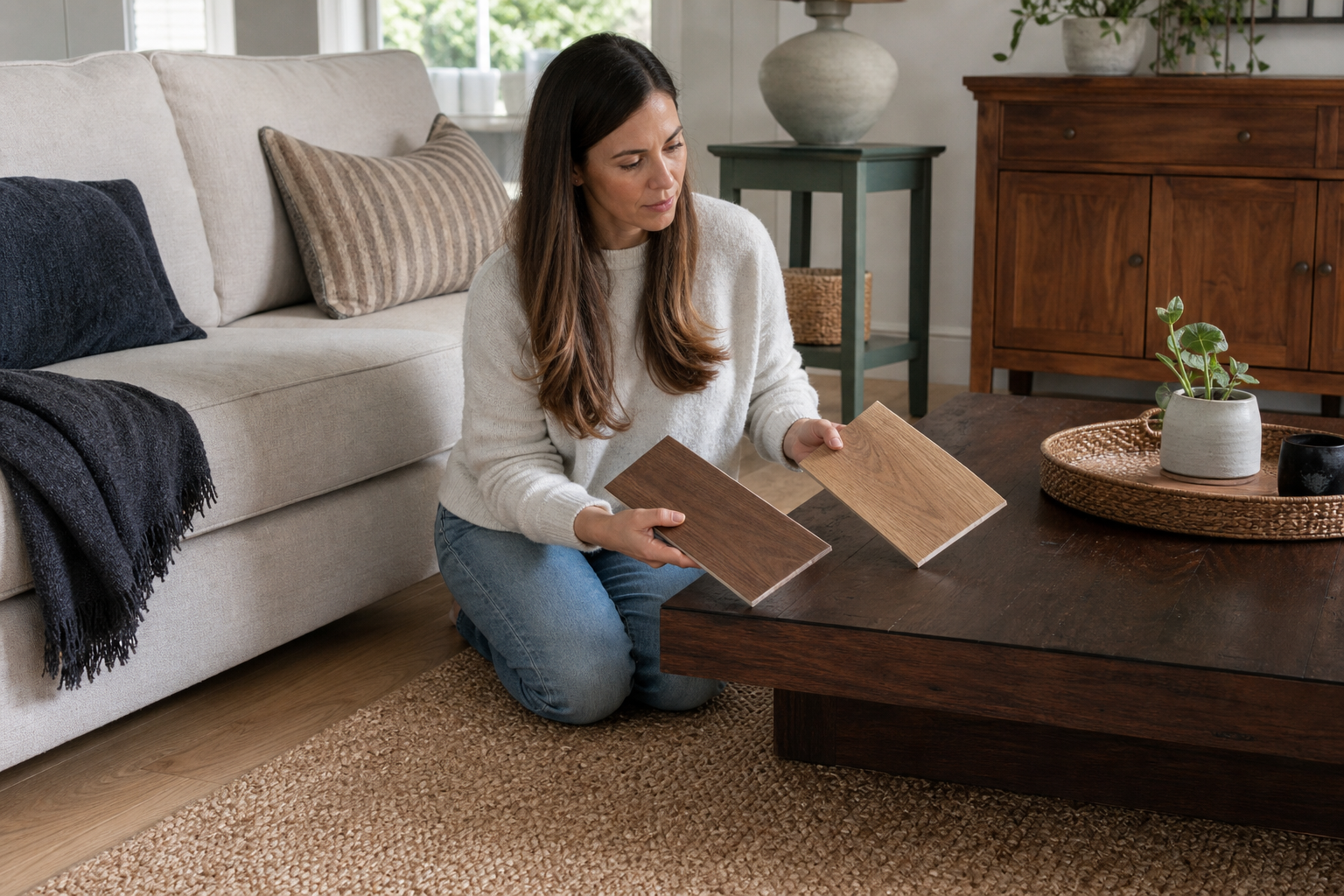
Gather physical samples whenever possible. Place wood, veneer, fabric, leather, paint, and stone samples beside the furniture that will remain. Review them in morning light, afternoon sun, and evening lamps. Cool LEDs can flatten a warm beige fabric; western light can make a wood finish look much redder than it did in a showroom.
The guide to wood, boards, veneers, and furniture finishes explains why a material name alone does not predict color, stability, or daily performance. Compare the actual finish system and sample, not just the species label.
Mix Styles Through Shared Lines and Proportions
A contemporary sofa can work with traditional lounge chairs if there is a bridge between them. They might share a similar seat height, a softened arm curve, visible wood at the base, or one small color repeated in a pillow. The connection should be noticeable without turning the room into a matched set.
Look at the degree of ornament. If an inherited chair has carved arms and patterned upholstery, a quiet sofa gives it room. Adding an equally decorative coffee table, lamp, rug, and cabinet makes every item compete. Conversely, a room of uniformly plain rectangles may need one rounded table or sculptural chair to avoid feeling clinical.
Repeat geometry selectively. Curved chair backs can relate to an oval table, while straighter media storage provides structure. One or two echoes are enough.
Coordinate Scale and Visual Weight Before Color
Pieces with compatible colors can still feel wrong together when their proportions disagree. A broad, low sofa beside a tall, delicate end table makes both look awkward. A skirted sofa, solid pedestal coffee table, and floor-based media unit can make the whole room feel heavy even if every finish is neutral.
Compare outside dimensions rather than retail seat-count labels. A “three-seat” sofa with wide arms may offer less usable space than a narrower model. Check seat depth, seat height, arm width, back height, and leg exposure. Use the practical selection checks in the living room furniture buying guide to connect comfort and material choices to the people who will use the room.
Tables also need a physical relationship to seats. A coffee table should be reachable without forcing everyone to lean far forward, yet it cannot consume knee room or the main route. An end table must work with the nearby arm and the objects placed on it. Do not use matching table heights as a goal when the seats themselves differ.
| Decision | Relationship to check | Common failure |
|---|---|---|
| Sofa and chairs | Seat height, depth, arm mass, conversation distance | One seat looks miniature or isolates its user |
| Coffee table | Reach, knee space, circulation, edge shape | Correct color but wrong footprint |
| End tables | Useful top height, lamp position, cord route | A matched pair serves only one seat well |
| Storage | Capacity, door swing, height, visual mass | Several heavy pieces crowd one elevation |
| Rug | Connects the main seating group | A small center island separates every piece |
Mix Wood Finishes Without Chasing an Exact Match
Identify whether each existing wood reads warm yellow, red, gray, or relatively neutral. Choose the wood with the largest visible area as the dominant direction. Other woods should either share its general temperature or create enough light-and-dark contrast to look deliberate.
For example, a medium oak floor paired with a slightly darker imitation-oak coffee table often looks like a failed match. Walnut, a painted table, or stone on a metal base may create a clearer relationship. The contrast tells the eye that the difference was chosen.
Use a bridge piece when the room already contains two important woods. A side table might combine a dark top with lighter legs, or a cabinet might connect wood with the black metal seen elsewhere. A rug can also separate a wood table from a similar wood floor, so the finishes no longer compete edge to edge.
Do not rely on online thumbnails to judge undertone. Ask for current production samples.
Combine Upholstery, Pattern, and Texture for Daily Life
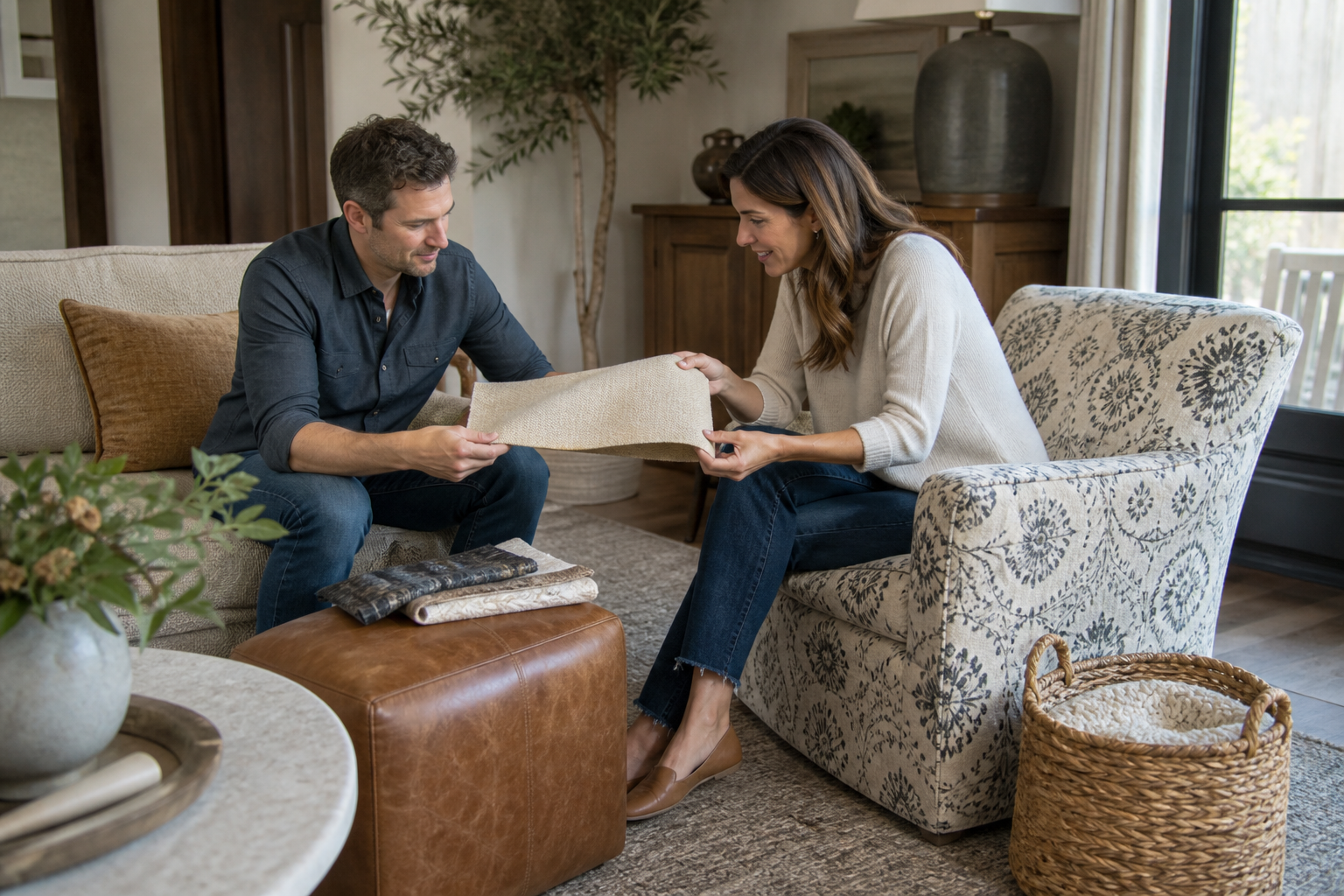
Large upholstery decisions should serve the household first. With children, pets, strong sun, or frequent entertaining, ask for fiber content, cleaning guidance, weave information, sample availability, and replaceable covers or components where relevant. “Performance fabric” is too broad to settle those questions by itself.
If the sofa is solid, one chair can carry a pattern. Consider how that pattern reads from the room entrance, not only at sample distance. A large-pattern chair surrounded by several small floral pillows gives the eye no quiet place. Limit pattern scales and use texture to add quieter variation.
Texture is especially useful in a controlled palette. A coarse weave, smooth leather, woven basket, matte wood, and stone can look layered even when their colors are restrained. Aim for contrast that can be felt as well as seen.
Pillows are an adjustment layer, not structural repair. They cannot correct a sofa that overwhelms the room or chairs that sit at the wrong height.
Let Metals, Stone, Glass, and Paint Repeat—Not Match
A black floor lamp should not be the only black metal object in the room. Repeat it lightly in a frame, table base, or cabinet hardware. That does not mean every metal must be black. One warm metal accent can coexist with a darker neutral metal when the mix is limited and repeated.
Stone and glass change visual weight as well as color. Glass can make a compact room feel lighter, but fingerprints, glare, and hard edges may not suit every household. Before ordering stone, ask about sealing, weight, edge details, and the indoor delivery route. Painted furniture can create a useful pause between several grain patterns.
Use the Rug, Lighting, and Art to Complete the Relationship
The rug is often the largest connecting layer in the seating group. It should make the principal seats read as one arrangement rather than fill only the empty rectangle beneath the coffee table. Tape the full rug size on the floor, including doors and traffic paths, before you order.
Lighting can repeat a line or metal, but each fixture still needs a job. A reading chair needs usable light, not merely a lamp that matches the table. Plan how floor and table lamps receive power. Do not run an extension cord across a walkway; consult a qualified local professional if a new receptacle or floor outlet is needed.
Artwork does not need to match the pillows exactly. A secondary color in the art can appear quietly in textiles, or the frame can repeat the room’s darker line. Protect the artwork’s identity instead of reducing it to a color swatch.
Integrate Inherited, Vintage, and Existing Pieces
Decide whether an older item is a functional asset, an emotional focal point, or simply something you have not reconsidered. A sound chair may justify reupholstery; an awkward cabinet may work better elsewhere.
Do not distort the entire plan around a weak piece. If an item must remain, make it a clear point of contrast rather than asking every new product to chase a finish that cannot be replicated. Give it breathing room and one or two small connections elsewhere.
The tradeoffs in the built-in versus freestanding furniture guide are useful when the existing mix also has to solve storage. A fitted cabinet can control dimensions and finish relationships around irregular walls or media equipment. Freestanding storage is often the better choice for renters or households that expect the layout to change.
Buy and Order in a Lower-Risk Sequence
Complete a scaled floor plan with circulation first. Confirm the lead piece, then test the rug, secondary seating, tables, and storage. Add lighting and accents after the large relationships work. This sequence is flexible, but it prevents a pile of small purchases from dictating an unsuccessful sofa and rug plan.
Tape the sofa, chairs, rug, and tables on the floor at the same time. Add cardboard at the height of a sofa back or cabinet if volume matters. Sit in the positions, set down a drink, open storage doors, and walk the main routes. Photograph at least two arrangements so you can compare the whole room rather than relying on memory.
Review return terms, production lead time, and delivery scope before paying. The safer online custom-furniture ordering process details drawings, samples, approvals, and responsibility boundaries that also improve complex mixed-furniture purchases.
Measure the entry door, elevator, hallway turns, stairs, landings, and ceiling pinch points. Compare those dimensions with the packaged product, not only its installed size. In a condo or apartment building, confirm elevator reservations, delivery hours, insurance rules, and floor protection. Ask who assembles the piece, removes packaging, anchors tall units, and handles touch-ups.
Run a Final Risk Check Before Approval
Review every sample, dimension, and product image on one page. Do not approve pieces only in isolation. Look for multiple almost-matching woods; too many floor-hugging forms; incompatible seat and table heights; stools or corners intruding into circulation; several unrelated metals; and a large item with no proven delivery route.
Count the visual focal points too. Decide what a visitor should notice first and allow supporting pieces to be quieter.
If existing furniture, exact dimensions, or storage requirements make standard products difficult to coordinate, custom living room furniture options can be evaluated against one room-wide brief. With a measured plan, current finish samples, delivery constraints, and a clear list of what must stay, Avrelahome can help align modules, dimensions, finishes, and installation needs without forcing the room into a matched suite.
Custom is not automatically the right answer. Portable standard furniture may be more practical for a rental, a near-term move, or a room that needs frequent reconfiguration.
Frequently Asked Questions
Does living room furniture have to match?
No. Furniture can differ in style, material, and age when a few relationships remain consistent. Coordinate scale, undertone, line, visual weight, or a repeated material. The goal is an understandable whole, not identical pieces.
How many wood tones can you use in one living room?
There is no absolute number, but smaller rooms benefit from restraint. One dominant wood plus one compatible or clearly contrasting secondary wood is easier to manage than several near-matches. Use rugs, paint, metal, or stone to create separation when needed.
Can a modern sofa work with traditional chairs?
Yes. Check seat height, overall mass, and conversation distance first. Then create one bridge through color, visible wood, leg shape, or softened curves. Let the more decorative piece be the accent rather than repeating all of its details.
Should the coffee table and end tables match?
They do not need to be a set. Repeat one material, undertone, geometric idea, or level of visual weight, then size each table for its actual seat and function. A matching pair that is awkward to reach is not a good match in practice.
When is custom furniture useful in a mixed living room?
Custom work can help when irregular walls, shallow depth, precise relationships to existing furniture, media and storage needs, or delivery assembly constraints cannot be addressed together by standard pieces. If the room changes frequently, modular or freestanding products may remain the safer choice.
Final Takeaway
Successful mixing does not hide differences; it gives them order. Protect the layout and daily function first. Then repeat a few relationships—wood temperature, line, metal, color, or visual weight—and allow individual pieces to have their own character.
Approve the living room as one composition, with one floor plan and one set of current samples. If a piece looks beautiful by itself but weakens circulation, balance, comfort, or the hierarchy of the room, it is not the right piece for this mix.