
Ordering custom furniture should feel exciting, but the safest time to slow down is before you pay a deposit. A good conversation at this stage turns inspiration into a scope that both you and the supplier can verify. It also reveals the assumptions most likely to cause an unexpected charge, a missed installation date, or a piece that cannot get through the front door.
The goal is not to interrogate a maker with a generic list. It is to leave with written answers about dimensions, construction, finishes, price, timing, delivery, installation, and responsibility when something changes. The questions below work for one made-to-fit piece, a wall of built-ins, or a coordinated whole-home package.

What Should You Prepare Before Asking for a Quote?
Begin with the room, the people who use it, and the constraints that cannot change. Record approximate room dimensions, ceiling height, door and window locations, baseboards, outlets, vents, radiators, and nearby fixtures. Add photographs taken from several angles. If access may be difficult, measure the front door, hallways, stair turns, elevator opening, and any tight landing.
Then describe how the furniture needs to work. A household with young children may prioritize washable finishes and rounded corners. A frequent entertainer may need a dining table that expands without blocking a circulation path. A home office with two monitors needs cable routes, ventilation, and usable knee space, not simply a handsome desk.
Bring inspiration images, but label what you like in each one. Is it the warm oak, quiet door spacing, low profile, or overall mood? A photo communicates taste; it rarely communicates dimensions or construction. If you are still sorting out which decisions can truly change, the custom, bespoke, and made-to-order comparison provides a useful starting point.
Your brief should also include a budget range, delivery ZIP code, target installation window, and the name of the person authorized to approve drawings and changes. These details help a supplier propose something buildable instead of spending time on an option that cannot fit the project.
Ask Exactly What “Custom” Means for This Order
The word custom is used broadly. Ask which parts of the product can change: width, height, depth, internal layout, construction, door style, wood species, finish, hardware, upholstery, or edge details. Also ask which parts come from a fixed system. A manufacturer may offer flexible dimensions but only a limited finish library; another may develop nearly every detail from scratch.
Request a written list of permissible substitutions. If a specified hinge, fabric, board, or veneer becomes unavailable, can the supplier replace it without approval? The right answer depends on the project, but the decision process should not be vague. A visually similar substitute may behave differently or affect maintenance, lead time, and warranty.
Confirm whether the quote covers one item or a coordinated set. In a multiroom order, note where grain direction, color, pulls, toe kicks, and reveal sizes should remain consistent. This is where a loose request such as “match the reference” needs to become a documented specification.
Who Owns the Measurements and Final Fit?
Ask who takes final field dimensions, when that measurement occurs, and what site conditions must be complete first. Drywall, flooring, tile, trim, appliance models, and plumbing locations can all change the usable opening. An early measurement may support design, but fitted work normally needs dimensions tied to the finished or clearly defined site condition.
For remote projects, clarify whether you, a local contractor, an installer, or the manufacturer supplies the dimensions. Identify who verifies them and who carries the risk if a number is wrong. Avrelahome can work from project information supplied at a distance, but the measurement responsibility still needs to be explicit for every order.
Older American homes deserve extra attention. Walls may be out of plumb, corners may not be square, floors may slope, and heavy baseboards may project into a cabinet run. Ask how fillers, scribes, leveling, and trim transitions will accommodate these realities. A perfect rectangular drawing does not guarantee a perfect site.
The whole-house customization process shows why dimensions should remain connected to drawing approvals, production, and installation rather than being treated as an isolated first step.
What Drawings and Samples Will You Approve?
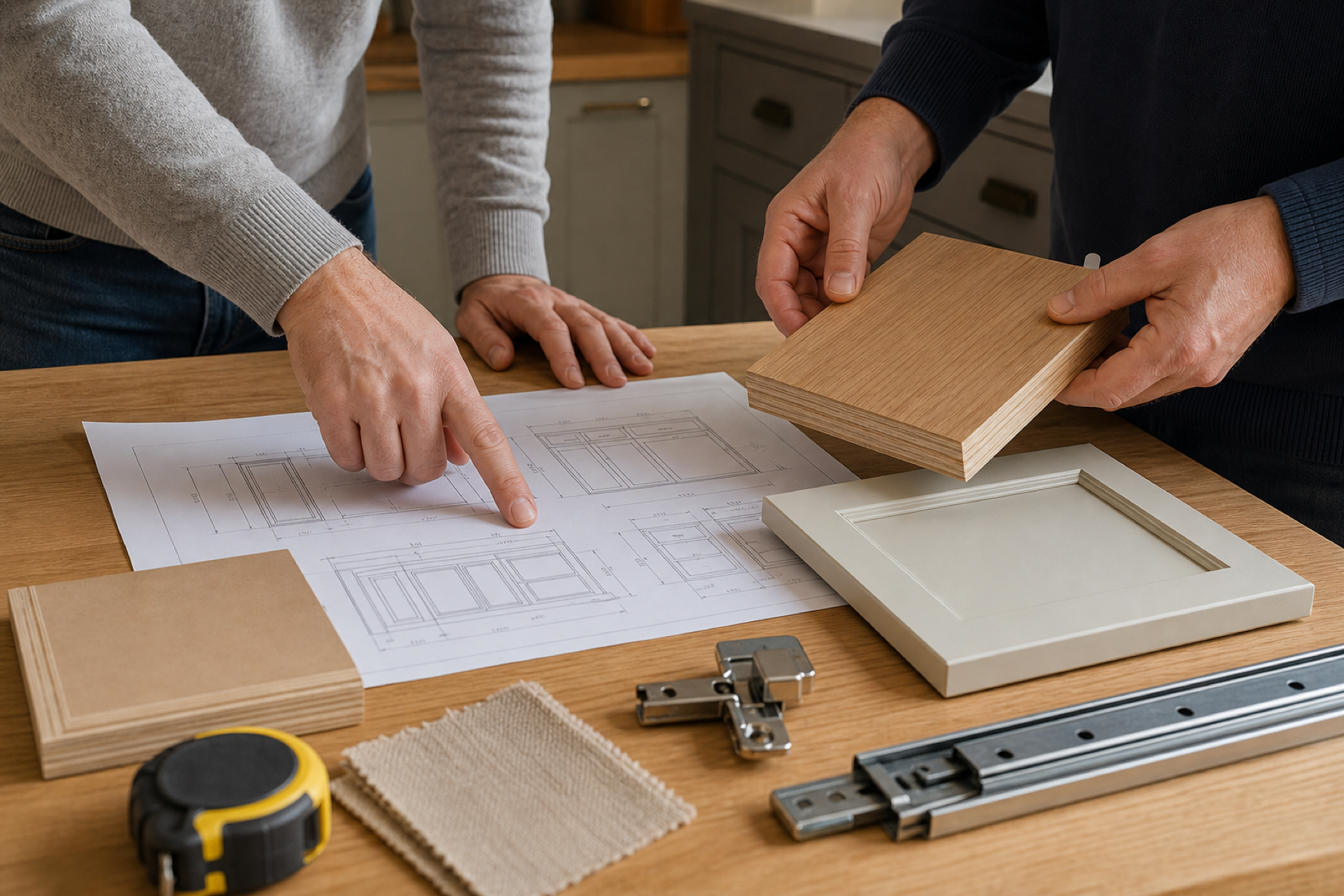
Ask what you will receive before production: plans, elevations, sections, three-dimensional views, hardware schedules, material references, or installation details. A rendering can help you understand appearance, but it may not show shelf thickness, drawer clearance, door swing, scribe space, or how two modules connect.
Useful shop drawings identify critical dimensions and interfaces. For a media wall, that includes the TV size, ventilation, wire path, outlet access, and mounting zone. For a wardrobe, it includes hanging clearances, drawer travel, lighting, and conflicts with room doors. For a banquette, it includes seat height, table relationship, upholstery thickness, and access to storage.
Ask how many revision rounds are included and how approvals are recorded. Every issued drawing should carry a date or version number. One person should have authority to approve it. Comments scattered across text messages, email, and marked screenshots easily produce conflicting instructions.
Samples should answer the risks that matter. A small color chip may confirm tone but not large-scale wood variation or sheen. A sample door can demonstrate edge quality, finish, hardware movement, and how the material looks at a realistic scale. For a large or repeated order, a prototype or first article can be worth the added time.
How Specific Are the Materials and Construction?
Do not stop at descriptions such as “solid wood,” “premium plywood,” or “high-end hardware.” Ask for recognizable specifications: wood species, panel type and thickness, veneer construction, edge treatment, finish system, hardware function, fabric, foam, stone, metal, glass, and acceptable substitutions.
Ask where each material is used. A cabinet might combine solid wood frames, veneered panels, and engineered interiors for sensible reasons. What matters is that the construction matches the intended performance and is accurately described. The Avrelahome materials overview can help frame the conversation, but your order still needs its own approved schedule.
Discuss normal variation. Natural wood and stone will not look identical across every panel. Ask how grain, color range, panel matching, and seam placement are managed. For painted finishes, ask how sheen and touch-ups are handled. For upholstery, confirm fabric direction, seam placement, cushion construction, and whether a performance treatment changes the hand or color.
Maintenance belongs in this conversation too. Find out which cleaners to avoid, whether water resistance is limited, how hardware can be adjusted, and whether replacement components can be identified later.
What Does the Price Include—and Exclude?
Ask for a line-by-line scope. Design development, drawings, samples, furniture, hardware, packing, taxes, freight, insurance, customs, final-mile delivery, installation, floor protection, debris removal, touch-ups, and corrections may be bundled or separated. Two totals cannot be compared until these responsibilities match.
The custom furniture cost guide explains the major price drivers. Before ordering, focus on what triggers a change. What happens if dimensions change after approval? How are upgraded materials priced? Is there a restocking or remaking charge? Does a delayed jobsite create storage fees?
Payment milestones should correspond to progress you can verify, such as approved drawings, completed production, passed inspection, or shipping documents. There is no universal deposit percentage that fits every project. The appropriate structure depends on order size, location, customization, and the parties’ agreement.
If the quote is in another currency, ask how long the price remains valid and who bears exchange-rate changes, bank fees, duties, and local taxes. For an overseas order, compare the landed project cost rather than the factory price alone.
When Does the Lead Time Actually Start?
Ask whether the clock begins at deposit, final measurement, drawing approval, sample approval, or receipt of materials. Those dates can be weeks apart. A statement such as “eight-week lead time” is incomplete until the starting event and included stages are defined.
Separate design and approvals, production, quality control, packing, freight, final-mile delivery, and installation. The realistic custom furniture timeline explains how these stages interact. Work backward from the date the room must be usable, not merely from the date the product should leave the factory.
Ask what can delay the schedule and how you will be notified. Common causes include incomplete site information, slow approvals, material availability, revised quantities, construction delays, freight disruption, and failed inspection. A useful schedule assigns decision dates to the buyer as well as production dates to the supplier.
How Will Delivery and Installation Work at Your Home?
For a US residence, discuss truck access, parking permits, HOA or building delivery hours, elevator reservations, stairs, narrow hallways, finished flooring, and on-site storage. Confirm whether delivery is curbside, threshold, room-of-choice, white glove, or followed by installation. Those phrases should be translated into actual tasks.
Ask how large pieces are divided for transport and assembled on site. A sectional, cabinet run, or oversized headboard may fit the room but not the access route. Identify who provides fasteners, templates, fillers, trim, mounting hardware, and special tools. If a local contractor installs imported cabinetry, the labeling and instructions become especially important.

Clarify site readiness. Who moves existing furniture? Who protects floors and walls? Must plumbing, electrical work, or appliances be disconnected first? Who removes packaging? What happens if the site is not ready on the scheduled date? Written answers avoid a crew arriving with a different understanding from the homeowner.
The Avrelahome website presents its whole-home and furniture capabilities, while the order documents should define the exact handoff for your address and installation team.
How Are Quality Problems, Damage, and Missing Parts Handled?
Ask what is inspected before packing and what evidence you will receive. Depending on the product, checks may cover dimensions, finish, color, door alignment, drawer operation, hardware, quantities, accessories, labels, and packaging. Photographs are more useful when tied to an item number and checklist than when they show only flattering angles.
Request the claim procedure before shipping. How quickly must transit damage be reported? Which photographs and packaging records are required? Who decides whether a part is repaired, replaced, or remade? Who pays for freight and local labor when responsibility is confirmed? A warranty statement without a practical claim path offers limited reassurance.
For a complex or overseas project, ask about spare finish material, touch-up kits, extra hardware, and replacement-part identification. Save the final drawings and hardware schedule after installation. These records can turn a future service issue from guesswork into a manageable task.
Red Flags to Notice Before Paying a Deposit
- A firm price and delivery date offered before anyone reviews dimensions and scope
- Refusal to identify construction, materials, hardware, or substitutions in writing
- Renderings presented as the only evidence of production capability
- Conflicting drawing versions or approvals spread across informal messages
- Claims that every late change is free and has no schedule effect
- No clear boundary for freight, installation, damage, or missing components
- Pressure to pay a large amount while essential specifications remain open
One unclear answer does not automatically disqualify a supplier. Several repeated gaps should not be ignored simply because the price is attractive. If you are comparing candidates, the manufacturer selection guide offers a broader scorecard for technical fit, documentation, quality control, and logistics.
Create a one-page comparison sheet and attach evidence to each answer. Instead of writing “good quality,” note “sample door approved on July 18” or “quote excludes final-mile delivery.” Concrete notes make the decision easier and become useful project records after the order is placed.
Frequently Asked Questions
How much deposit should I pay for custom furniture?
There is no single percentage suitable for every order. Look for a payment schedule linked to verifiable milestones and make sure the cancellation, change, and refund terms are written clearly before payment.
Can a manufacturer give a final price from inspiration photos?
Photos can support an early budget estimate, but a final price normally requires dimensions, construction, material, finish, hardware, quantity, delivery, and installation scope. Treat a photo-only quote as preliminary unless the written exclusions say otherwise.
Who should approve the shop drawings?
Designate one final approver. Keep dated or numbered drawing versions, sample approvals, and change orders together so the workshop, buyer, contractor, and installer work from the same information.
Should I ask for a physical sample?
Yes when color, texture, sheen, joinery, upholstery, or hardware movement materially affects the decision. The higher the order value or repeat quantity, the more useful a representative sample or pilot becomes.
What if my renovation is not ready for final measurements?
Use preliminary dimensions for planning, but identify which finished conditions must be complete before the order is released. Do not let an early estimate silently become the final production measurement.
Final Takeaway
The best custom order is not the one with the fewest questions. It is the one whose important questions have written, verifiable answers before production begins. When drawings, materials, price, schedule, access, and responsibility are clear, the project becomes easier to manage and far less dependent on assumptions.