
There is no single best material for every piece of custom furniture. Solid wood brings natural texture and repairability, but it moves as humidity changes. Plywood and veneered panels can create stable cabinet boxes and broad surfaces. MDF provides a smooth base for painted doors and routed details. Well-specified particleboard can serve particular cabinet applications at a controlled cost. The most dependable furniture usually assigns materials by component, load, exposure, and maintenance—not by one prestige label applied to the entire order.
That distinction matters because a material name does not guarantee good construction. A wide solid-wood door without an allowance for seasonal movement may be less stable than a well-built veneered panel. A high-grade cabinet board can still fail first at an unprotected sink cutout or poorly bonded edge. Ask where a material is used, what it has to withstand, and how that detail can be maintained or replaced.

Begin With the Way the Furniture Will Be Used
List the conditions the furniture will face: span and load, opening cycles, water vapor, direct sun, heating or air-conditioning vents, children or pets, cleaning products, moves, and your expectations for future repair. A dining top, bathroom vanity door, bookcase shelf, and upholstered headboard do not share the same risks, so they should not share the same priorities.
US homes also vary by region and building type. Winter heating can create very dry interiors. Coastal and southern climates may stay humid for long periods. Strong western sun can warm and fade exposed surfaces. Stable indoor humidity helps wood furniture, but the design should still accommodate normal material behavior. “Wood moves” is not an excuse for careless joinery, and no wood-based product should be expected to tolerate an unnoticed leak indefinitely.
If the scope itself is still unclear, start with what custom furniture means in practice. Select materials after dimensions, functions, and use conditions are defined. Otherwise, an attractive sample can distract from the structural question it is supposed to answer.
Solid Wood: Strong Character, With Movement to Manage
Solid wood is useful for table legs, chair frames, arms, door frames, edge lippings, pulls, and other parts where touch, shaped detail, or future refinishing matters. It can often be sanded and recoated, and no printed pattern fully duplicates its natural variation. It also changes dimension as its moisture content changes. Species, cut, grain direction, board width, and construction all influence that movement.
For that reason, “all solid wood” does not automatically mean more stable. Wide tops and doors need appropriate board selection, joinery, support, and room to move across the grain. A connector that rigidly traps a broad wood panel can contribute to checking or distortion. Ask how the lumber is dried, matched, joined, supported, and fastened. Those answers reveal more than the species name alone.
Natural color, knots, and grain also vary. An order should use samples and written criteria to define the intended visual direction and an acceptable range rather than promise identical boards. When a wall of cabinet doors needs tight visual continuity, sequenced veneer or another controlled surface may produce a more coherent result than individual solid boards.
Plywood and Veneered Panels: Stability for Larger Surfaces
Furniture-grade plywood uses layers with alternating grain direction, making it a common choice for cabinet cases, shelves, and structures that need useful fastener holding. Plywood is not one uniform specification. Ply count, core gaps, face grade, thickness, bonding quality, and edge treatment all affect the outcome. A proposal that says only “plywood” still leaves important questions unanswered.
Veneer places a thin layer of real wood over a more stable substrate. It can work well on doors, case sides, tops, and large built-ins where broad solid lumber would be harder to control. A good veneer specification addresses grain direction, leaf matching, continuity across doors, edge treatment, substrate, and clear coat. Light surface damage may be repairable, but veneer normally offers less sanding depth than solid wood.
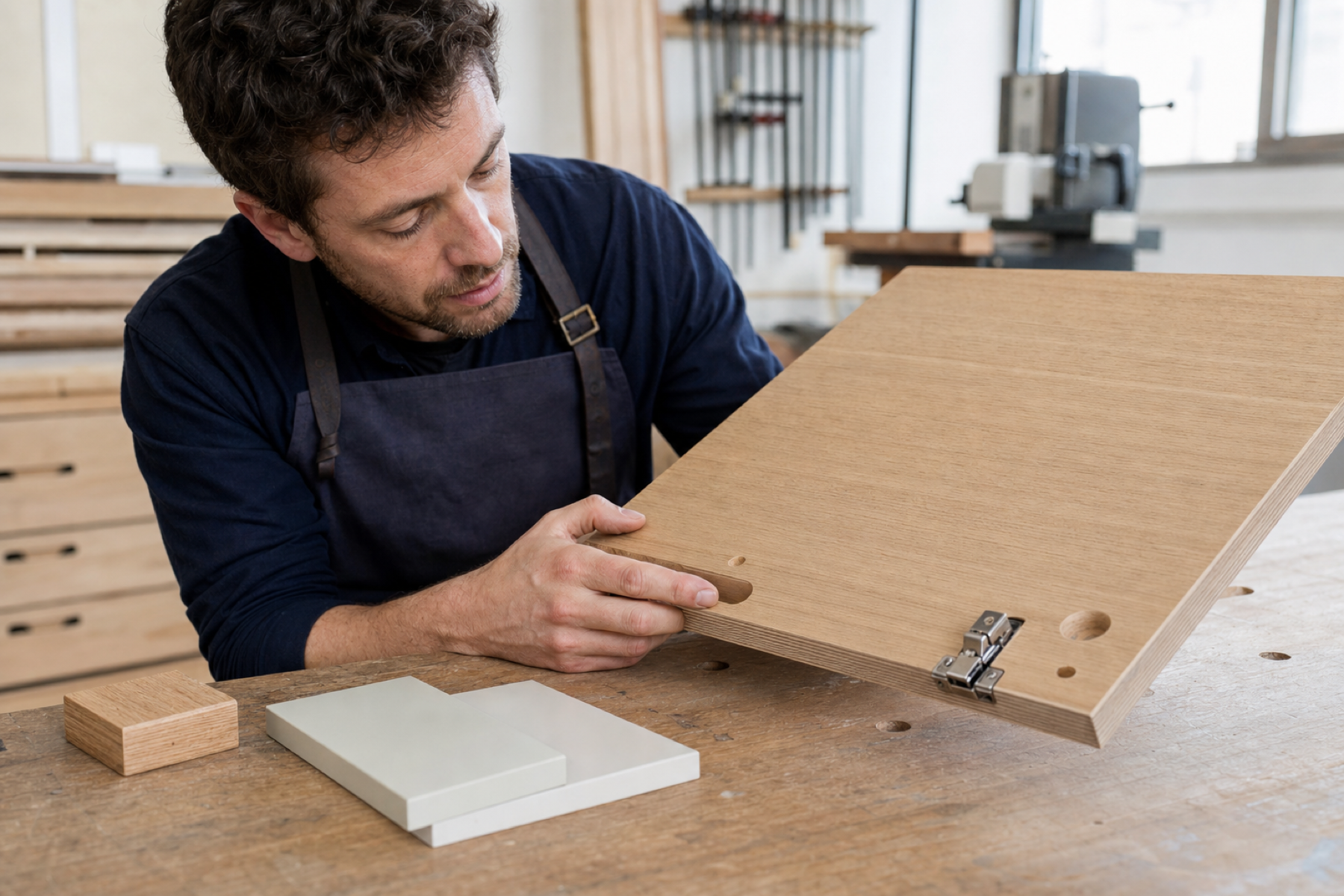
Engineered panels can improve stability and use visual-grade wood efficiently. Their weak points tend to hide in incomplete specifications: an unbalanced back face, an exposed edge, a long shelf without support, or a connector expected to survive repeated disassembly. Avrelahome’s materials and finishes overview can help organize the categories, but a production specification should name the substrate, thickness, face, back, and edge treatment together.
MDF and Particleboard Are Not Interchangeable Shortcuts
MDF has a uniform surface and can be useful for smooth painted finishes, routed profiles, and some door styles. Its edges and faces machine consistently, but the material is dense and comparatively heavy. Fasteners at an edge or in furniture expected to be taken apart repeatedly need appropriate engineering. Water exposure can cause significant swelling, so sink areas, bathroom floors, and other leak-prone locations require protection and access for early detection.
Particleboard is widely used in cabinet cases and modular furniture. It can provide a flat substrate and controlled cost, but density, thickness, surface lamination, edge banding, and connector design vary considerably. Treating every particleboard as poor quality is too crude. So is accepting vague descriptions such as “eco board” or “high-density board” without knowing what product and application they describe.
For either material, ask for the actual thickness and component use. Check shelf spans, edge-band material and thickness, sink and floor details, hinge fixing, connector type, and whether the furniture is expected to move or be reassembled. Request material documentation relevant to the product and project. Missing information should prompt a question; marketing claims such as “zero emission” should never be accepted without applicable evidence.
Veneer, Laminate, Paint, or Clear Coat?
Veneer preserves natural grain and warmth. High-pressure laminate and other durable decorative surfaces can be easy to clean and visually consistent. Painted finishes create a controlled color and range of sheens, though impact repairs at corners may be difficult to match. Clear coats emphasize the wood beneath them while determining stain resistance, feel, and maintenance.
Do not select from one tiny sample under showroom lighting. Ask how the finish looks across a large area, how grain repeats, where seams and edges fall, and how it responds in touch and cleaning zones. White and dark high-gloss faces can show fingerprints; a super-matte surface is not automatically compatible with every cleaner. Get written care guidance and test an inconspicuous area before using a new product.
Clarify whether a sample is only a color reference, an appearance-control sample, or a complete finish system on the specified substrate. A paper color chip cannot demonstrate veneer figure, coating build, edge quality, or tactile feel. Keep the approved sample and its number for a whole-home project. That improves later identification, although natural materials and separate production batches can still show reasonable variation.
The customization model matters too. A size-adjusted product may offer only standard finishes, while a deeper development process may coordinate grain, edges, and custom colors. The comparison of custom, bespoke, and made-to-order furniture explains why the promised level of change should be verified instead of assumed.
Complementary Materials Complete the System
Most custom furniture is not made from wood alone. Metal may form bases, reinforcements, trim, and hardware. Specify its finish, visible weld standard, edge safety, and connection to wood components. Glass should suit its size, support, edge condition, and risk of impact; confirm how a damaged panel could be removed and replaced.
Natural stone offers distinctive pattern, but it is heavy and may stain or display natural fissures and color variation. Engineered quartz and sintered surfaces have their own tradeoffs in appearance, heat exposure, stain resistance, edge fabrication, and repair. Every top needs suitable support. Cutouts and long-distance shipping add risk. Decide whether stone is installed at the factory, fitted at the home, or supplied by a local countertop fabricator.
For upholstery, evaluate the cover, foam and fill, suspension, frame, seams, and replaceability as one system. “Genuine leather” or “high-density foam” does not fully describe performance. Ask where the material will be used, what seat feel is intended, how it is cleaned, whether patterns are matched, and whether cushion or cover components can be serviced.
Different Rooms Need Different Priorities
In a kitchen, examine sink and dishwasher exposure, steam, heat, trash pullouts, and heavily used drawers. A stable case, protected edges, dependable hardware, and a cleanable surface often matter more than upgrading every component to solid wood. In a bathroom, keep board edges away from standing water, preserve plumbing access, and allow the room to dry. No cabinet material should conceal a continuing leak.
Living-room furniture emphasizes visual continuity, cable routing, equipment ventilation, shelf span, and sunlight. Bedroom wardrobes need stable doors, sensible interior ventilation, adequate hanging and shelf support, and smooth hardware. A home office adds desktop abrasion, monitor loads, heat from equipment, wire paths, and printer vibration.

Rentals and hospitality spaces may receive more frequent cleaning and less delicate care. Durable faces, replaceable components, and identifiable hardware can be more valuable than a difficult-to-repair decorative treatment. The Avrelahome home page shows its product and project categories by room, but each material schedule should still respond to the real users and maintenance available at that site.
Samples and Specifications Make Quotes Comparable
Build a component-by-component schedule instead of accepting an “all wood package” or “premium board” description. At minimum, list the component, substrate, thickness, face finish, back finish, edge, hardware, color or sample number, and notes. Cabinet sides, doors, backs, shelves, drawers, tops, and exposed end panels should not be collapsed into one line.
Ask competing suppliers to price the same material boundary. A veneered plywood case and a laminated particleboard case are different specifications, so their totals cannot be compared without adjustment. The manufacturer evaluation guide covers drawings, samples, and process checks. For materials, also ask the supplier to explain why each combination suits your span, environment, and opening frequency.
View physical samples under the project’s real light. Warm lamps, north-facing daylight, and intense afternoon sun can shift color perception. Place samples beside flooring, wall paint, counters, and existing furniture. Record which physical sample was approved; a phone photo is a poor color-control standard.
Before production, cross-check the material schedule against the drawings. A rendering may show wood grain without naming the substrate. A sample number may be approved while an old code remains on the door list. The final version review is where material selection becomes a production instruction.
Where the Budget Should Go First
With a limited budget, protect structure and failure-prone details first: sensible shelf spans, stable doors, suitable connectors, frequently used drawer slides and hinges, edges near water, and packaging strong enough for the delivery route. Next, prioritize the surfaces people see and touch every day, including tops, fronts, arms, and primary hardware. Evaluate expensive upgrades that are mainly decorative after those needs are covered.
That does not mean hidden parts can be ignored. A cabinet case with inadequate support or poor anchoring will still limit the furniture’s life. The principle is to spend according to consequence rather than apply one costly material to every component. The custom furniture cost guide provides a broader view of the tradeoffs among material, complexity, and service scope.
Avrelahome’s custom furniture service page can help organize the product categories in a brief. State budget priorities when requesting a proposal. “Highest quality” is not measurable, but “protect the kitchen drawer hardware and exposed work surfaces before upgrading decorative interior panels” gives a supplier something useful to price.
Risk Checks Before Approval
Request documents that correspond to the actual material in the order, not an unrelated sample or general promise. Check the product name, manufacturer, date, and scope. If a project has building-code, indoor-air, flammability, or commercial occupancy requirements, have the local designer, contractor, or authority identify the applicable standard. A furniture sales description should not be treated as a code determination.
Ask about cleaning limits, sun-related change, and finish touch-up. Define how natural variation will be handled and how replacement pieces will be matched to the sample and production revision. Check the shipping weight and lifting plan for large tops and cabinet modules. Ask whether solid-wood or veneered parts require a controlled period in the building before final fitting.
For an overseas order, consider sending labeled spare hardware, touch-up material when transport rules allow it, and a small number of project-specific wear parts with the main shipment. Confirm that the packing list identifies them. This is often easier than reconstructing an unnamed component years later, but it should be proportionate to the project rather than used to cover unclear specifications.
Frequently Asked Questions
Is solid wood always better than engineered board for custom furniture?
No. Solid wood is valuable for tactile, shaped, and repairable parts, but it moves with humidity. Engineered panels may be more appropriate for broad cabinet cases and stable doors. Judge the component, span, environment, joinery, and finish—not the label alone.
Is plywood better than MDF?
They serve different purposes. Plywood is often chosen for structural cabinet parts, useful fastener holding, and lower weight. MDF offers a uniform surface for smooth paint and routed doors. Grade, thickness, edge protection, and moisture detailing matter as much as the category.
Is wood veneer durable enough for quality furniture?
Yes, when the substrate, bonding, edges, and protective finish are suitable. Veneer provides real wood grain with dimensional stability, but it generally has less depth available for aggressive sanding than a solid-wood component.
Should kitchens and bathrooms avoid all wood-based panels?
Not necessarily. Choose an appropriate substrate and surface, protect edges and cutouts, avoid standing water, and keep sinks and plumbing accessible for inspection. No wood-based material should be treated as a waterproof solution to an ongoing leak.
How can I evaluate an “eco-friendly board” claim?
Ask for the manufacturer, exact product, and test or compliance documents that correspond to the order. Check the named standard, date, and scope. Have a qualified local professional identify any project-specific regulatory requirement.
Which furniture finish is easiest to maintain?
Many durable laminate surfaces are straightforward to clean, but performance depends on the product, texture, edges, and cleaner. Clear coats, paint, veneer, oil, and wax each have different care needs. Test the approved sample and keep the supplier’s maintenance instructions.
Final Takeaway
The most useful material question is not “Which option is the most premium?” It is “Why is this material right for this component?” Structure, surface, edge, hardware, environment, and maintenance work together. A mixed-material specification is not a compromise; it can be more stable, serviceable, and budget-conscious than one material forced into every role.
List the critical components, approve physical samples, and reconcile the final drawings with the material schedule before production. Then you are buying a complete system that can be manufactured, transported, installed, and lived with—not just an attractive material name.