
Importing custom furniture from China is not simply a matter of finding a lower factory price. It is a project chain that runs through product definition, compliance, production, inspection, international freight, customs clearance, receiving, and installation. A weak handoff at any point can erase the savings created at another.
The process can make sense for a coordinated residential package, retail collection, hotel, development, or multi-unit project. It is less forgiving when dimensions are still changing, the quantity is very small, or the delivery date has no contingency. The safest approach is to assign every important decision to a named party before a deposit turns design questions into production problems.

First, Decide Whether Importing Fits the Project
International sourcing works best when the project has enough volume or design value to absorb development, samples, inspections, freight, and receiving. A guestroom package repeated across many rooms, a coordinated model-home collection, or casegoods for several apartment units may justify that fixed work. One urgent sideboard often does not.
Compare the cost of furniture installed and ready to use, not only the unit price. Include your team’s design and approval time, sample shipping, quality checks, ocean or air freight, duties, broker and destination charges, storage, final-mile delivery, assembly, installation, and a realistic allowance for spares or corrections.
Local or mixed sourcing may be more resilient when the site is unfinished or field conditions are irregular. One hybrid is to import repeatable furniture and use qualified local parties for field-sensitive work. The right boundary depends on what can be frozen before production.
Build a Specification Package Before Requesting Quotes
A supplier cannot price “good quality” consistently. Prepare quantities, overall and internal dimensions, use conditions, substrate, visible finish, hardware, upholstery construction, performance needs, packaging, assembly, and installation responsibility.
Separate nonnegotiable requirements from details open to engineering and areas where you want a recommendation. If a cabinet must fit specified equipment, identify the clear opening, plug clearance, cable route, and ventilation. If a sofa is intended for a rental property, state the cleaning, durability, seat-feel, and replacement considerations rather than relying on a reference photograph.
Add U.S. site information early. Record destination ZIP code, residence or project type, doorway and elevator constraints, loading conditions, room or unit labels, and delivery method. A 96-inch media cabinet that fits the final wall may still need to ship in modules to turn through an apartment corridor. Module joints and carton size are design decisions, not last-mile surprises.
If the product brief is still evolving, use the comparison of OEM and ODM furniture manufacturing to decide which details should be developed from scratch and which can begin with an existing platform.
Assign U.S. Import and Compliance Responsibilities Early
Before paying a deposit, identify the importer of record, customs broker, freight forwarder, product-compliance owner, insurer, and U.S. receiver. State who will confirm classification, value, country-of-origin marking, entry data, bond, estimated duties, and agency documentation. A broker can file an entry, but the commercial parties still need to provide accurate, complete product information.
Do not accept an importer structure you do not understand because a quote says “door to door.” Ask which entity appears as importer, supplies the bond, pays duties and destination charges, and holds records. Document the relationships among seller, exporter, importer, and consignee.
Classification depends on what the furniture is, what it is made from, and sometimes how it functions. Give the broker drawings, photographs, material breakdowns, intended use, and product value. Do not rely on a generic code copied from a prior shipment. Duties and additional trade measures can change, so obtain a current estimate for the actual product instead of treating an online percentage as universal.
Product requirements also vary. Finished goods containing regulated hardwood plywood, medium-density fiberboard, or particleboard may be subject to EPA TSCA Title VI formaldehyde requirements, including applicable certification, labeling, recordkeeping, and import information. Upholstered furniture, children’s furniture, products with electrical components, and contract installations may raise different federal, state, local, or customer standards. Name each applicable requirement and its evidence; a broad statement that the product “meets U.S. standards” is too vague to approve.
Regulated solid-wood pallets, crates, and other wood packaging used to support or protect cargo entering the United States generally need applicable ISPM 15 treatment and marking. Confirm packaging material and marks before loading. Compliant shipping wood does not prove that the furniture itself satisfies product requirements; these are separate checks.
This is operational guidance, not customs or legal advice. A licensed U.S. customs broker and appropriate product or legal specialist should evaluate the specific shipment, especially when classification, origin, regulated materials, children’s use, electrical parts, or high values are involved.
Find and Verify the Right Furniture Manufacturer
Look for evidence relevant to the actual assignment: similar dimensions, materials, construction, quantity, customization depth, and destination. A factory experienced in upholstered seating may not be the right choice for wall-sized casegoods, even if both portfolios look polished.
Verify the legal company name, address, contact details, contract party, and payment beneficiary. Ask the supplier to explain its process from brief through engineering drawings, samples, material control, production, inspection, packaging, and corrective action. The guide to choosing a custom furniture manufacturer provides a deeper capability checklist.
For a meaningful order, consider a live video review, factory audit, paid prototype, or smaller first release. Ask how drawing revisions are controlled and components labeled. A useful manufacturer identifies missing information; an immediate promise that everything is possible is not an engineered answer.
Communication discipline matters across time zones. Use one decision log with the item, version, owner, deadline, and outcome. Consolidate comments rather than sending contradictory notes from several stakeholders. Confirm material names, dimensions, and approvals in a shared written record.
Compare Quotes Using One Scope and One Delivery Point
Every supplier should quote the same quantity, drawing version, material definition, hardware, finish, upholstery, packaging, sample scope, inspection expectation, and delivery point. List optional upgrades and substitutions separately. If a selection is not final, use an explicit allowance.
Write the Incoterm with the named place and the agreed rule version. The term helps allocate specified transport costs and risk, but it does not define product quality, payment milestones, testing responsibility, intellectual property, installation, or every destination fee.
An EXW factory price cannot be compared directly with a quote that includes main freight or destination service. Ask a forwarder and broker to price the same origin, destination, package dimensions, weight, commodity description, and schedule. Clarify whether the destination figure includes port or terminal handling, customs entry, examination risk, chassis or equipment, appointment, residential access, liftgate, inside delivery, and storage.
The pre-order custom furniture checklist can help uncover exclusions before they become change orders.
Calculate Landed Cost, Not Just Factory Price
Build landed cost by shipment and installed unit. Include product, samples, origin handling, main freight, insurance, duties and applicable fees, brokerage, terminal charges, possible examination, receiving, storage, final mile, unpacking, installation, and spare parts.
Use final carton dimensions rather than early product estimates. Upholstered furniture and assembled cabinets can be expensive to move because volume, not only weight, controls the shipment. Flat packing or modular construction may improve loading, but only if assembly quality, instructions, hardware, and site labor remain acceptable.
Run at least three scenarios: expected, delayed, and disrupted. A missed free-time window, site not ready for delivery, customs examination, or late document can produce charges quickly. Contingency is not a prediction that something will fail; it prevents a manageable delay from making the entire sourcing decision uneconomic.
Currency and quote validity also matter. State the currency, validity period, deposit date, and which material or freight assumptions may be revised. Do not hide uncertain costs inside a falsely precise total.
Approve Drawings, Materials, and a Representative Sample
Renderings communicate appearance; production drawings control fabrication. Review overall and internal dimensions, door and drawer swings, shelf spacing, equipment openings, clearances, grain direction, veneer or upholstery seams, hardware locations, module joints, fastening points, and carton breakdown.
Return one consolidated, dated response. Mark the drawing approved, rejected, or approved only with listed corrections. After a revision, confirm the new sheet rather than assuming the comments were transferred. Changes to dimensions, materials, finish, hardware, quantity, or delivery should produce a written cost and schedule effect.
Use physical finish and material samples when color, texture, sheen, or touch matters. View them in the intended room lighting. Natural wood, stone, and leather require an acceptable range because a small sample cannot guarantee identical pattern or tone over an order.
A representative sample should be checked for dimensions, comfort, stability, joints, surface quality, hardware, assembly, labeling, and packaging. Connect the approved sample to a drawing and specification version. A sample is not useful as a control if no one records what was accepted or changed.

Put Quality Control at Measurable Gates
Choose inspection points where correction is still practical. Depending on the product, these may include material verification, frame or cabinet assembly, pre-finish review, upholstery preparation, hardware installation, final function testing, and packaging.
For larger orders or a new supplier, consider an independent pre-shipment inspection. The inspection brief should reference the approved documents, quantities, sampling approach, critical dimensions, finish range, operation checks, packaging, labels, and pass/fail rules. “Looks good” is not an acceptance standard.
Leave time for correction and reinspection. If inspection occurs on the day cargo must reach a consolidation warehouse, the buyer may face a false choice between shipping known defects and missing the booking. Put the inspection window into the production calendar.
The Avrelahome furniture quality checklist illustrates how product, finish, function, packaging, and documentation can be reviewed as separate evidence rather than one general impression.
Write the Order and Payment Terms Clearly
The purchase documents should identify both parties, products, quantities, referenced drawings and samples, packaging, price and currency, Incoterm and named place, milestones, change procedure, inspection rights, spare parts, claim timing, delay handling, and dispute terms.
Payment milestones should correspond to verifiable progress and leave a reasonable opportunity to address problems before final release. Pay the verified contract party through a traceable method. Independently confirm any change in beneficiary or bank account through a previously established channel; do not rely only on a reply inside the same email thread.
State who owns design files, production drawings, tooling, and approved samples, and who may use them. For a high-value or commercially important program, appropriate legal review can cost much less than resolving ambiguous ownership or remedy terms after production.
Plan Freight, Customs Clearance, and U.S. Receiving
Before completion, coordinate the commercial invoice, packing list, bill of lading instructions, country-of-origin marks, required product or agency documents, insurance, and entry data. Give the broker enough time to review descriptions and supporting information before arrival.
Confirm full-container or less-than-container service using the final packing list. A smaller shipment is not automatically simpler; consolidation can add handling points, minimum charges, deconsolidation, and warehouse coordination. A full container may reduce handling but requires the receiving site to unload safely within the appointment and equipment window.
The U.S. receiver needs the arrival range, equipment type, package count, unloading plan, storage map, and installation sequence. Hotels and multi-unit projects should label cartons by room, unit, floor, or phase before shipping. Sorting at a U.S. jobsite wastes skilled time.
For buyers organizing the full remote approval path, the guide to ordering custom furniture online shows how to control drawings, samples, payments, and receiving across distance.
Inspect Arrival and Manage Claims
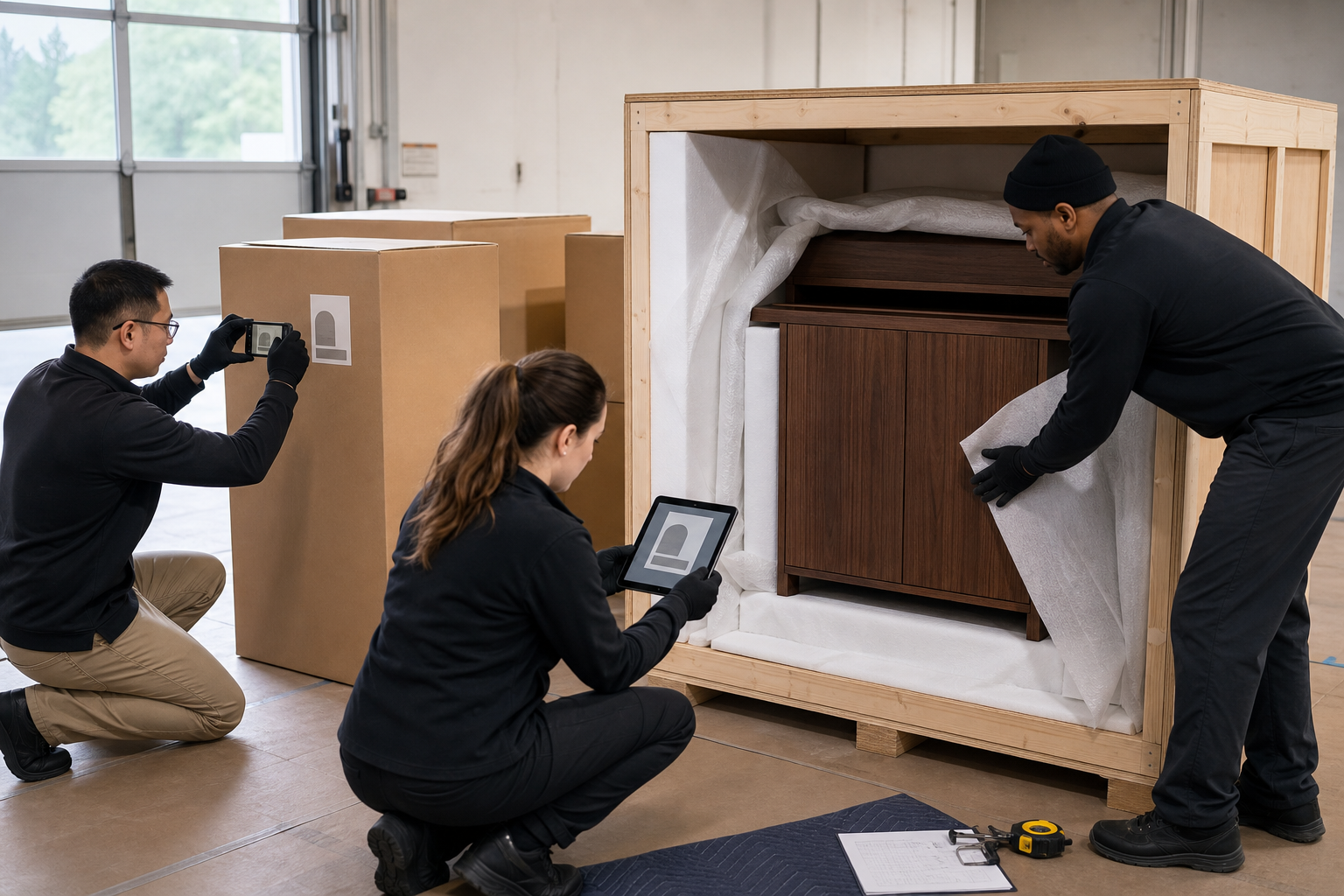
At delivery, confirm the container seal where applicable, package count, and visible condition before unloading. Photograph the container or truck, pallets, labels, punctures, crushed corners, water marks, and shifted cargo. Follow the carrier and insurer process for noting exceptions.
After unpacking, verify item identity, orientation, quantity, dimensions, finish, hardware, and basic operation. Use the room or unit labeling plan to move each package once. Keep packaging and do not make improvised repairs until the seller, carrier, or insurer has confirmed the claim process.
Connect arrival evidence to the pre-shipment inspection and loading record. When package numbers, loading photographs, and destination photographs align, it is easier to distinguish a manufacturing issue from packaging failure or transit damage.
Red Flags That Should Stop the Shipment
Pause if a supplier gives a final price without dimensions or quantity, refuses production drawings or a representative sample, cannot define materials or packaging, requests payment to an unexplained third party, or offers a vague door-delivered arrangement without identifying the importer and customs responsibilities.
Also pause if several files show different dimensions, the sample differs from the approved specification, required documents cannot be tied to the actual product, wood packaging marks are missing, or a failed inspection has no documented corrective action. These may be solvable, but a vessel booking should not force acceptance.
For a coordinated import program, Avrelahome can help define the product package, samples, production checkpoints, packing logic, and project handoffs. Its custom furniture manufacturing scope provides a starting point for residential, hospitality, and project categories. U.S. import, legal, tax, and product-compliance roles should still be assigned to the appropriate qualified parties for the actual shipment.
Frequently Asked Questions
Is importing custom furniture from China always cheaper?
No. Quantity, customization, package volume, duties, inspections, freight, storage, final mile, and installation all affect the result. Compare landed and installed cost at the required date, not only factory price.
Do I need a customs broker?
A licensed U.S. customs broker is often valuable for a commercial furniture shipment, classification, entry preparation, and agency coordination. Using a broker does not eliminate the need to provide accurate product information or understand the importer structure.
How do I determine the duty rate?
Duty depends on correct classification, value, origin, and current applicable measures. Give a broker product photographs, materials, construction, function, and value. Do not assume every type of furniture has the same rate.
Should I use a full container or a shared shipment?
It depends on volume, weight, schedule, routing, handling, and destination charges. Compare options using the final packing list and include consolidation, deconsolidation, storage, and final-mile costs.
Can I skip the sample and go directly to production?
That may be reasonable for a stable repeat order tied to an approved sample and strong records. For a new design, comfort-sensitive seating, unfamiliar material, or high-value order, skipping a representative sample converts a controllable development risk into a batch risk.
Final Takeaway
A successful furniture import is not built on one factory promising to handle everything. It is built by dividing product, customs, compliance, quality, transport, and installation responsibilities among parties equipped to own them.
Define the specification and landed-cost model before choosing a supplier. Confirm the importer and product requirements before paying a deposit. Approve drawings and a representative sample before releasing volume production. This sequence matters more than any single price, trade term, or sailing date.