
OEM and ODM are not two quality grades. They are different ways to divide design work, decision rights, development cost, and production risk between a furniture buyer and a manufacturer. The right model depends less on the label and more on what your project already knows.
For a U.S. retailer, hospitality group, developer, or multi-unit furnishing program, the useful question is not, “Which acronym is better?” It is, “Who should define the product, which details must be distinctive, and which uncertainties must be resolved before production?” Answer those questions first, and the sourcing model becomes much easier to choose.

What OEM and ODM Mean in Furniture Manufacturing
In an OEM arrangement, the buyer provides or controls the product design. The manufacturer turns approved drawings, specifications, materials, hardware, finishes, and packaging requirements into a manufacturable product. The buyer normally has more control over appearance, dimensions, function, and brand differentiation, but also carries more responsibility for timely decisions and accurate documentation.
In an ODM arrangement, the manufacturer begins with a product platform or design it has already developed. The buyer adapts that platform through selected dimensions, finishes, upholstery, colors, hardware, features, or packaging. This can shorten development, but it does not mean the buyer has nothing to approve. It also does not automatically mean that an existing product is suitable for a particular U.S. market, building type, or delivery channel.
The line is not always sharp. A factory might call a finish change “OEM,” while a buyer uses the same term only for an entirely original design. Before comparing proposals, define what will actually change and who owns each decision. The Avrelahome OEM and ODM furniture overview is a useful starting point for mapping those responsibilities.
The Short Answer: Choose by Decision Ownership
Choose OEM when you already have a developed concept, a clear customer experience, and product details that must remain unique. It is often the better path when a specific silhouette, storage function, dimension system, or brand language is central to the business case.
Choose ODM when speed and reduced front-end development are more important than owning every detail. It can work well when a proven frame, cabinet platform, or construction method is close to the intended product and the remaining changes are controlled.
There is a second test: how stable is demand? A new retail concept that is still testing seat depth, price, package size, and customer preferences may absorb unnecessary cost if it jumps directly into a fully original line. A hotel lobby intended to create a signature experience may lose the point of the design if it only changes the color of a standard collection.
My practical rule is to spend original-development effort only where customers, operators, or installers can recognize the difference. Keep proven construction where it serves the brief; customize the dimensions, touchpoints, functions, and visible decisions that create actual value.
OEM vs ODM Furniture: Side-by-Side Comparison
| Decision area | OEM | ODM |
|---|---|---|
| Starting point | Buyer-controlled concept or specification | Manufacturer-developed platform |
| Design control | Usually higher | Limited to agreed options and modifications |
| Development work | More drawings, engineering, sampling, and approvals | Less when the platform already fits the brief |
| Differentiation | Potentially high | Moderate unless meaningful changes are negotiated |
| Speed | Usually slower before production | Usually faster if structural changes stay limited |
| Best fit | Stable, distinctive, well-documented requirements | Speed-focused projects with flexible requirements |
Do not assume OEM always has a higher minimum order quantity, or that ODM is always cheaper. Minimums may be driven by material purchasing, dedicated tooling, production changeover, packaging, and freight efficiency. Total project cost also includes design, samples, inspections, packaging, shipping, destination handling, storage, and installation. A lower factory price can still create a higher delivered cost.
Start With the Project Brief, Not the Label
A useful brief states the product type, user, quantity, dimensions, performance needs, target price, desired delivery date, packaging method, and U.S. destination. Separate nonnegotiable requirements, details open to optimization, and questions for the manufacturer.
For a residential product, document the American living context. A dining chair needs to work with the intended table height and typical clearances. A bed should coordinate with the specified U.S. mattress size. A media cabinet needs usable internal dimensions, cable paths, and ventilation, not just an attractive front elevation. If the piece ships to homes, consider how the carton will pass through a 36-inch entry door, an apartment corridor, a stair turn, or an elevator.
A 96-inch-wide cabinet, for example, should not be assumed to travel as one assembled object. The brief should identify module sizes, visible joints, connection methods, wall anchoring, and who completes installation. The guide to questions to ask before ordering custom furniture can help expose missing responsibilities before a quote becomes an order.
The brief should identify where the product will be sold or installed. Retail cartons, residential delivery, hotel installation, and staged unit turnover require different packaging, labeling, and receiving plans.
When OEM Is the Better Fit
OEM is generally the stronger option when the design itself carries commercial value. A retail brand may need a recognizable profile and a consistent family of dimensions. A hospitality project may need guestroom casegoods that align with a designer’s elevations, power locations, and operational needs. A residential developer may need storage that fits a repeatable floor plan while accommodating appliance, baseboard, and wall conditions.
It also makes sense when a product must solve a function that existing platforms do not address. That might be a banquette built around a precise aisle, a media unit designed for specified equipment, or a compact desk with a defined power-management route.
The tradeoff is approval work. Someone on the buyer’s side must be able to review engineering drawings, sample dimensions, materials, color, hardware, packaging, and later changes. If approvals arrive as scattered comments from several people, OEM can become slow and expensive. Centralize decisions, number every drawing revision, and state which version is approved for production.
If your team is still evaluating production partners, this guide to choosing a custom furniture manufacturer explains why process evidence matters as much as portfolio images.
When ODM Is the Better Fit
ODM can suit a retailer adding a category quickly, a time-sensitive model home, or a project testing demand before funding an original program. Existing engineering can reduce structural decisions and samples.
The advantage disappears when modifications reach into every part of the platform. Changing a chair’s overall width, seat pitch, foam build, leg geometry, upholstery method, and carton size may amount to a new product even if the original frame inspired it. At that point, the quote and timeline should reflect real engineering rather than an ODM label.
Review the platform for the intended U.S. customer instead of assuming it is universal. Check seat height and depth, table clearance, mattress dimensions, storage needs, hardware operation, assembly instructions, and packaging. A product proven in one market or sales channel may still need adjustment for another.
ODM also needs a clear differentiation strategy. A new finish and private-label carton may be enough for a value-focused assortment. For a design-led brand, it may be too easy for customers to find a visually similar item elsewhere. Decide how much exclusivity the business case actually needs, then put any territory, channel, or product restrictions in writing.

Why a Hybrid OEM-ODM Model Often Works Best
Many sensible projects do not fit a pure category. A buyer might retain a manufacturer’s proven cabinet box, drawer system, or chair frame while developing different proportions, fronts, bases, upholstery, finishes, storage configurations, and packaging.
This hybrid route directs time and budget toward the details people notice and use. A developer’s bedroom package might use an established drawer construction but adapt widths to the floor plan, change pulls for the design language, and divide cartons by unit. A hotel might keep a proven lounge-chair frame while specifying a different seat feel, textile, exposed wood finish, and fire-performance brief appropriate to the project.
Write the boundary carefully. Identify the manufacturer’s existing platform, the project-specific additions, and the details the manufacturer may substitute or optimize. Also state what happens if a material, finish, or component becomes unavailable. The word “custom” does not define ownership or approval authority.
Compare Quotes on the Same Scope
A comparable quote identifies quantity, exterior and critical internal dimensions, substrate, exposed finish, hardware, upholstery build, packaging, freight scope, installation, and exclusions. Optional changes should have separate prices. If a finish or fabric has not been selected, use a stated allowance rather than hiding the uncertainty.
Clarify sample cost, development fee, tooling, testing, inspection, replacement parts, and packaging development. Ask whether a sample charge is credited later and under what conditions. If the order includes several furniture types, request line items so one attractive total does not conceal an expensive or underspecified component.
Review materials at the construction level. “Walnut finish” might describe solid walnut, walnut veneer over plywood or engineered board, a printed surface, or simply a walnut-colored stain on another species. The guide to materials for custom furniture provides a framework for separating appearance from substrate and performance.
The quote should state where delivery responsibility ends. Ex-factory product pricing, port delivery, curbside service, room-of-choice delivery, and installed furniture are not comparable scopes. Choose the commercial structure only after the physical path is understood.
Protect Design, Drawings, Samples, and Tooling
Do not assume the OEM label automatically gives the buyer ownership of every design file. The contract should identify who owns or may use the concept, engineering drawings, renderings, approved samples, dedicated tooling, molds, and packaging artwork. It should also describe any exclusivity by product, territory, customer, or time period.
Keep a record of what each party contributed. If a manufacturer modifies the engineering to make a buyer’s concept stable or manufacturable, the relationship between the original design and the production drawing should be explicit. For valuable or legally sensitive designs, use appropriate professional advice rather than relying on informal messages.
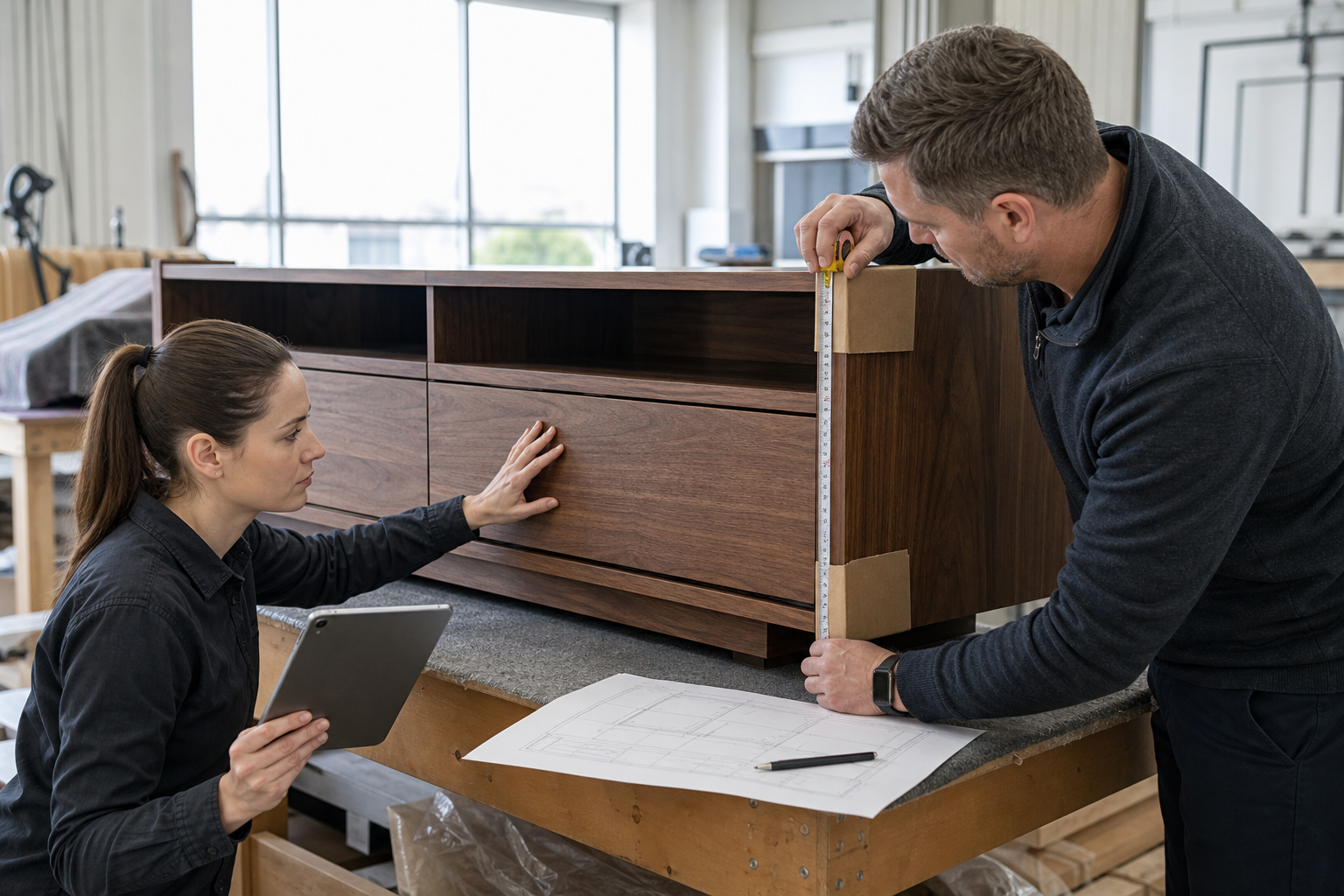
An approved sample is an operational control, not a decorative keepsake. Check dimensions, comfort, stability, surface quality, hardware, assembly, labels, and packaging. Record every approved deviation and connect the physical sample to a drawing and specification version. Natural wood, stone, and leather require an approved range, because one small sample cannot promise identical grain or tone across a full order.
Plan Quality Control Around Approval Gates
Build quality control into the sequence: brief freeze, engineering drawing approval, material and finish approval, first article or sample approval, packaging confirmation, in-process inspection, and pre-shipment inspection. Each gate needs an owner, a version, an acceptance standard, and a recorded result.
More photos do not necessarily create more control. Ask for evidence when a problem can still be corrected. A joint can be reviewed before finish, hardware alignment before packing, and carton protection before the full shipment is closed. Generic workshop videos are less useful than evidence tied to the actual model, quantity, and approved document.
For products entering the United States, the buyer and manufacturer should identify the applicable testing, labeling, documentation, and traceability requirements for the actual product, materials, intended use, and sales channel. Requirements can differ for upholstered furniture, children’s products, electrical components, residential casegoods, and contract installations. A broad promise to “meet U.S. standards” is not a substitute for naming the requirement and the evidence.
Account for U.S. Shipping, Delivery, and Installation
Plan packaging and installation while the product is still being engineered. Confirm carton dimensions, pallet or container loading, moisture and corner protection, unloading equipment, warehouse handling, final-mile service, elevator reservations, assembly, wall anchoring, touch-up, and packaging removal.
Hospitality and multi-unit projects often need phased deliveries, unit labels, an installation sequence, attic stock, and a process for shortages or damage. Early arrival can create storage and handling costs that erase a favorable factory price.
For home delivery, model the difficult path rather than the average one. A New York apartment freight elevator, a Los Angeles hillside entry, and a Houston suburban garage offer very different access. Module size and carton weight should reflect the real destination, not merely maximize container efficiency.
If you are estimating the calendar, review the custom furniture timeline. Development, sample approval, production, ocean or domestic freight, receiving, and installation are separate stages, and schedule contingency belongs between them.
Red Flags Before You Place an Order
Pause if a supplier gives a final price without quantity or dimensions, cannot explain which design elements are proprietary, refuses production drawings or samples, describes materials and hardware only as “premium,” or leaves inspection and delivery responsibilities until after the deposit.
Also pause when several drawings show different dimensions, the approved finish has no reference code, structural changes are being described as simple ODM options, or the production release depends on decisions no one owns. These issues may be fixable, but production should not be used to force a decision.
For buyers building a furniture program, Avrelahome can help turn a brief into a defined OEM, ODM, or hybrid scope. Its custom furniture manufacturing service covers coordinated product categories for residential and project use. The goal is to make the design boundary, evidence, and delivery responsibility visible before money is committed to volume production.
Frequently Asked Questions
Does OEM mean the buyer owns the furniture design?
Not automatically. Ownership and permitted use should be defined by the contract and the actual files, samples, and tooling involved. The OEM label alone does not settle intellectual property rights.
Can ODM furniture carry my brand?
Private labeling, packaging, and finish changes can often be negotiated, but the agreement should address trademarks, design rights, and any territory or channel limitations. Do not assume branding creates design exclusivity.
Is OEM or ODM faster?
ODM is usually faster when an existing platform closely matches the brief and structural changes remain limited. OEM usually requires more engineering and sampling. Repeated changes can make either route slow.
Can a project start with ODM and move to OEM later?
Yes. A buyer can use a lightly adapted platform to test demand, then use sales, installation, or operator feedback to develop a more original product. Define the transition path and design rights before the first order.
What do I need before requesting a quote?
At minimum, provide the product type, quantity, major dimensions, material or performance direction, target price position, delivery destination, timing, and desired degree of customization. Mark any information that is provisional.
Final Takeaway
OEM creates room for deeper differentiation and control; ODM avoids development work that an appropriate existing platform has already solved. Choose by identifying which decisions must remain yours, how stable the requirements are, and what evidence your team can realistically approve.
Whichever label appears on the proposal, risk is controlled by the same fundamentals: a clear brief, versioned drawings, representative samples, named responsibilities, specific acceptance evidence, and a delivery plan that works at the actual U.S. destination.