
A nightstand works when you can reach a glass, phone, medication, or lamp switch without twisting out of bed. It also needs enough surface and storage for the bedside routine without narrowing the path or becoming a landing zone for clutter.
That sounds simple, but “standard nightstand size” is a weak starting point. Platform beds, storage frames, adjustable bases, thick mattresses, and mattress toppers create very different sleeping heights. The right dimensions come from the finished bed, the sleeper, and the space beside it—not from the furniture label.
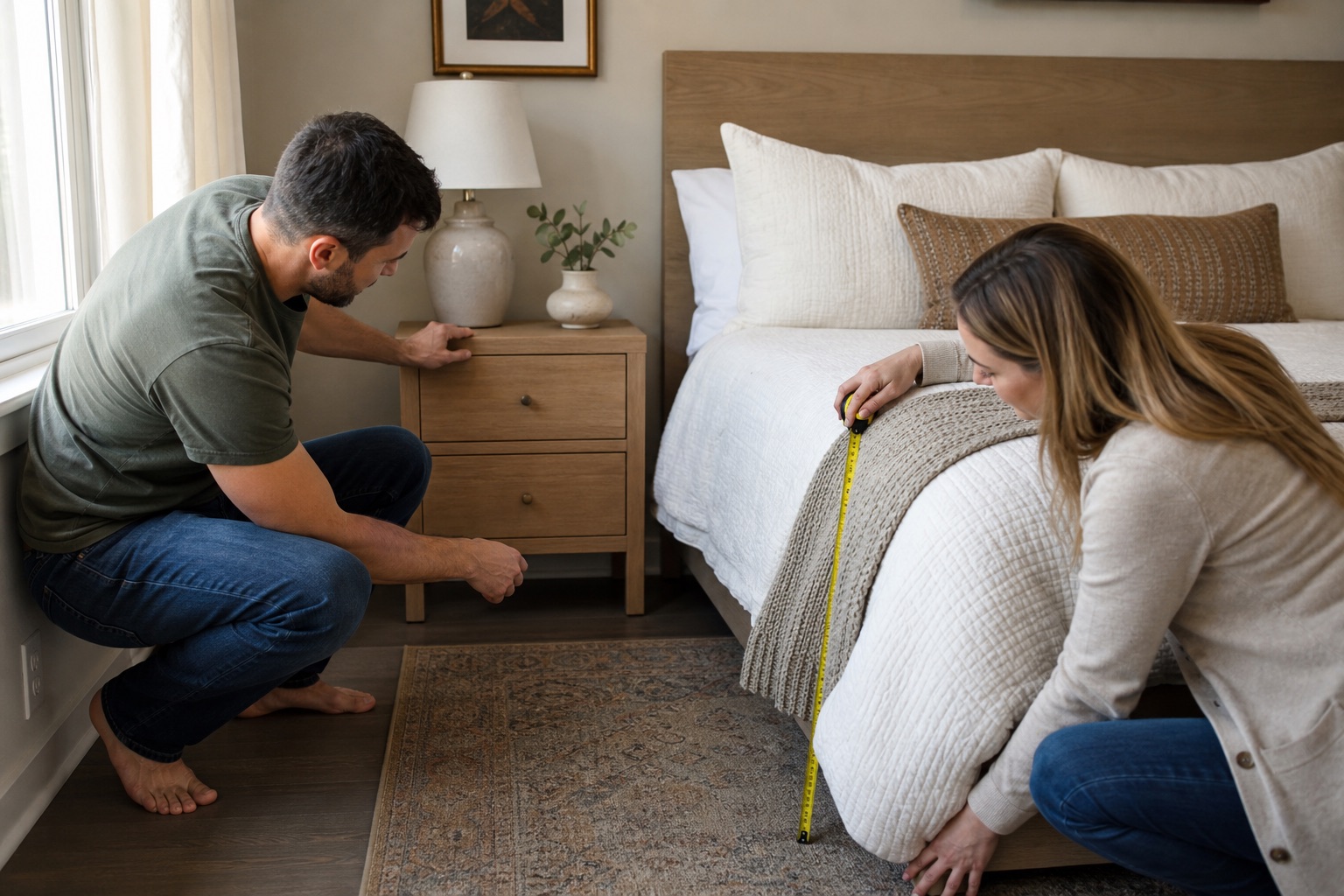
Measure the Finished Bed and the Available Bay
Assemble the components that determine the sleeping surface: frame, foundation if used, mattress, and any substantial topper. Measure from the floor to the top of the uncompressed mattress. Do not rely on the bed frame height or a mattress specification by itself. Record the result on both sides if the floor is uneven.
Then measure the clear bay from the outside of the bed frame to the nearest wall, door casing, closet, dresser, or circulation route. Note baseboards, outlets, floor registers, HVAC returns, window trim, curtains, and any wing or ledge on the headboard. Measure the left and right sides independently. In an older U.S. house, a wall that appears straight may not leave the same width from front to back.
Use the room-measuring sequence in Avrelahome’s step-by-step furniture measuring guide, then add operating space. A drawer needs room to extend. A hinged door needs an arc. A person needs somewhere to stand while opening either one. A cabinet that fits the gap but cannot open is not the right size.
For delivery, compare the packaged or assembled piece with doors, stair turns, elevator openings, and the last turn into the room. Joined headboard-and-nightstand systems need particular care.
Set Height by Reach, Not by a Fixed Number
For many sleepers, a top near the mattress surface is the most natural to reach. It may be a little below or above without causing a problem. The useful test is whether the primary user can reach the objects used at night while lying in a normal position, without a deep downward bend or an awkward lift of the shoulder.
A very low table can make a phone or glass harder to see and grasp. A top that rises far above the mattress can put lamp hardware, a glass, or a sharp corner uncomfortably close to the sleeper’s face. Neither condition is automatically unsafe, but both deserve a real test instead of an online rule.
Sit and lie down with the pillows arranged as they are normally used. Reach toward a box or temporary surface at the proposed height. Account for shoulder mobility, vision, and anything that must be accessed quickly, such as glasses or medication. A person who sleeps with several pillows may reach differently from someone using a thin pillow.
The existing bedroom furniture checklist treats the nightstand as support for a routine rather than a mandatory matching piece. That distinction matters: comfortable reach is more important than aligning decorative moldings across the room.

Choose Width From the Things It Must Hold
List the items that genuinely need to be within reach. A phone, glasses, and wall-mounted light switch may need only a compact surface. A table lamp, water glass, book, medication organizer, charging dock, and tissues require more usable area and separation. Keep drinks away from electrical devices and leave a clear place to set something down in the dark.
Width affects visual scale: a substantial king can make a tiny table look incidental, while oversized cabinets can trap a queen bed. Proportion helps, but it does not override circulation.
For two sleepers, do not assume the nightstands need identical capacity. One person may need three drawers and a reading lamp; the other may need one shallow drawer and a small charging shelf. A coordinated pair can share a finish, hardware detail, or top material while using different widths.
Before increasing width for appearance, decide whether that space would be more valuable as a clear path, curtain clearance, or access to a nearby closet. The small-bedroom layout guide explains why preserving one useful route often matters more than making every elevation symmetrical.
Limit Depth to Protect the Bedside Path
Depth is easy to overlook because product listings emphasize width. Yet depth controls how far the front edge and hardware project into the path. Ideally, the nightstand should not extend substantially beyond the side of the bed frame where a shin or hip can catch it during a nighttime walk.
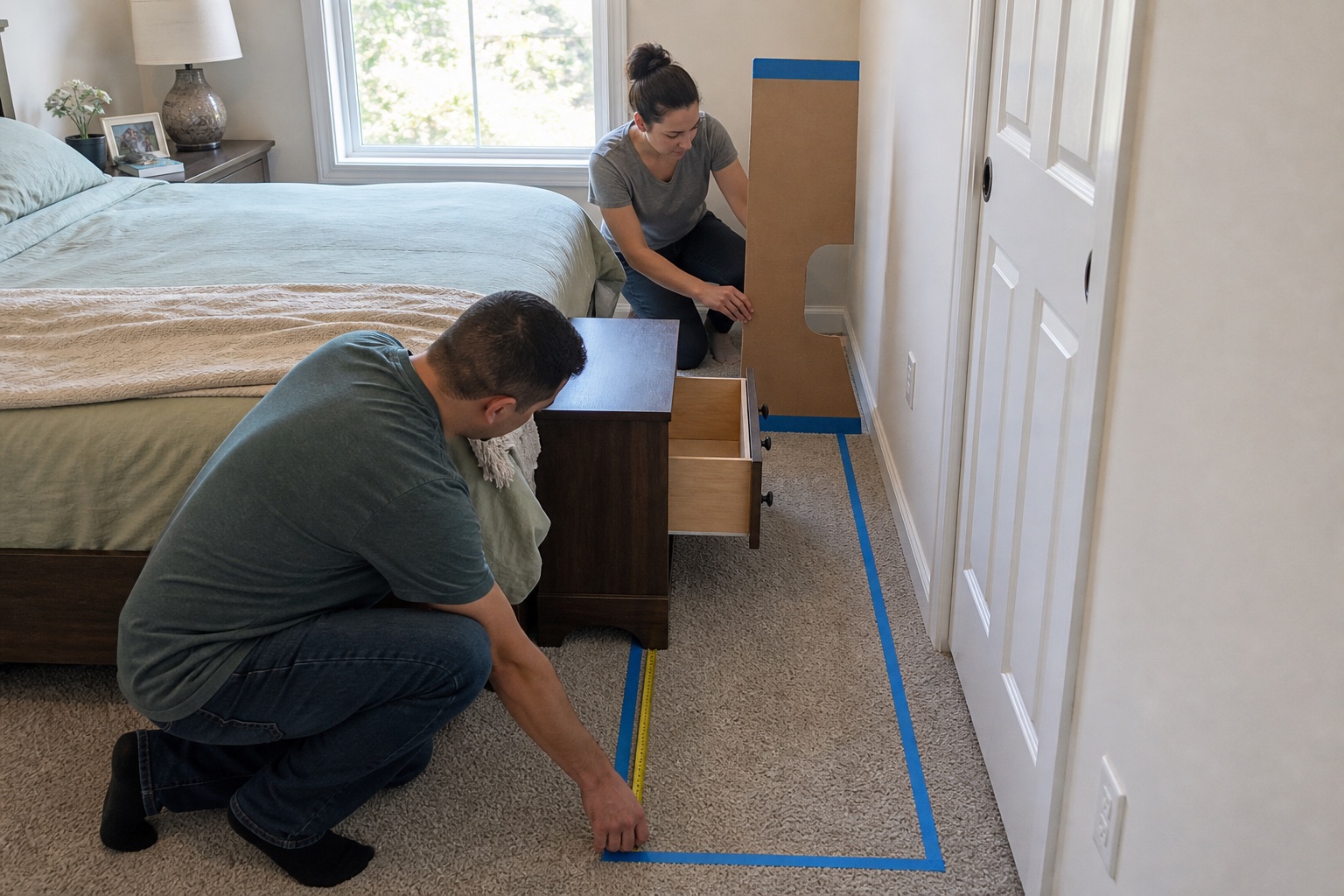
Include the pull or knob in the projection. Then add the open drawer position and the standing area required to use it. Check whether the front corner interferes with making the bed, opening a closet door, or walking toward the bathroom. A deep cabinet may provide more theoretical capacity while making the room less usable every day.
Painter’s tape can show the footprint, but a cardboard box is better because it reveals height and volume. Put the box beside the bed for an evening. Reach for it while lying down, walk past it in low light, and try to change the bedding. This inexpensive test catches more problems than comparing dimensions on a screen.
Use Common Dimensions as a Starting Band
Retail sizes vary, so the ranges below are planning bands rather than standards. Confirm the actual product and the finished bed before ordering.
| Bedroom condition | Useful starting point | What to verify |
|---|---|---|
| Low platform bed | Top close to the low mattress surface; compact width where practical | Comfortable reach without a tall cabinet dominating the bed |
| Typical queen-bed room | Roughly 20–28 inches wide and 16–20 inches deep | Lamp footprint, drawer extension, and route to the closet or bath |
| King-bed room with generous wall space | Roughly 24–36 inches wide per side | Proportion without sacrificing curtain, door, or walkway clearance |
| Tall storage bed or thick mattress stack | Height selected from the measured mattress top | Reach, bed mechanism, and whether a taller narrow cabinet needs anchoring |
| Very tight bedroom | Shallow cabinet, floating drawer, or compact shelf | Minimum bedside function plus safe circulation |
The inch ranges are not a promise that a product will fit. A 24-inch-wide cabinet may be reasonable beside one queen bed and impossible beside another because the room has a door casing or baseboard heater. Use the table to narrow the search, then test the exact outline.
Select Drawers, Shelves, or Doors for the Contents
Drawers conceal medication, chargers, sleep masks, and small personal items. Check the drawer’s inside dimensions, not just the cabinet size; thick sides and decorative fronts can reduce capacity. Full extension is useful when the drawer is deep, but it needs unobstructed space beside the bed.
An open shelf feels lighter and provides fast access to books or a basket. It also displays cords and everyday clutter. A hinged door can hold bulkier items but may conflict with the bed frame or a narrow standing zone. Sliding or tambour-style access can solve a tight swing condition, though the mechanism changes cost and internal space.
Material should follow use. A water-resistant, easily wiped top is sensible where a glass or humidifier is common. The custom furniture materials guide helps separate visible finish, structure, hardware, and exposure instead of treating one premium surface as proof of quality.
Hardware often has more daily impact than an expensive face. Open a drawer with one hand, check whether the pull catches clothing, and ask how the slides can be adjusted or replaced.
Coordinate Two Sides Without Forcing a Match
Matching nightstands can make a room calm, particularly when the bed wall is broad and balanced. They are not required. Different storage needs, a window, a closet door, an off-center bed, or unequal wall bays may make an asymmetric pair more useful.
Connect the two sides through a shared top height, hardware finish, leg shape, or pair of lamps even when widths and materials differ.
Avoid pieces that are almost, but not quite, the same wood color. A clear contrast in paint, metal, stone, or upholstery is often easier to coordinate. Repeat a small material vocabulary and compare undertones under the room’s actual light.
Height is the relationship worth keeping closest because it affects reach and the bed-wall horizon. Width, drawer count, and base style can differ more freely.
Adapt the Choice to Unusual Beds and Small Rooms
A low platform bed usually benefits from a restrained nightstand or floating shelf. A tall conventional cabinet beside it can feel top-heavy and make the reach awkward. Conversely, a low table beside a storage bed with a thick mattress may force the sleeper to reach sharply downward.
An adjustable base deserves a test in both flat and commonly raised positions. Make sure the moving frame cannot trap a cord, strike a drawer pull, or carry bedding into objects on the nightstand. The ideal surface position when flat may become less convenient with the head elevated, so prioritize the position used most often.
In a small room, subtract before shrinking everything. A wall sconce can release surface area. A floating drawer exposes more floor and can make cleaning easier. One properly sized nightstand and one compact shelf may serve two unequal sides better than two tiny cabinets that hold nothing useful.
The bedroom furniture overview offers broader bed and storage context, while the whole-bedroom planning page is more relevant when the bed wall, wardrobe, lighting, and supporting furniture need to be coordinated as one layout.
Know When Floating or Custom Work Earns Its Cost
A standard nightstand is usually the sensible choice when it fits the bay, meets the storage need, and leaves the outlet and walkway accessible. It is easier to replace and take to another home. Custom work earns consideration when the bay is unusually narrow, the wall is uneven, a baseboard conflicts with a full back, or the bedside unit must integrate precisely with a headboard, wall panel, lighting, or power plan.
A floating unit can ease cleaning and preserve visible floor, but wall construction, blocking, fasteners, cabinet weight, stored load, and installer responsibility must be resolved. A rendering cannot confirm support.
For a tailored order, specify the finished outside dimensions, usable drawer dimensions, materials, edge treatment, hardware, wall gap or scribe, outlet cutouts, cord path, mounting system, packaging, and installation scope. Avrelahome’s custom furniture planning service can help compare a coordinated bedside solution with standard furniture, but an order-specific drawing and responsibility list should still be approved before production.
Plan the Lamp, Charging, and Outlet at the Same Time
A table lamp consumes more surface than its base alone; the shade and switch need clearance too. Confirm that the lamp does not crowd the sleeper or collide with a headboard wing. A wall-mounted light can free the top, but the switch or control should be reachable from the normal sleeping position.
Integrated outlets, USB ports, and wireless charging should remain replaceable and ventilated. Do not bury a receptacle, cross the path with an extension cord, or route a cable through an adjustable bed’s mechanism.
Guest rooms benefit from obvious power a first-time occupant can understand. Technology changes faster than a cabinet, so do not make one proprietary charger the only option.
Test the Full Setup Before You Order
Place tape for the footprint and a box for the proposed height. Add the front edge of the pull and the fully extended drawer. Walk the route from the bedroom door to the bed, closet, and bathroom. Open adjacent furniture, pull the curtains, make the bed, and reach for a glass from a normal sleeping posture.
Then write down the measured mattress height, available width on each side, proposed cabinet dimensions, open-drawer projection, outlet location, and delivery limits. For a built-in or floating piece, identify who performs the final field measurement after floors, baseboards, and wall finishes are complete.
Follow the manufacturer’s anchoring instructions for tall or unstable furniture, especially in a child’s room. Wall-mounted units need fasteners suited to the structure. Confirm that the piece does not obstruct air, heat, egress, or outlet access.
If a standard catalog dimension repeatedly creates a compromise, Avrelahome can be one source for comparing a measured bed-wall package. Keep the decision grounded in the room, installation conditions, and written specifications rather than treating custom work as automatically better.
Frequently Asked Questions
Should a nightstand be the same height as the mattress?
It does not need to be exact. A top near the mattress surface is a useful starting point, but the best height is the one the sleeper can reach comfortably from the normal pillow position. Test slightly lower and higher options before choosing.
What is a standard nightstand height?
Retail products often fall somewhere in the low-to-upper 20-inch range, but that range is not a fit rule. Measure the finished mattress top because a low platform bed and a tall storage bed require different relationships.
How wide should a nightstand be?
Choose enough width for the lamp, drink, charging, and storage actually needed, while preserving the route beside the bed. Rough planning bands can help you shop, but the available bay and drawer operation determine the final limit.
How deep should a nightstand be?
It should be deep enough to hold necessary items without projecting awkwardly into the walking path. Include hardware and open-drawer space when testing depth; a slightly shallower cabinet is often better in a tight room.
Do king beds need larger nightstands?
Not automatically. Wider nightstands may balance a large bed in a generous room, but circulation, windows, and closet access come first. Two medium cabinets can be more useful than oversized pieces chosen only for proportion.
Do you need two nightstands in a small bedroom?
No. Two regular sleepers benefit from a reachable surface on each side, but those surfaces can differ. One full nightstand plus one floating shelf or compact table may preserve more useful floor space.
Can you use different nightstands on each side of the bed?
Yes. Keep the top heights reasonably compatible with each sleeper and connect the pieces through color, hardware, lamps, or visual weight. Different widths and storage configurations can respond to different needs.
Is a floating nightstand safe?
It can be when the mounting system, wall structure, fasteners, cabinet weight, and expected load are properly resolved. Installation should follow the supplier’s requirements; appearance alone cannot confirm adequate support.
Choose for Reach, Capacity, and a Clear Path
The right nightstand begins with the completed bed and the person using it. Set the top where the sleeper can reach naturally, provide enough width for the real bedside routine, and limit depth so the room remains easy to move through. Then verify drawers, power, delivery, and installation. That measured approach produces a better result than buying a matching pair first and asking the room to accommodate it later.