
A sofa frame is almost completely hidden by upholstery, padding, and dust cover. That makes simple claims such as “solid wood,” “hardwood,” or “lifetime frame warranty” unusually persuasive. None of them proves that the finished structure is right for its span, users, suspension, moving route, or service conditions.
A high-quality frame is a system. Materials, member sizes, joints, corner reinforcement, legs, suspension, removable connections, manufacturing control, and delivery protection have to work together. The useful question is not whether one impressive material appears somewhere inside. It is whether the documented structure carries real loads without avoidable movement and can be inspected, delivered, and repaired sensibly.
Begin With the Loads the Sofa Must Carry
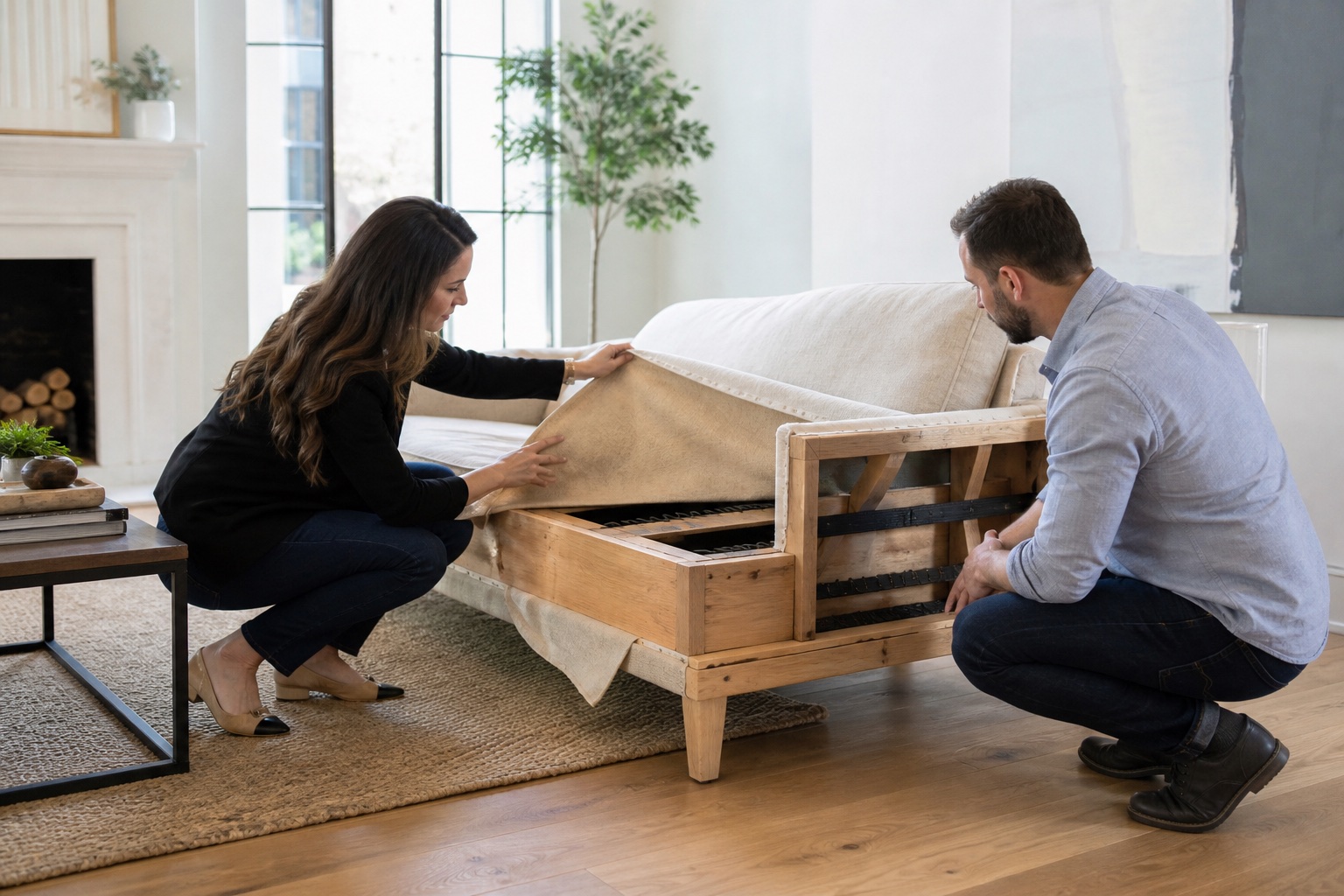
Start with the users and configuration. A compact loveseat, a 96-inch three-seat sofa, a deep sectional, a reconfigurable modular sofa, and a hotel-lobby seat do not create the same loads. Record how many people will use it, the likely range of body sizes, daily hours of use, whether children jump on it, and whether people routinely sit on the arms. Add pets, sleeper mechanisms, power functions, and the possibility of frequent moves.
Span matters. Long front and rear rails, wide seats without intermediate legs, deep platforms, and projecting arms increase bending and twisting. A responsible design manages those forces with appropriate rail sections, cross supports, center legs, and connection details. Increasing the grade of one board does not correct a poorly supported layout.
Delivery is part of the structural brief in a U.S. home. A finished sofa may fit the living room but not a 36-inch entry door, an apartment elevator, or a stair turn. Removable arms, backs, or modular connections can solve that problem, but each detachable joint must locate accurately, tighten repeatedly, and remain quiet after assembly.
Use the comparison below as a briefing tool, not a universal recipe.
| Frame area | Main job | Useful evidence | Common risk |
|---|---|---|---|
| Seat rails | Carry people and suspension loads | Material, section, span, support locations | Long unsupported run |
| Arms and back | Resist leverage and repeated movement | Joint and reinforcement detail | Loose interface hidden by padding |
| Corner or module joint | Control twisting and alignment | Blocks, brackets, bolts, fit | Fastener without adequate bearing |
| Leg connection | Transfer load to the floor | Mounting plate, insert, rail support | Leg attached to a weak panel |
Judge Materials by Where They Are Used
The front rail, rear rail, side rails, arm posts, back, corner blocks, curved panels, and nonstructural closure panels do different work. Properly selected and moisture-controlled solid wood can serve load-bearing members and joint zones. Well-made furniture-grade plywood can provide stable wide surfaces, curves, or repeatable routed components. Some engineered panels may be reasonable in noncritical closure or shaping roles, but they should not be described vaguely as if every internal part were the same.
When plywood is proposed, ask about thickness, layer construction, voids, edge quality, bonding, and exact location. When solid wood is proposed, ask for the species or useful material class, member dimensions, defect control, grain direction, moisture management, and splicing method. The best materials for custom furniture guide explains why a material name must be tied to a component, exposure, finish, and maintenance plan.
Weight is weak evidence. A heavy sofa may contain a robust frame, but weight can also come from a sleeper mechanism, inefficient material use, or dense padding. A thoughtfully engineered structure may control weight without sacrificing required strength. Compare the documented construction instead of lifting one corner and guessing.
Look Beyond the Word “Hardwood”
“Hardwood” is a botanical or commercial category, not a uniform performance grade. Species vary, and an unsuitable section of a strong species can still split at a fastener or move after assembly. Knots, short grain, checks, poor edge distance, and uncontrolled moisture matter as much as the family name.
“Kiln-dried” also describes a process, not a permanent condition. Ask what moisture range the factory controls at machining and assembly, how stock is stored, and how changes are handled. A sofa shipped to arid Arizona faces a different environment from one installed near a humid Gulf Coast. No responsible label can promise that wood will never move.
A useful specification identifies the member, material, approximate section, and connection rather than repeating “kiln-dried hardwood frame” across every quote. If a supplier protects proprietary dimensions, it can still provide a section drawing, representative cutaway, or written construction schedule sufficient for comparison.
Joints and Reinforcement Matter More Than a Single Fastener
Good frames may combine adhesive, dowels, screws, bolts, shaped joints, corner blocks, brackets, or other connectors according to the node. No fastener can be judged without its bearing area, grain direction, edge distance, penetration, hole accuracy, clamping, adhesive coverage, and load direction.
Staples are often treated as shorthand for low quality. That is too simple. Staples can appropriately secure webbing, dust cover, or components while an adhesive cures. Concern is warranted when a primary load-bearing joint relies on light staples without adequate fit, glue, joinery, or reinforcement. A cluster of visible screws is not automatic proof either. Screws driven near an edge, into end grain, at poor angles, or with little engagement can create a weak connection.
Focus on the interfaces most likely to move: front rail to side rail, arm to seat frame, back to base, sectional corner, center support, leg mounting, and any removable connection. Corner blocks should fit and transfer force into both adjoining members, not merely occupy the corner. A cross support or center leg should carry load to the floor without creating a new stress concentration.
The questions to ask before ordering custom furniture provide a useful framework for turning joint descriptions, drawings, samples, substitutions, and claim responsibilities into written answers before a deposit is paid.
The Suspension Must Work With the Frame
Coil systems, sinuous springs, webbing, and other seat supports continually transfer load into the frame. Their count, spacing, direction, attachment, edge distance, and tension influence both comfort and structural fatigue. A strong perimeter with sparse or poorly anchored suspension can still sag, squeak, or concentrate force in one rail.
Do not assume one suspension name always wins. Ask whether the system fits the seat width, depth, cushion build, and use level. Find out whether a damaged spring, clip, or webbing run can be reached from below. A serviceable dust cover or documented access method is more useful than a permanently sealed underside.
Cushions and upholstery can disguise structural behavior. Thick soft cushions may delay notice of a developing low spot. A tight cover may reveal a hard frame edge. Arm width changes leverage; a sleeper or storage mechanism adds weight and moving loads. The newly published fabric versus leather sofa guide reinforces the same principle: the cover, cushion, support, and structure must be evaluated as one product.
Inspect What You Can Before Buying
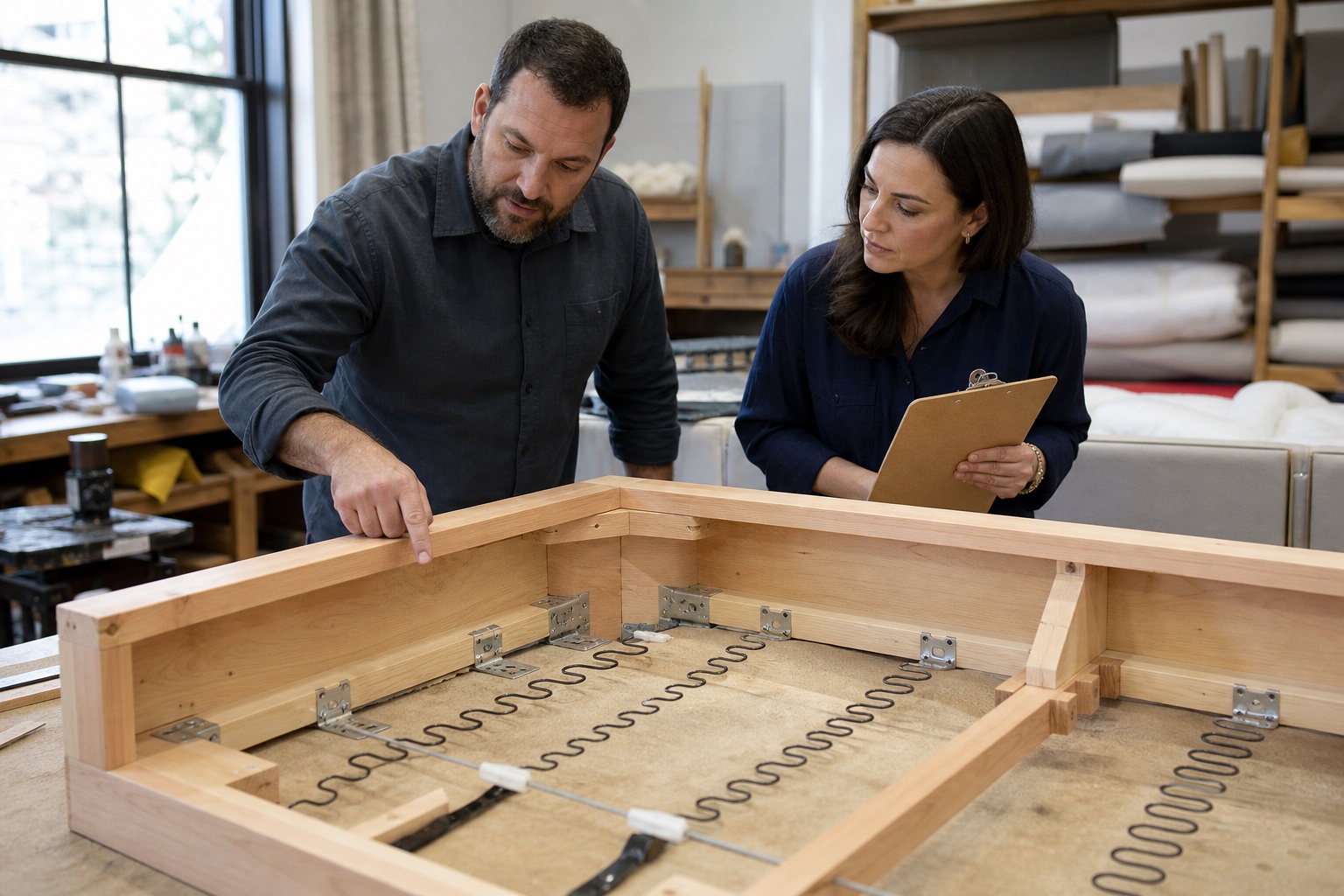
In a showroom, begin on a level floor. Press gently at different corners to check for rocking. Sit in every position, including near each arm, and listen for repeatable noises. Apply modest hand pressure to the arms and back to detect abnormal looseness; do not perform a destructive test. Look for square leg placement, tight module interfaces, and a seat line that does not drop sharply in one bay.
If an accessible zippered dust cover is provided, ask permission to look inside. Check for visible splits, loose nodes, missing hardware, crushed areas from transport, and sharp edges that could abrade webbing. Hidden wood does not need showroom-grade cosmetic finishing. It does need sound load paths and smooth contact where suspension or upholstery crosses it.
For an online or custom order, request model-specific frame photographs, a cutaway or section, a dimensioned drawing, a material schedule, and representative joint details. Generic factory photographs do not prove the construction of the quoted sofa. The manufacturer selection guide can help evaluate whether drawings, sample control, inspection, and change management support the sales claim.
For a repeated hotel or rental order, consider a sample unit, mock-up, or first-article inspection. Record the approved item number, dimensions, frame revision, suspension, cushion, upholstery, and acceptable variation. Then define how production units will be checked against it.
Specify a Custom Frame That Can Be Compared
Issue one brief with overall dimensions, configuration, seat count, use level, likely users, arm behavior, removable components, destination, delivery route, and on-site assembly responsibility. Add the frame material by component, principal member sections, reinforcement approach, suspension, leg or plinth attachment, cushion build, upholstery, and service access.
Ask the drawing to show the front and rear rails, side rails, cross supports, legs, arms, back interface, and sectional connections. The material schedule should place solid wood, plywood, other panels, and metal at their actual locations. Require written approval for substitutions instead of accepting “equivalent material” as an undocumented factory choice.
The sofas and couches page is a practical starting point for describing a custom configuration, while the living room furniture page helps place the sofa within clearances, tables, storage, and the rest of the room. The quote should use the same revision as the approved drawing and sample.
Avrelahome can discuss frame construction around room dimensions, configuration, comfort preference, upholstery samples, quantity, packing, and destination. A responsible outcome is not a bare “hardwood” promise. It is a reviewable drawing and material schedule connected to the commercial scope.
Review Testing, Warranty, and Repairability
Testing evidence should identify the product, configuration, method, load conditions, sample, and result. An internal test, third-party standard, or project-specific requirement can each be useful when its scope is clear. A result for a chair or short sofa does not automatically cover a long sectional. Residential evidence does not automatically satisfy a hotel contract or local requirement.
Read the frame warranty rather than comparing the largest number. Check how “frame” is defined, whether commercial or rental use is excluded, and how transport damage, improper assembly, squeaks, loosening, inspection, parts, labor, and international freight are handled. A long term offers limited help if the owner must pay more to diagnose and ship the sofa than a local repair would cost.
Repairability is often more practical than a marketing duration. Ask whether the underside can be opened, whether legs and module connectors can be replaced, how long drawings and part numbers are retained, and whether a local upholstery shop can reach common failure points. Hotels and rentals should consider spare hardware and the downtime created by an unusable unit.
Protect the Frame During Delivery and Installation
Structural damage can occur after a sound factory inspection. Carrying a sofa by one arm, twisting it through a stairwell, lifting it from the wrong point, exposing packaging to moisture, or setting a center leg at the wrong height can strain joints. Packaging should protect corners, removable parts, legs, and upholstery, with clear orientation and lifting information for larger pieces.
Recheck the front door, hallway, elevator, stairs, turns, and finished-floor protection before dispatch. Clarify whether the U.S. service is curbside, threshold, room-of-choice, white glove, or installation. Those labels should be translated into actual tasks, including unpacking, assembly, leveling, placement, and debris removal.
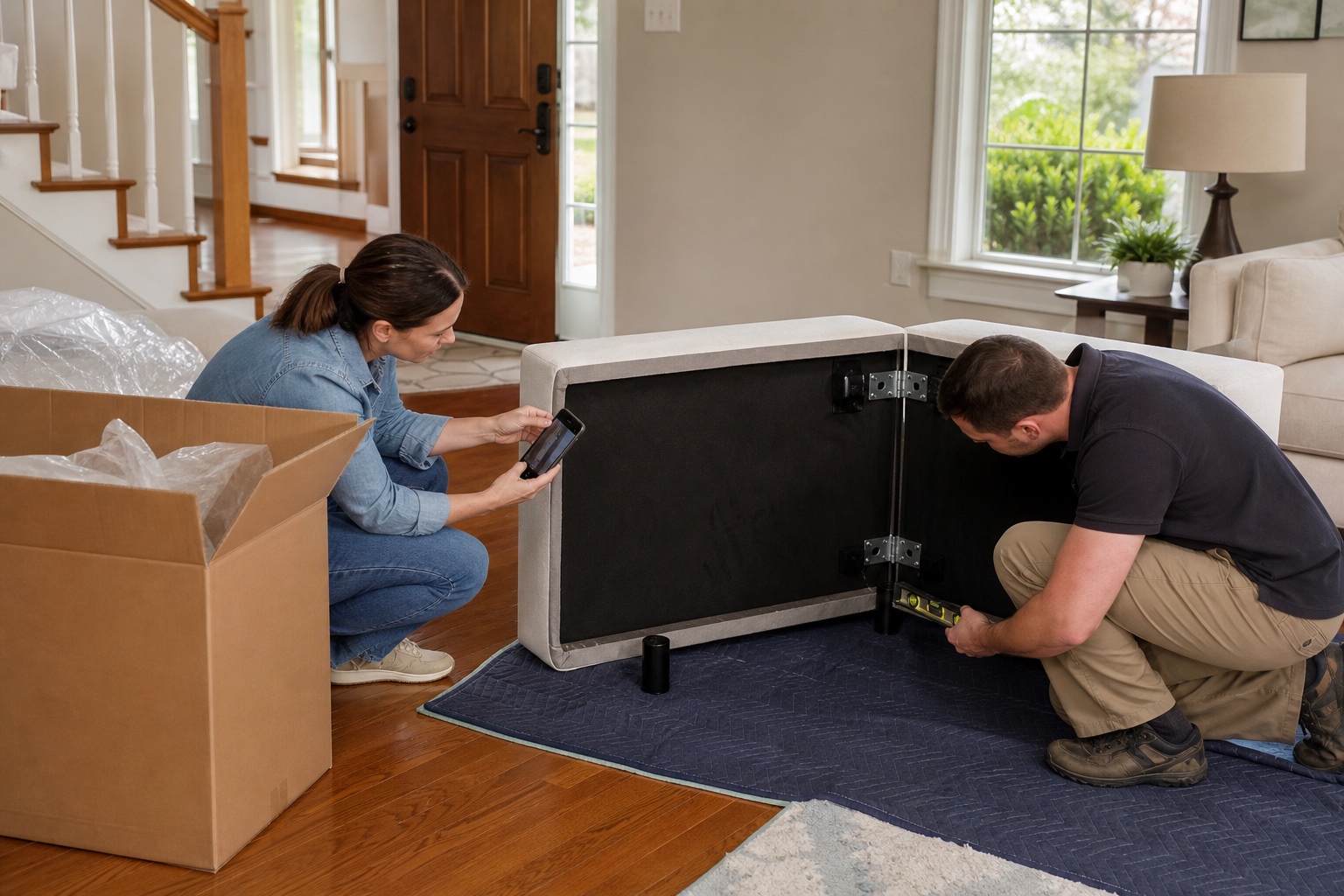
At arrival, photograph the carton and impact marks before unpacking. After assembly, check level, module connections, legs, arms, back, noises, suspension line, and upholstery tension. Preserve packaging, labels, and photographs if a problem appears, and follow the claim window before authorizing a field repair.
Complete the Final Risk Check
Match the quote, drawing, sample, and frame schedule by revision. Confirm who approves the final dimensions, substitutions, delivery split, on-site assembly, leveling, and corrective work. Ask what evidence accompanies pre-shipment inspection and how a claim distinguishes a manufacturing defect from transit damage or improper installation.
Review access one last time against the largest packaged piece. Confirm that removable joints are labeled, hardware is counted, and assembly instructions identify tightening sequence and support points. For a multi-unit project, establish incoming inspection before sofas are distributed to rooms.
The best buying decision is based on evidence proportionate to the risk. A single residential sofa may justify model-specific photos, a useful drawing, and a careful delivery plan. A hotel package may justify a mock-up, controlled revision, documented inspection, spares, and a formal claim process. In both cases, the quality claim should be specific enough to verify.
Frequently Asked Questions
Are hardwood sofa frames always best?
No. Species, moisture, member size, defects, grain direction, joint design, and location all matter. Well-made plywood can be more stable than unsuitable solid wood in some wide or curved components.
Is a plywood sofa frame worse than solid wood?
Not by definition. Furniture-grade plywood can be reliable when its thickness, layer construction, bonding, edge quality, and placement fit the load. Thin, voided, or poorly bonded material is a different proposition.
Do staples mean a sofa frame is low quality?
Not automatically. Staples can be appropriate for webbing, dust cover, or assembly positioning. A primary structural joint that depends on light staples without adequate fit, adhesive, joinery, or reinforcement deserves concern.
Does kiln-dried wood prevent all cracking and warping?
No. Kiln drying is one control step. Moisture at assembly, storage, transport, member design, and the destination environment still influence wood movement.
What are signs that a sofa frame may be damaged?
Persistent rocking, a new repeatable noise, a local drop in the seat, loose arms or back, misaligned legs, and a visible split underneath warrant inspection. Stop heavy use and document the condition before repair.
Does a long frame warranty prove quality?
No. Its value depends on definitions, exclusions, evidence, parts, labor, freight, and the permitted use. Review the actual structure and the claim process as well as the duration.
Buy the Documented Structure, Not the Label
A high-quality sofa frame is not one material word. It is a structure matched to its users, span, suspension, configuration, access route, and service plan. Identify materials by component, review joints and support, inspect available evidence, and put the approved construction into the drawing and purchase scope.
When testing, warranty, repair, delivery, and responsibility are also clear, the frame can be judged before upholstery hides it—and managed if a problem ever appears.