
Ordering custom furniture online can work well, but it is not the same as choosing a finished item from a catalog. You cannot rely on a showroom visit to confirm scale, finish, comfort, or construction. Those physical judgments have to be translated into dimensions, drawings, samples, written responsibilities, and approval points.
The goal is not to eliminate every uncertainty. It is to identify the decisions that can change fit, appearance, cost, delivery, or installation and settle them before production. A trustworthy process makes it clear what you are buying, who owns each measurement, when changes stop, and what happens when the furniture reaches your home.
First, Decide Whether the Project Is Suitable for Remote Ordering
Freestanding tables, chairs, sofas, beds, desks, and storage cabinets are often easier to order remotely than wall-to-wall installations. They still need accurate dimensions and a verified delivery route, but they do not usually require a cabinet to be scribed to an uneven wall or coordinated with multiple construction trades.
Complex built-ins deserve more caution. Sloped ceilings, fireplaces, stone surfaces, plumbing, electrical equipment, irregular walls, and tight architectural reveals may require a qualified local field measure or another agreed site professional. A laser distance meter does not reveal every bowed wall, weak fastening substrate, or change in floor level. If the project depends on those conditions, determine how they will be inspected before you pay for fabrication.
Remote ordering also asks something of the buyer. You need time to review drawings, handle samples, keep decisions organized, and prepare delivery access. If the schedule is extremely compressed, the site is still changing, or critical details will be decided during installation, the risk increases. Online communication is not the problem; unresolved physical information is.
Build a Brief That a Supplier Can Actually Price
Start with a one-page summary. State the room, furniture type, number of users, primary function, items that must be stored, style direction, and preferred materials. Add room photographs, a basic plan, inspiration images, and examples of what you do not want. Separate requirements from preferences so a supplier knows what cannot be traded away.
For seating, include the number of seats, preferred seat depth or feel, household pets, children, and cleaning expectations. For storage, list the equipment or objects that must fit, including their dimensions and how often they are accessed. A printer bay, record collection, dinnerware cabinet, and toy drawer may occupy similar exterior space but need very different interiors.
Provide a realistic budget range, target-use date, ZIP code, residence type, floor level, elevator information, entry restrictions, and installation expectations. “High quality” and “as soon as possible” are not specifications. If you are still deciding what level of customization you need, review the main types of custom furniture before asking several companies to price different interpretations.
Keep the brief concise enough to read, then place supporting measurements and photos in labeled attachments. File names such as “Dining-wall-east-Aug-3” are more useful than “IMG_4821.” Clear organization at the beginning reduces contradictory messages later.
Measure the Room and the Entire Delivery Route
Record wall width, ceiling height, windows, doors, baseboards, outlets, supply and return vents, radiators, and irregular conditions. Use several measurements rather than assuming opposite sides are equal. Photograph the tape or laser reading where context matters. For a fitted piece, note whether floors, wall finishes, stone, fireplace work, and trim are complete.
Then measure how the furniture will enter. Check the front door, vestibule, hallways, stair width, landings, elevator opening, ceiling pinch points, and the destination doorway. A cabinet can fit the final wall and still be impossible to carry through a stair turn. If a large piece will ship in modules, drawings should show module sizes, connection points, and visible seams.
Most important, write down who owns the final production dimensions. Early homeowner measurements may be adequate for budgeting, but a fitted installation often needs a final check after relevant construction is complete. The room measurement guide can help you prepare, but the order documents still need a named dimension owner and a release point. Assumed or pending dimensions should be visibly marked on drawings.
Shortlist Suppliers by Process, Not Just Portfolio Images
An attractive gallery shows design direction; it does not prove dimensional control, packaging quality, or service after delivery. Ask whether the company has produced a similar size, material, installation type, and destination. Request a clear explanation of the path from brief to quote, drawings, samples, production, inspection, packing, and delivery.
Notice how the supplier handles uncertainty. A useful response restates the important constraints, identifies conflicts, and asks targeted questions. An immediate promise that “everything is possible” may feel accommodating but does not demonstrate that access, construction, or cost has been considered.
Verify the legal business name, contact information, contract party, and payment recipient. They should align or be explained in writing. For more ways to evaluate capability and documentation, use this guide to choosing a custom furniture manufacturer. For a high-value or unfamiliar relationship, a paid design phase, physical sample, prototype, or lower-risk first piece can provide evidence before a larger release.
Communication quality is part of the product. Useful messages include a drawing version, decision owner, deadline, and next step. Scattered voice notes and unnumbered screenshots make it difficult to prove which detail was approved.
Put Every Quote on the Same Scope
A meaningful quote identifies quantity, dimensions, substrate, exposed surface, finish, hardware, upholstery construction, packaging, freight, delivery method, installation, and exclusions. If more than one furniture type is included, ask for line items. Optional upgrades and substitutions should have separate prices rather than disappearing into one total.
If the order crosses a border, confirm the delivery term, freight scope, duties and tax responsibility, customs handling, destination charges, and final-mile service. “Shipping included” might mean delivery to a port, a warehouse, the curb, or a room. Those are very different scopes. Even a domestic order should state whether service is curbside, threshold, room-of-choice, or white glove.
Compare usable function, not only exterior size and total price. One cabinet may include adjustable shelves, drawer hardware, finished interiors, cable management, and installation; another may not. A low price can be legitimate if the scope is simpler. It becomes risky when the missing scope is invisible.
Ask how long the quote remains valid and which selections could change it. Material availability, special hardware, finish development, freight, and jobsite changes can all affect price. A transparent allowance is more useful than an unrealistically fixed promise built on undefined assumptions.
Treat Production Drawings as the Main Approval Gate
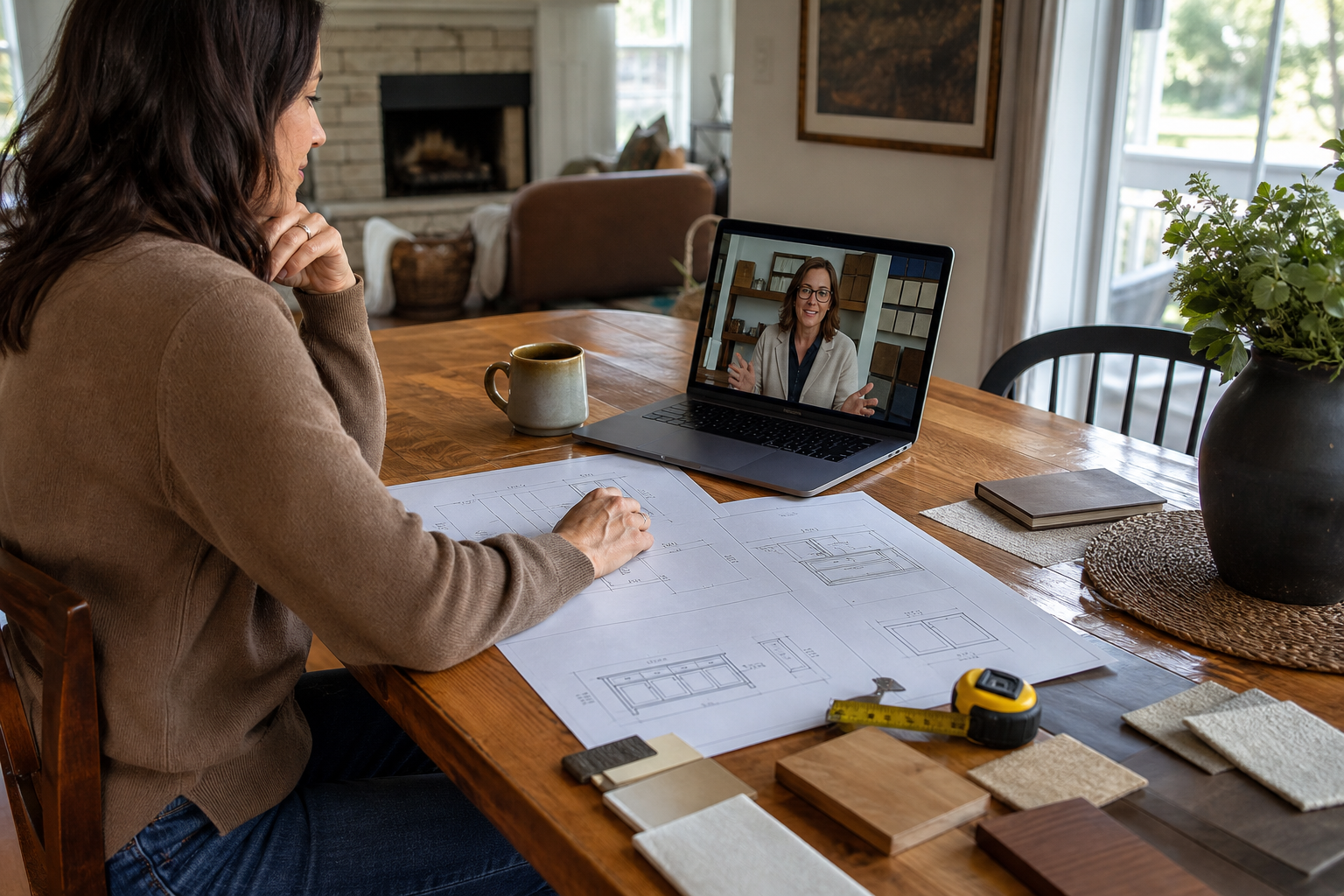
Renderings help you understand appearance, but they are not enough for fabrication. Production drawings should show overall dimensions, internal clearances, door and drawer swings, shelf spacing, seat height and depth, top thickness, legroom, wall gaps, module connections, hardware locations, and the relationship between adjacent parts.
Check the details that disappear in a front view. Which way does wood grain run? Where do veneer seams or upholstery joins occur? Can drawers open without hitting a wall or handle? Does a media cabinet provide cable access and ventilation? Can an installer reach the anchoring points? If an opening is meant for equipment, compare the clear internal dimension—not the outside cabinet width—to the equipment and its plugs.
Review every sheet and return one consolidated response. Mark the version and date as approved, approved with stated corrections, or not approved. A casual “looks good” in a chat thread can be interpreted broadly. Once corrections are made, confirm that the revised sheet—not the old rendering—is the production reference.
Changes to dimensions, materials, hardware, finish, quantity, or delivery should trigger a revised drawing or specification and a written cost and schedule impact. Approval control may feel formal for a piece of furniture, but it protects both buyer and maker from relying on different versions.

Use Physical Samples to Control Color and Touch
Screens alter color through camera settings, display calibration, compression, and room lighting. Whenever finish matters, review physical samples for wood veneer, stain, paint color and sheen, upholstery, stone, laminate, or metal. View them in the room during daylight and under the evening lights you actually use.
Give an approved sample a reference code and define what it represents. A painted panel can be a tight color and sheen standard. Natural wood or stone needs an agreed range because grain, tone, and pattern vary. A small sample also cannot predict the exact distribution across a large surface, so discuss matching, sequencing, and acceptable natural variation.
For high-risk comfort or structure, consider a prototype. A sample chair, loose cushion, corner detail, drawer, or partial mock-up costs time and money, but it can be less expensive than discovering a problem after a full quantity is finished. Use prototypes where the consequence of being wrong justifies the extra step.
Put the Order, Payment, and Changes in Writing
The order documents should identify both parties, product scope, referenced drawings and samples, price, currency, taxes or duties, delivery terms, estimated milestones, payment schedule, change process, inspection, and claim timing. Clarify whether installation is included and which site preparations belong to the buyer. The questions to ask before ordering custom furniture are useful for finding gaps before a deposit is due.
Payment milestones should correspond to real work and preserve reasonable opportunities to verify progress. Use a traceable method paid to the named contract party. Any request to change bank details deserves verification through an independent, previously established channel. Do not rely on a reply within the same potentially compromised email thread.
This is practical purchasing guidance, not legal advice. For a high-value, cross-border, or commercially significant order, consider having an appropriate professional review the terms. The larger the consequence of a misunderstanding, the less you should depend on informal chat history.
Create a decision log with the date, subject, version, approver, and outcome. It can be a simple spreadsheet. The value is that a finish approval, changed dimension, or postponed delivery date can be found without reconstructing weeks of messages.
Follow Production Without Micromanaging It
Agree on meaningful checkpoints before production begins. Depending on the piece, these may include material confirmation, frame or cabinet assembly, finish preparation, upholstery, hardware installation, final quality review, and packing. Progress photos or video should show details relevant to your order, ideally with the drawing version or an identifiable component—not only generic workshop activity.
More messages do not necessarily create more control. Ask for evidence at the points where a mistake can still be corrected. Once finish is applied or upholstery is closed, some changes become costly. A late aesthetic reconsideration is not the same as correcting work that differs from an approved document.
Build realistic time for sample shipping, drawing revisions, material procurement, production, inspection, freight, receiving, and installation. This overview of custom furniture timelines explains why the production window is only one part of the calendar. Add contingency when the furniture must coordinate with a renovation or a fixed move-in date.
Plan U.S. Delivery, Receiving, and Installation Before Shipping
Confirm whether service ends at the curb, driveway, threshold, room of choice, or after assembly. Can a large truck enter the street or community? Does a condo require an elevator reservation, loading-dock time, insurance certificate, or limited work hours? Identify who unpacks, assembles, anchors, touches up, and removes packaging.
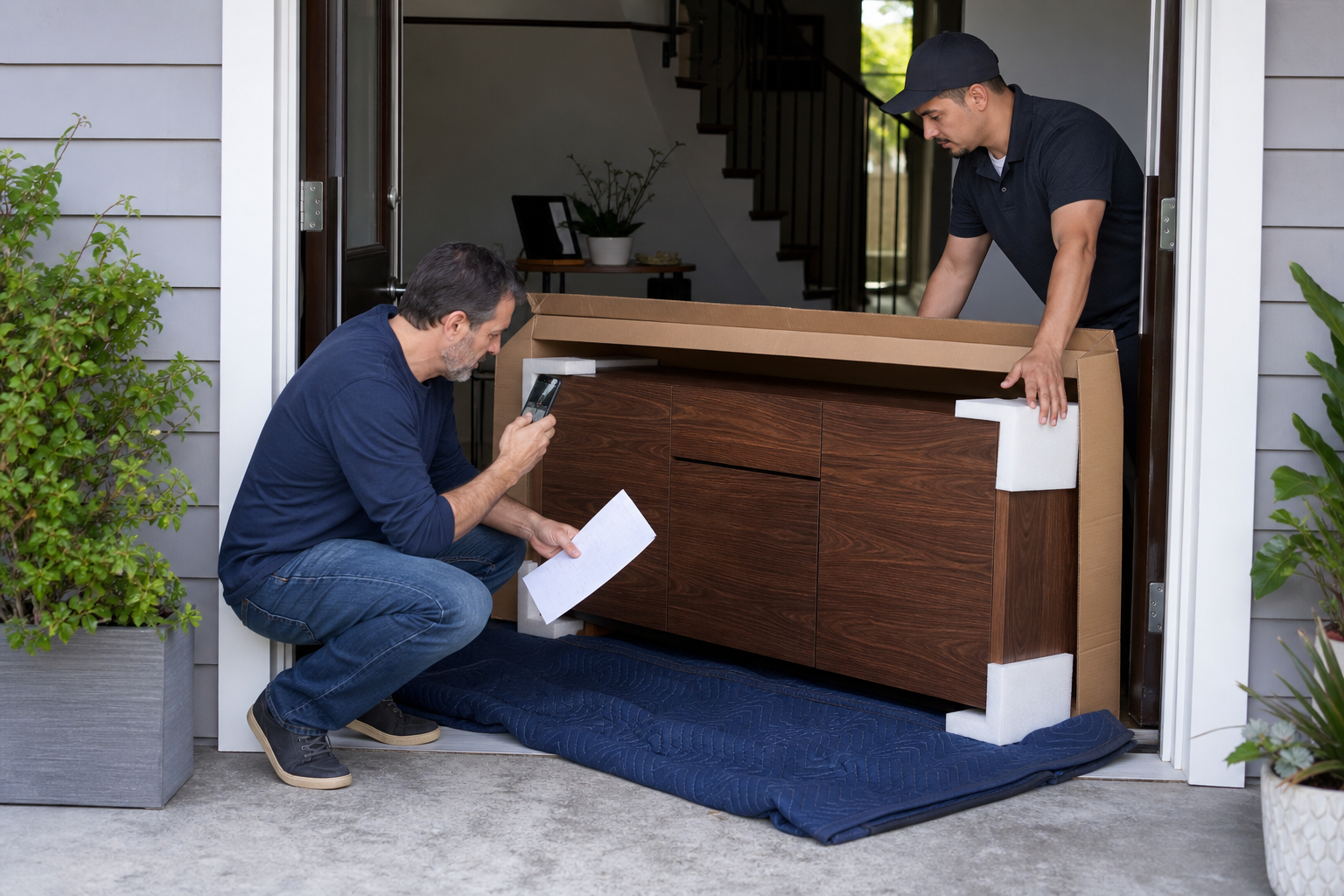
Prepare a clear receiving area and the right number of people. On arrival, photograph the exterior packaging, labels, and piece count before opening. Record punctures, crushed corners, water exposure, or missing packages according to the carrier’s procedure. After unpacking, check item identity, orientation, dimensions, finish, hardware, and basic operation.
Do not discard packaging or attempt improvised repairs until you understand the seller’s and carrier’s claim requirements. A concealed-damage window may be short. If installation involves wall anchoring, electrical changes, or heavy overhead components, use appropriately qualified help and confirm the substrate before drilling.
Red Flags That Should Pause the Order
Pause when a supplier offers a “final” price without dimensions or scope, refuses production drawings, will not name materials or hardware, pressures you into an untraceable full payment, repeatedly changes payment details, or cannot explain shipping and installation responsibility. A beautiful rendering does not compensate for missing construction information.
Also stop when the site is not ready for final measurement, two drawings show different dimensions, a finish has no approved reference, or the delivery route has not been checked. These are solvable issues, but production should not be used to force a decision. Resolve the contradiction, issue a dated revision, and then release the work.
For buyers organizing a remote project, Avrelahome can help structure the brief, specification decisions, delivery location, and installation conditions before production. The custom furniture service overview provides a starting point for the product scope. The useful objective is not perfect certainty; it is making every important uncertainty visible, owned, and approved.
Frequently Asked Questions
Can I order custom furniture from photos alone?
Photos are useful for style, but they do not define production. You also need dimensions, materials, construction details, hardware, finish references, delivery terms, and installation requirements.
How much deposit is normal for online custom furniture?
There is no universal percentage. It depends on project scale, material purchasing, design work, and the supplier’s process. Tie payments to written terms and meaningful milestones rather than assuming one number is safe in every situation.
What if the color looks different from my screen?
A screen is not a dependable physical color standard. Approve a physical sample when color matters and document the expected variation for natural wood, stone, leather, or other variable materials.
Who should take the final measurements?
The order should name the responsible party. Buyer measurements may be sufficient for some freestanding pieces. Complex fitted work usually benefits from a final measure by someone qualified to assess the actual site, followed by written approval.
What should I do if the furniture arrives damaged?
Keep the packaging, photograph the unopened package, labels, and damage, and notify the seller and carrier within their stated process and time limits. Do not repair the piece or discard evidence before confirming the claim steps.
Final Takeaway
Successful online custom furniture orders are built on controlled information, not confidence inspired by a photograph. Prepare a useful brief, establish measurement responsibility, compare equal scopes, approve production drawings and physical references, document payment and changes, and plan receiving before shipment. When every consequential decision can be checked, distance becomes a manageable project condition instead of an excuse for ambiguity.